Classics at the Carolinas: Lunch with Mickey Rooney

Barbecue patrons still talk about the day Mickey Rooney came to town.

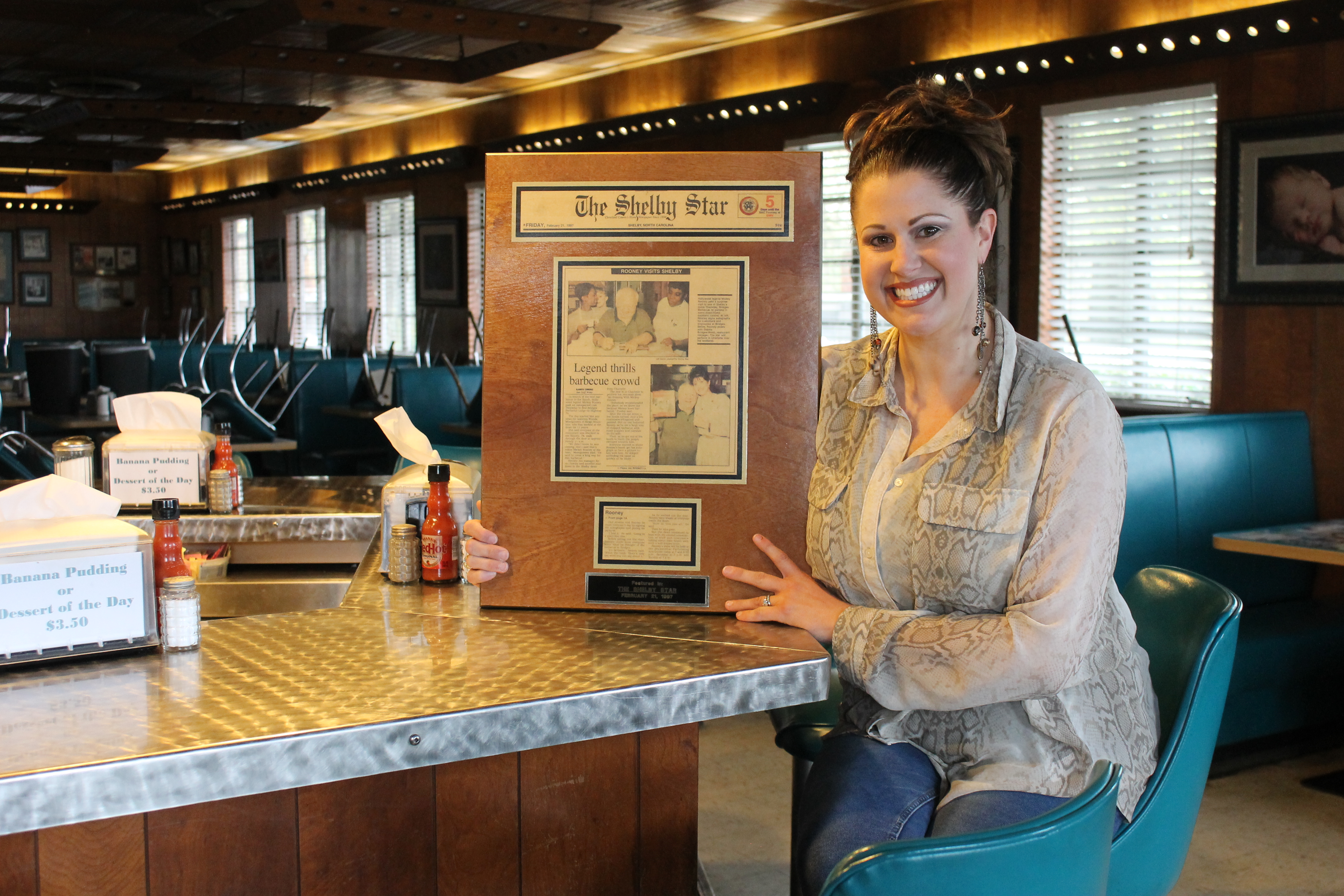
Rooney, who passed away Sunday at age 93, visited Shelby, NC to eat at Red Bridges Barbecue Lodge in 1997.  He was told it was the best barbecue in North Carolina.

Read the full story I wrote for The Shelby Star here: 

http://www.shelbystar.com/news/local/lunch-with-mickey-rooney-1.302034?tc=cr


(The Star/Jessica Pickens) Natalie Ramsey, VP of Red Bridges Barbecue, remembers when Mickey Rooney visited the restaurant in 1997. She holds a Shelby Star article that hangs in the restaurant.

(The Star/Jessica Pickens) Natalie Ramsey, VP of Red Bridges Barbecue, remembers when Mickey Rooney visited the restaurant in 1997. She holds a Shelby Star article that hangs in the restaurant.


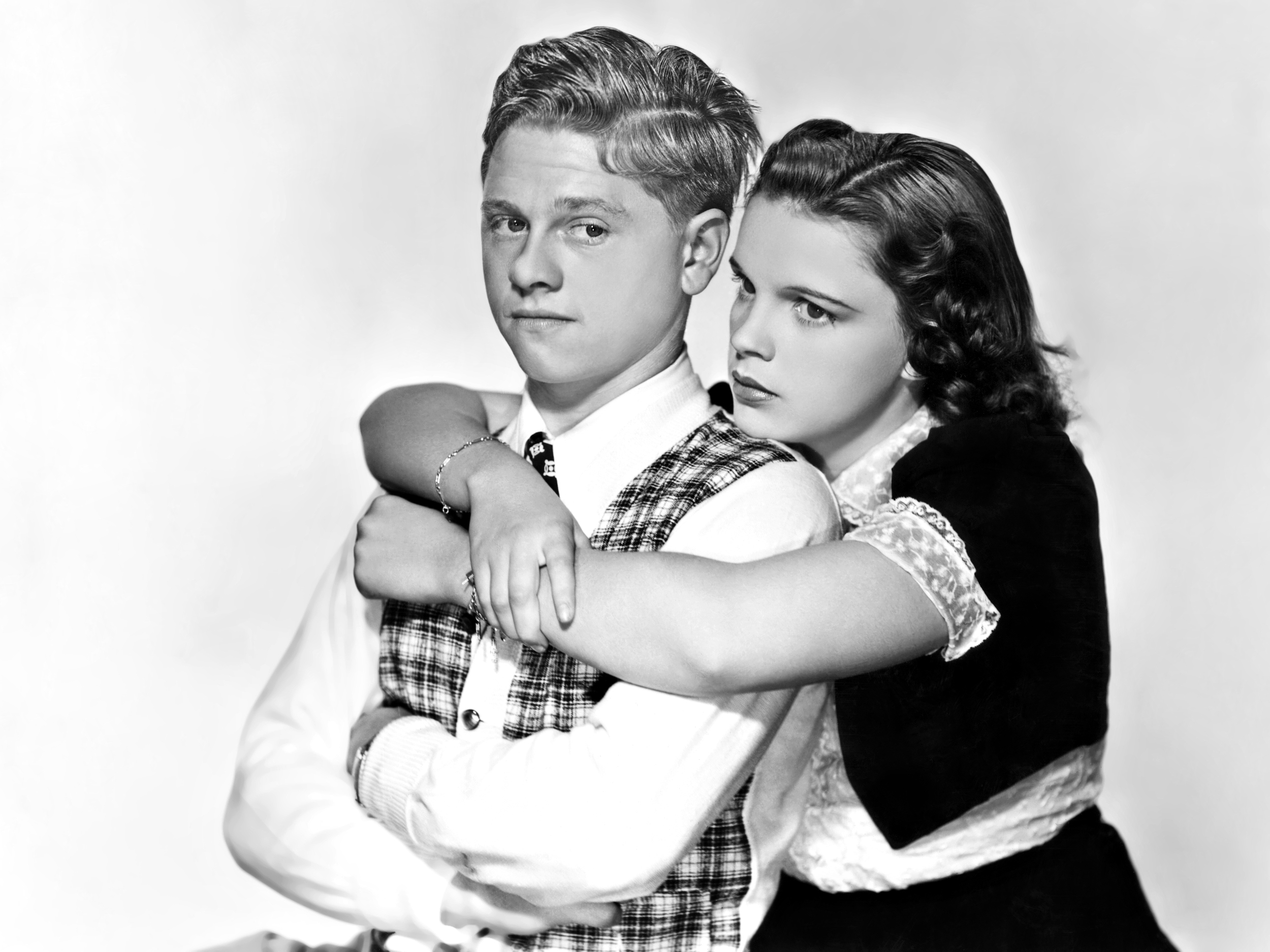
Starring in 10 films with Judy Garland and winner of a Juvenile Academy Award along with Deanna Durbin, Rooney was the top box office draw of 1939.

I can’t deny that Rooney occasionally gets on my nerves in his films, but he was an important aspect of film history-starting in vaudeville, acting in silent films as a youngster and making movies into his 90s, including the 2011 Muppets film.

He had energy and could definitely sell a song.

What are your memories of Mickey Rooney? Did you have a favorite film or ever see him in person? 

Mickey Rooney and Judy Garland in "Love Finds Andy Hardy."

Mickey Rooney and Judy Garland in “Love Finds Andy Hardy.”


Check out the Comet Over Hollywood Facebook page, follow on Twitter at@HollywoodComet or e-mail at cometoverhollywood@gmail.com

Musical Monday: “Campus Rhythm (1943)

It’s no secret that the Hollywood Comet loves musicals.
In 2010, I revealed I had seen 400 movie musicals over the course of eight years. Now that number is over 500. To celebrate and share this musical love, here is my weekly feature about musicals.

This week’s musical:
“Campus Rhythm” — Musical #483

full.campusrhythm-TC-8923__95376.1383175877.1280.1280

Studio:
Monogram Pictures Corporation

Director:
Arthur Dreifuss

Starring:
Gale Storm, Johnny Downs, Marie Blake, Robert Lowery, Claudia Drake, GeGe Pearson, Candy Candido

Plot:
Radio singer Joan Abbott (Storm) has been in show business all her life and wants to go to college. However, her uncle has the power to sign her to a radio contract when she is ready to leave for school. Joan runs away from the radio career and goes to college under the fake name Susie Smith. She meets school newspaper man Scoop (Downs) and frat boy wolf Buzz (Lowery) who vie for her attentions, much to the chagrin of Buzz’s girl Cynthia (Drake). Cynthia suspects Joan’s true identity and contacts the radio station.

Trivia:
-The movie is about a radio singer and features real radio performer GeGe Pearson.
-Candy Candido uses goofy voices in his musical numbers. You may recognize his voice as the voice to characters in some Disney films.

Highlights:
-Jitterbugging co-eds featuring dancer Genevieve Grazis

Notable Songs:
None of the songs are famous or popular, but they are all fun and very World War II era such as:
-It’s Great to be a College Girl sung by Gale Storm
-Walkin’ the Chalk Line sung by Gale Storm and GeGe Pearson
-Swing Your Way Through College sung by Gale Storm
-You Character sung by GeGe Pearson
-But Not You sung by Gale Storm

My Review:
“Campus Rhythm” is a low budget film with a simple plot and several unfamiliar actors. However, it’s a lot of fun.
Collegiate films are some of my favorite and this ranks pretty well. It’s full of 1940s fashion and music.
This is a fresh little film and it’s 63 minutes worth watching.

 Also checkout our friend Raquel’s post on “Campus Rhythm” over at Out of the Past blog! 

Check out the Comet Over Hollywood Facebook page, follow on Twitter at @HollywoodComet or e-mail at cometoverhollywood@gmail.com

Musical Monday: “The Helen Morgan Story” (1957)

It’s no secret that the Hollywood Comet loves musicals.
In 2010, I revealed I had seen 400 movie musicals over the course of eight years. Now that number is over 500. To celebrate and share this musical love, here is my weekly feature about musicals.

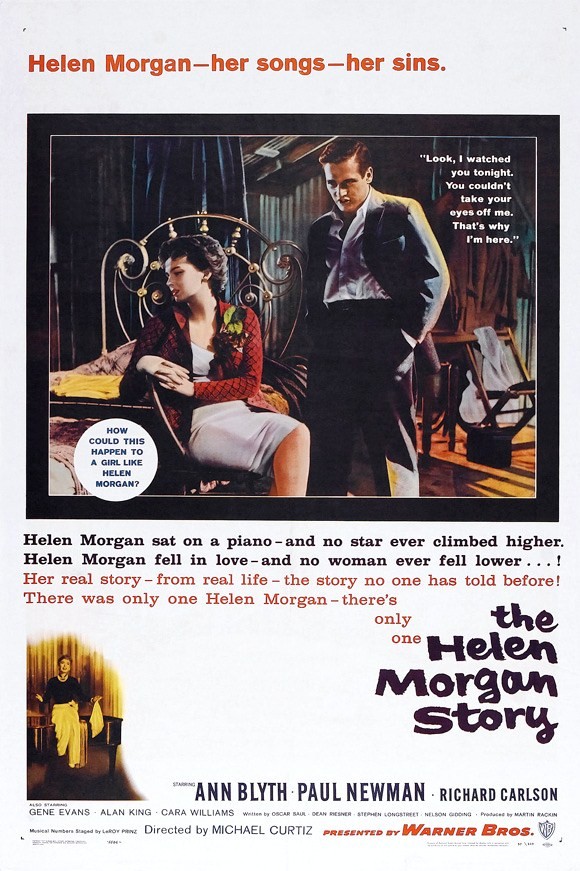
Tthe-helen-morgan-story-movie-poster-1957-1020431163his week’s musical:
“The Helen Morgan Story” –Musical #481

Studio:
Warner Brothers

Director:
Michael Curtiz

Starring:
Ann Blyth, Paul Newman, Richard Carlson, Ed Platt, Gene Evans, Alan King, Cara Williams, Virginia Vincent, Juanita Moore, Leonid Kinskey
As themselves: Rudy Vallee, Walter Winchell, Jimmy McHugh

Plot:
Biographical musical film on the life of singer Helen Morgan. The film starts with Morgan (Blyth) starting out her career dancing at a carnival show that is managed by Larry Maddux (Newman).
Morgan becomes famous, going from nightclub singer to Broadway star. Along the way, her alcoholism and on and off relationship with Maddux torment her.
Morgan hits rock bottom, broke and drunk. The movie ends with Morgan healthy and being honored by celebrities and Walter Winchell.

Trivia:

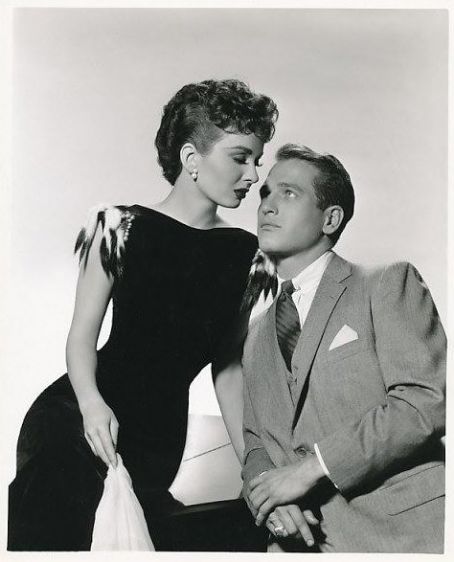
Ann Blyth and Paul Newman in a publicity still for "The Helen Morgan Story"

Ann Blyth and Paul Newman in a publicity still for “The Helen Morgan Story”

-Ann Blyth had a lovely singing voice but was dubbed by singer Gogi Grant.
In an interview, TCM Primetime Host Robert Osborne asked Ann Blyth why she was dubbed.
Blyth told Osborne she figured Warner Brothers wanted a different sound so chose Grant. When Blyth was researching the role, she listened to a record of the real Helen Morgan and her voice was actually more soprano and not very strong. But Grant was popular at the the time, and she figured the producers thought that would help promote the movie.
The critics felt Blyth’s voice would have worked better in the film.


-“The Helen Morgan Story” was Ann Blyth’s last theatrical film.
In an interview with Robert Osborne, she said the parts just weren’t there anymore. She later was offered the lead in “The Three Faces Of Eve” which Joanne Woodward won an Academy Award for.

-Peggy Lee, Susan Hayward, Jennifer Jones, Judy Garland, Patti Page and Doris Day were all considered for the lead.

-Doris Day turned down the role of Helen Morgan, because she thought the hard drinking character would hurt her career. Day had similar concerns before she portrayed Ruth Etting in “Love Me or Leave Me” (1955), according to her autobiography.

-The same year, five months before the film was released, Polly Bergen portrayed “Helen Morgan” on television on “Playhouse 90.” Bergen won an Emmy for Best Lead Performance by an Actress.

Notable Songs:
All of the songs are performed by Gogi Grant and are well known, including:
-“Can’t Help Loving that Man of Mine” from “Show Boat”
-“Bill” from “Show Boat”
-“The One I Love Belongs to Somebody Else”
-“Someone to Watch Over Me”
-“Somebody Loves Me”
-“You Do Something to Me”
-“Why Was I Born?”

For comparison of Helen Morgan and Gogi Grant’s voices, both singing “Why Was I Born?” –

Helen Morgan:

Gogi Grant who dubbed Ann Blyth: 

My Review:

The real Helen Morgan

The real Helen Morgan

Fifty-seven years later, I’m upset that Ann Blyth was dubbed by Gogi Grant.
Blyth said she thought Warner was looking for a different sound, but Blyth would have sang the songs well.

Also, the real Helen Morgan’s voice matched Blyth’s voice more than the belting, Judy Garland-Like Grant’s voice.
Obviously as the story of Helen Morgan’s life is a bit fabricated.

Morgan was married three times, which wasn’t shown in the film. She also died of liver failure due to alcoholism in 1941, yet the film unsurprisingly painted a happy ending.

“The Helen Morgan Story” isn’t a great movie, but it isn’t bad either. It is simply a run-of-the-mill sad, torch singer biopic that was characteristic of the 1950s. This time it was just Ann Blyth in the lead role, rather than Susan Hayward.

Check out the Comet Over Hollywood Facebook page, follow on Twitter at @HollywoodComet or e-mail at cometoverhollywood@gmail.com

Musical Monday: “Call Me Madam” (1953)

It’s no secret that the Hollywood Comet loves musicals.
In 2010, I revealed I had seen 400 movie musicals over the course of eight years. Now that number is over 500. To celebrate and share this musical love, here is my weekly feature about musicals.

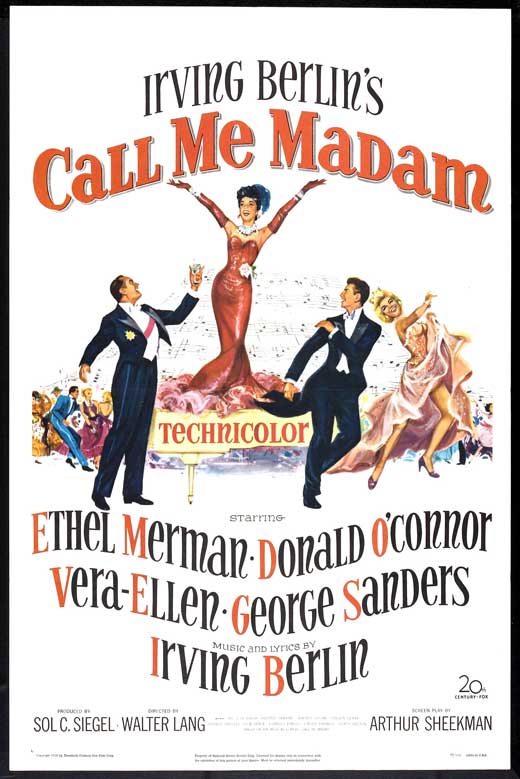
Call Me MadamThis week’s musical:
“Call Me Madam” –Musical #430

Studio:
20th Century Fox

Director:
Walter Lang

Starring:
Ethel Merman, Donald O’Connor, Vera-Ellen, George Sanders, Billy De Wolfe, Helmut Dantine, Walter Slezak

Plot:
Set in 1951 during the Truman-era, socialite Sally Adams (Merman) heads to the fictional European country of Lichtenburg as a United States of America ambassador. Adams’ assistant Kenneth Gibson (O’Connor) falls in love with Princess Maria (Ellen) and Adams falls in love with General Cosmo Constantine (Sanders).
Based on the Broadway play with music by Irving Berlin.

Trivia:
-Film adaptation of the 1950 Broadway play that also starred Ethel Merman. The show opened Oct. 12, 1950, and ran for 644 performances through May 3, 1952. Merman won a Tony for her performance on stage.
-Sally Adams is based on based on Washington, D.C. hostess and Democratic Party fundraiser Perle Mesta. Mesta was selected by Harry Truman to be the American ambassador to Luxembourg. The musical is a satire of the behavior of gauche Americans abroad, according to Hollywood Musicals Year by Year by Stanley Green.
-Carol Richards dubbed Vera-Ellen’s singing voice.
-20th Century Fox studio head Darryl F. Zanuck was making “Call Me Madam” and “Gentlemen Prefer Blondes” at the same time. Zannuck noted in his memoirs “Madam” was a better film but “Blondes” would make more. Blondes did double the gross of Madam, Memo from Darryl F. Zanuck: The Golden Years at Twentieth Century-Fox edited by Rudy Behlmer

Highlights:

Vera-Ellen and Donald O'Connor dancing to "It's a Lovely Day Today"

Vera-Ellen and Donald O’Connor dancing to “It’s a Lovely Day Today”

-George Saunders has a lovely singing voice in “Marrying for Love.”
-Three minutes into the film, Merman almost says “I don’t know what the hell your talking about” but stops herself and repeats the line. “I don’t know what the he- I don’t know what you are talking about.”
-Donald O’Connor and Vera-Ellen’s dance to “It’s a Lovely Day Today” in the garden. And all of their dances together.
-Vera-Ellen’s wardrobe.

Notable Songs:
-Hostess with the Mostest sung by Ethel Merman
-It’s a Lovely Day Today sung by Donald O’Connor and Vera-Ellen. Ellen is dubbed by Carol Richards.
-Marrying for Love sung by George Saunders
-You’re Just In Love sung by Donald O’Connor and Ethel Merman
-Mrs. Sally Adams sung by a trio of ladies answering the phone. Their voices blend beautifully

My Review:
A little bit of Ethel Merman can go a long way, but you can’t deny this is her best film role.
The film was taken from a successful Broadway show that also starred Merman, “Call Me Madam” is colorful and has an excellent cast.
Merman originated several musical roles on stage such as “Annie Get Your Gun,” “Panama Hattie,” “DuBarry was a Lady” and “Gypsy.” However, when the shows went from stage to film, Merman’s role was always recast with a younger, sexier star. However, film audiences get to see Merman in a role she originated on film with “Call Me Madam.” Though to me, her singing voice can be overwhelming, you can tell Merman’s appeal on stage with the energy and humor she shows in the film role.
Also in the film, I would say Donald O’Connor steals the show. He sings and dances beautifully and has the opportunity to sing a duet with Merman. Vera-Ellen also dances beautifully, but her performance is lessened by the terrible accent she has to speak.
George Sanders is a surprise in the musical with his beautiful singing voice.
Though “Call Me Madam” isn’t my favorite musical, its energetic, funny and fun. The Irving Berlin songs are entertaining, the costumes are beautiful and the talent is excellent.

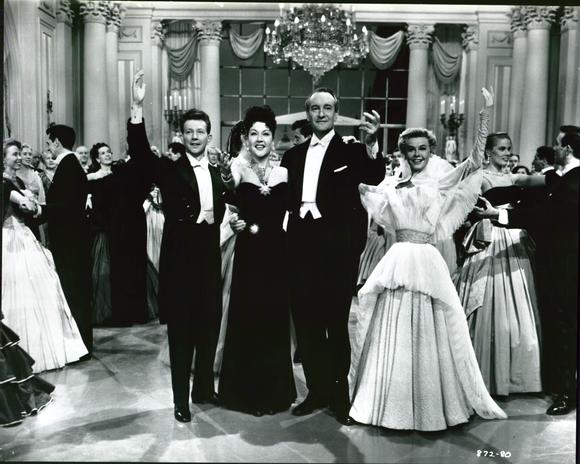
Donald O'Connor, Ethel Merman, George Sander,  Vera-Ellen in "Call Me Madam"

Donald O’Connor, Ethel Merman, George Sander, Vera-Ellen in “Call Me Madam”

 Check out the Comet Over Hollywood Facebook page, follow on Twitter at @HollywoodComet or e-mail at cometoverhollywood@gmail.com

Musical Monday: “Paddy O’Day” (1935) *St. Patrick’s Day Edition*

It’s no secret that the Hollywood Comet loves musicals.
In 2010, I revealed I had seen 400 movie musicals over the course of eight years. Now that number is over 500. To celebrate and share this musical love, here is my weekly feature about musicals.

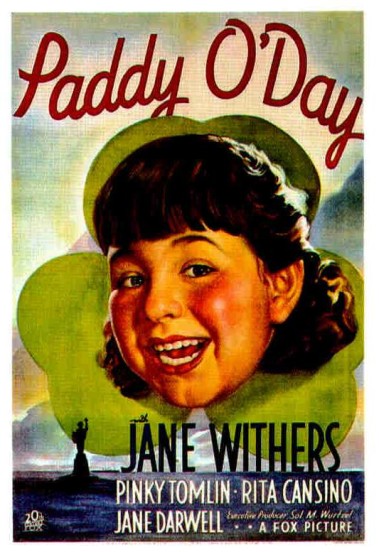
paddy o'dayThis week’s musical:
“Paddy O’Day” –Musical #480

Studio:
20th Century Fox

Director:
Lewis Seiler

Starring:
Jane Withers, Jane Darwell, Pinky Tomlin, Rita Hayworth (as Rita Casino), Russell Simpson, Vera Lewis, Louise Carter

Plot:
Paddy O’Day (Withers) is an Irish orphan who travels from Ireland to the United States to live with her mother. When she arrives, she learns that her mother is dead. With the help of some friends Paddy make along the way, she is able to stay in the United States and not return to Ireland.

Trivia:
-This is one of four films Jane Withers made in 1935. The others were “The Farmer Takes a Wife,” “Ginger” and “This is the Life.”
-Rita Hayworth’s sixth film role. Rita is credited as Rita Cansino. She changed her last name to “Hayworth” the next year.
-This is Rita Hayworth’s firs prominent film role.
-Jane Withers and Rita Hayworth became friends while making this movie. Withers gave the eulogy at Hayworth’s funeral in 1987.
-Judy Garland was considered for a performance in this film, according to Judy: A Legendary Film Career by John Fricke

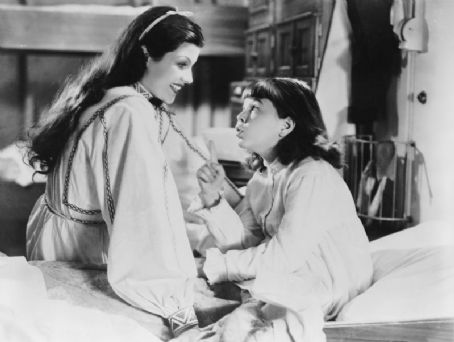
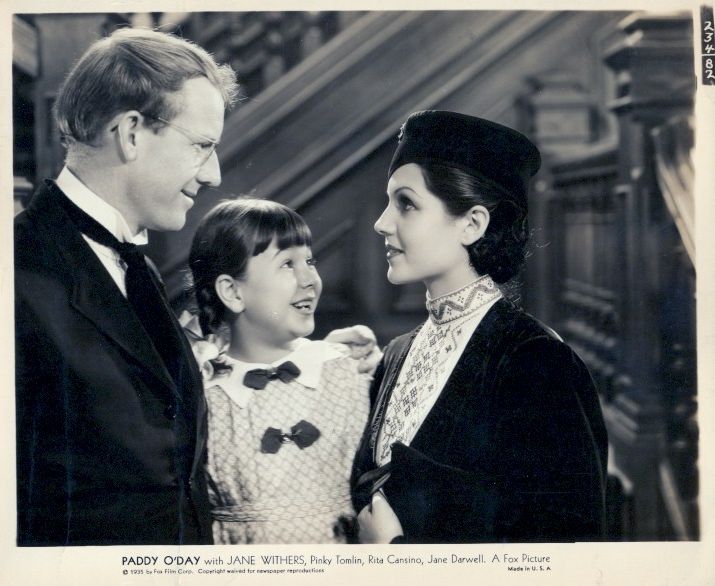
Rita Hayworth and Jane Withers in "Paddy O'Day" (1935)

Rita Hayworth and Jane Withers in “Paddy O’Day” (1935)

Highlights:
-Young Rita Hayworth dancing at the very beginning of the film.

Notable Songs:
-Keep the Twinkle in Your Eye sung by Jane Withers (three times)
-Changing My Ambitions sung by Pinky Tomlin
-I Like a Balalaika sung by Jane Withers

Pinky Tomlin, Jane Withers and Rita Hayworth in "Paddy O'Day" (1935)

Pinky Tomlin, Jane Withers and Rita Hayworth in “Paddy O’Day” (1935)

My Review:
“Paddy O’Day” is an adorable film and a good example of the type of films child star Jane Withers starred in at Fox. While Shirley Temple made the big budget, glittering A films at Fox, Withers was in the B movies at Fox.
However, she was very popular because she seemed like a regular kid and was more relatable, said TCM Primetime host Robert Osborne.
The only issue in this film is that Withers has a cringe worthy Irish accent. But she’s so adorable that you can look past it. I also wish Jane Darwell had a larger role.
It’s also fun to see 16-year-old Rita Hayworth dancing in the movie, looking young, fresh and not yet glamorized.
One interesting note: Jane Withers didn’t have a major crying scene. This is unusual for a 1930s child star. Most child stars boasted their crying talents.
Happy Saint Patrick’s Day with this Irish themed, fun film!

Check out the Comet Over Hollywood Facebook page, follow on Twitter at @HollywoodComet or e-mail at cometoverhollywood@gmail.com

Musical Monday: “Muscle Beach Party” (1964)

It’s no secret that the Hollywood Comet loves musicals.
In 2010, I revealed I had seen 400 movie musicals over the course of eight years. Now that number is over 500. To celebrate and share this musical love, here is my weekly feature about musicals.

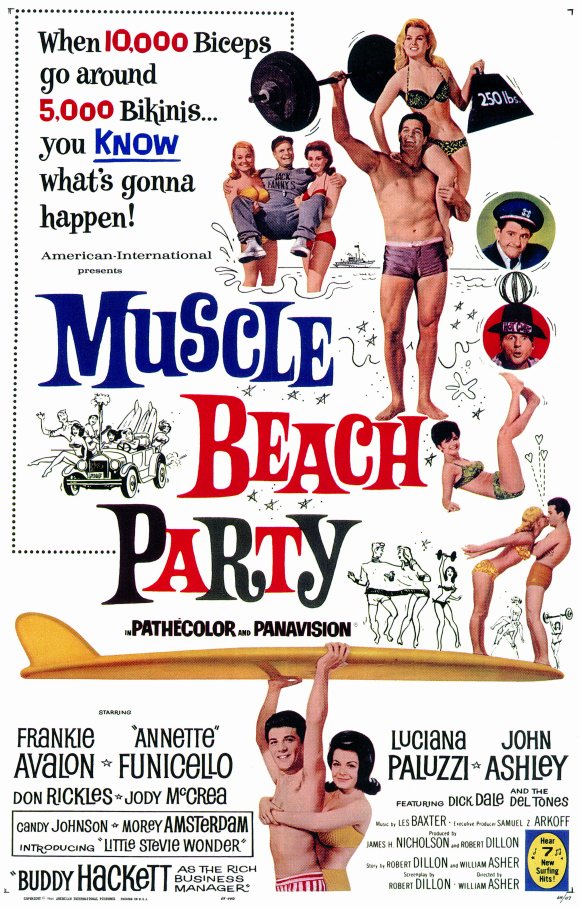
muscle-beach-party-movie-poster-1964-1020144107This week’s musical:
“Muscle Beach Party” –Musical #298

Studio:
American International Pictures

Director:
William Asher

Starring:
Annette Funicello, Frankie Avalon, John Ashley, Don Rickles, Jody McCrea (son of Joel McCrea and Frances Dee), Dick Dale, Donna Loren, Candy Johnson, Morey Amsterdam, Stevie Wonder, Buddy Hackett, Peter Lorre, Luciana Paluzzi, Peter Lupus

Plot:
Frankie (Avalon) and Dee Dee (Funicello) head to the beach for Easter vacation with their friends to surf, dance and have fun. Once they get to the beach they meet Jack Fanny (Rickles) and his group of muscle bound body builders. When Contessa Julie (Paluzzi) can’t woo Flex (Lupus), she tries to steal Frankie from Dee Dee.
Cheesy gags, music and dancing are sprinkled throughout the plot line.

Trivia:
-Stevie Wonder was 13 when he appeared in this film and was billed as “Little Stevie Wonder.”
-“Muscle Beach Party” cost $300,000 to make and grossed $12 million, according to The Encyclopedia of Surfing by Matt Warshaw
-The second beach movie directed by William Asher, following “Beach Party” (1964). This film was followed by “Bikini Beach” (1964), “Beach Blanket Bingo” (1965) and “How to Stuff a Wild Bikini ” (1965), all directed by Asher.
-The only beach movie that doesn’t feature Eric Von Zipper and his gang.
-Larry Scott, the body builder who played Rock, was an actual bodybuilder and was the first Mr. Olympia.

Muscle men in "Muscle Beach Party" (Comet Over Hollywood/Screen capped by Jessica P)

Muscle men in “Muscle Beach Party” (Comet Over Hollywood/Screen capped by Jessica P)

-Peter Lorre died two days before “Muscle Beach Party” premiered on March 25.
-In all of the beach movies, Annette Funicello wore more conservative bathing suits. That was out of her respect to Walt Disney who asked her to keep up a clean image, Funicello said in an interview.
-Donna Loren was signed to a multi-picture deal. The heads of American International were impressed with her duet with Dick Dale, Drive-In Dream Girls: A Galaxy of B-Movie Starlets of the Sixties by Tom Lisanti.
-During one scene, Peter Lorre and Frankie Avalon say the other looks familiar. This is a joke referencing their previous film they made together, “Voyage to the Bottom of the Sea” (1961).
-Most of the beach films only took two weeks to make, according to Beyond the Stars 2: Plot Conventions in American Popular Film edited by Paul Loukides, Linda K. Fuller

Frankie and Annette "surfing" in "Muscle Beach Party" (Comet Over Hollywood/Screen capped by Jessica P.)

Frankie and Annette “surfing” in “Muscle Beach Party” (Comet Over Hollywood/Screen capped by Jessica P.)

Highlights:
-Cartoon opening credits
-Surfing footage, especially when we are supposed to believe the stars are surfing.
-Candy Johnson’s 1960s dancing in her tasseled outfits
-Guitarist Dick Dale performing
-Cheesy humor like a cartoon cupid playing a harp beside Luciana Paluzzi as she’s looking at the bodybuilders.

Credits with Candy Johnson dancing and Stevie Wonder dancing:

Notable Songs:
-Muscle Bustle performed by Donna Loren and Dick Dale
-Happy Street performed by Stevie Wonder
-A Boy Needs a Girl sung by Annette Funicello (I noted this because it’s Annette’s only solo. It’s not her best song ever and ends abruptly, but worth noting). Reprised later by Frankie Avalon
-Muscle Beach Party sung by Dick Dale and the Del Tones
-Runnin’ Wild sung by Frankie Avalon

Jody McCrea (Joel McCrea's son), Dick Dale, John Ashley, Frankie Avalon and Annette Funicello in "Muscle Beach Party"

Jody McCrea (Joel McCrea’s son), Dick Dale, John Ashley, Frankie Avalon and Annette Funicello in “Muscle Beach Party”

My Review:
I’m always surprised how Frankie and Annette end up together at the end of each film when she has to win him back from another girl.
So obviously none of the beach films have a serious, ground breaking plot and “Muscle Beach Party” isn’t excluded. All the silly plots also all occasionally blend together.
However, they are a great deal of fun. The outfits are great, the music is awesome and the dancing sequences on the beach are my favorite (especially if it involves Candy Johnson and Donna Loren). It’s a great snapshot of culture in the early 1960s. And Annette is one of my favorites so I can’t hate any of her films.
Compared to several of the films, I would say “Muscle Beach Party,” “Beach Party” and “Beach Blanket Bingo” are my three favorites.
So if you are looking for brainless, RIDICULOUS, hair-brained fun, check out this film…or any other beach movie.

Check out the Comet Over Hollywood Facebook page, follow on Twitter at @HollywoodComet or e-mail at cometoverhollywood@gmail.com

Actress Beauty Tip #33: Greer Garson almond oil skin

This is the thirty-third installment of the monthly classic actress beauty tips that I have read about and tested.

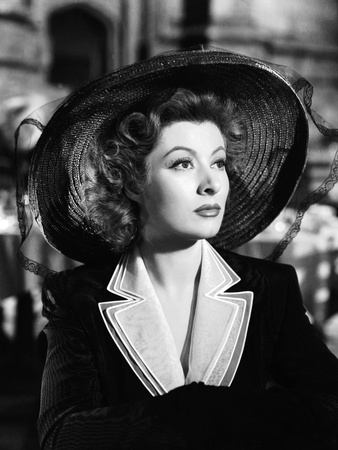
greer garsonBeautiful red-headed actress Greer Garson had flawless skin.

The Academy Award winning actress told beauty columnist Lydia Lane that she used almond oil to ease lines around her eyes.

“Greer Garson looks wonderful and can afford anything but she uses pure almond oil, which she buys at the drug store,” Lane wrote in response to a 1963 letter. “She says it keeps the fine lines from around here eye.”

Lane interviewed Garson several times for her syndicated beauty column that ran from 1938 to 1980.

Garson used almond oil when she washed off her make-up. It was a ritual she and her mother discovered in England, she said in a 1952 Lane column.

Almond oil was also a favorite moisturizer of First Lady Jackie Kennedy, according to Vickie Calvert’s book “Living Natural and Stress-Free in the 21st Century.”

2014-03-08_14.14.01My skin is too oily to use heavy sweet almond oil on my face during the day, like how Kennedy used the oil. I tried the oil more like Greer Garson.

I wasn’t able to find almond oil in stores, so I turned to eBay and bought a small bottle for $3.

This past week, I put almond oil on my face and around my eyes before I went to bed. I don’t necessarily have fine line around my eyes, but it did make my skin smoother in the morning. This was especially helpful with dry patches that are more prevalent with winter weather.

Some articles say almond oil helps with dark circles under the eyes. Even with plenty of sleep and the oil, it hasn’t helped me.

To review: I can not vouch for sweet almond oil decreasing fine lines. However, it made my skin smooth and helped with winter dry skin. It did not help with dark circles around the eyes though.

Check out another Greer Garson beauty tip here: https://cometoverhollywood.com/2010/07/01/actress-beauty-tips-2-champagne-hair-rinse/

Check out more Comet Over Hollywood Actress Beauty Tips here: https://cometoverhollywood.com/category/beauty-tips/

Check out the Comet Over Hollywood Facebook page, follow on Twitter at @HollywoodComet or e-mail at cometoverhollywood@gmail.com

Interview and review: “Vivien Leigh: An Intimate Portrait”

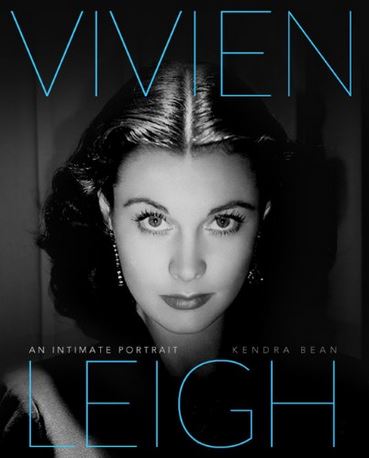
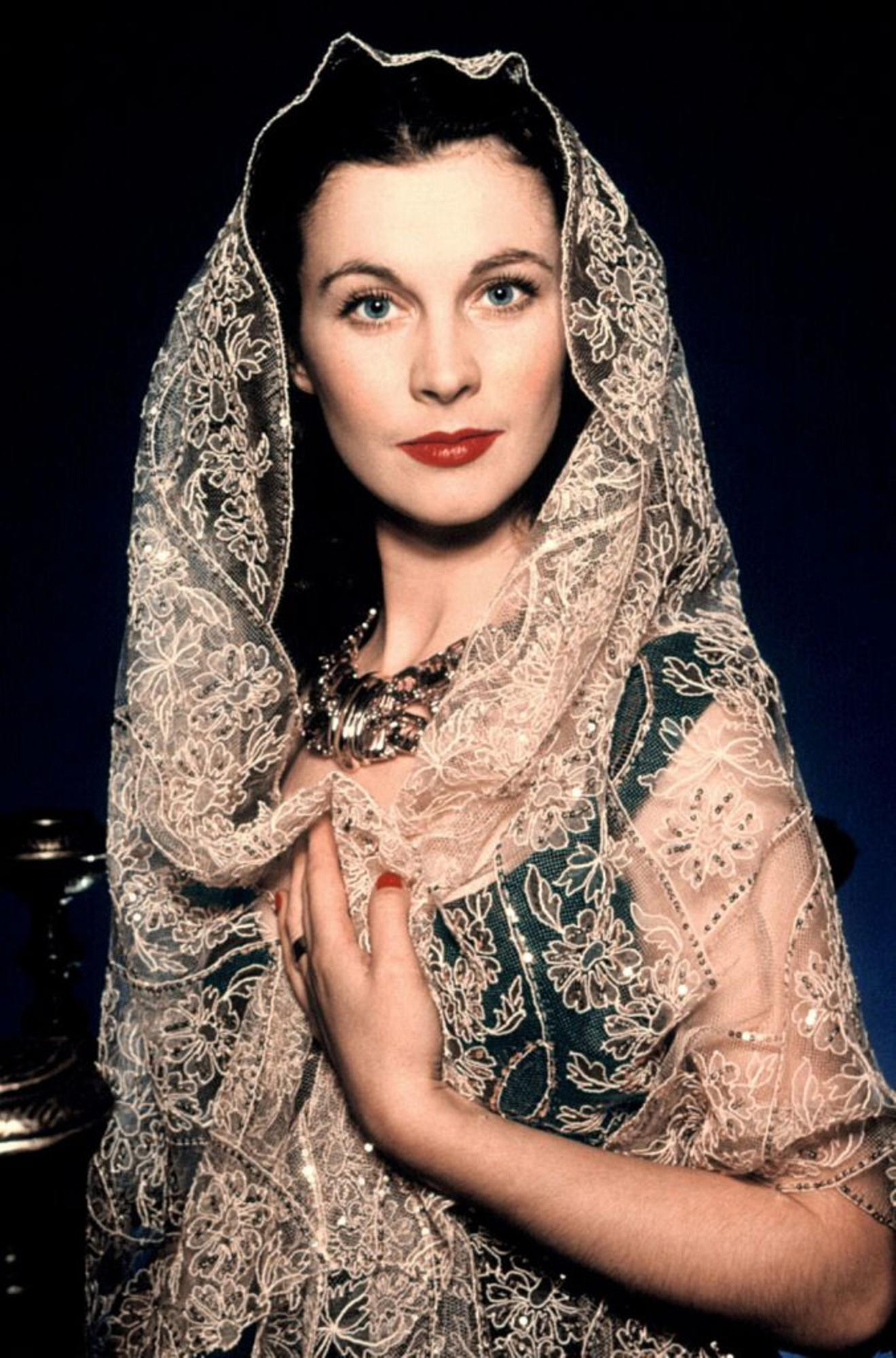
vivien leigh book coverAfter 75 years, her fresh portrayal as Scarlett O’Hara is one of the most memorable screen performances of all time.

Last November, the “Gone with the Wind” actress celebrated her 100th birthday. And to help celebrate, film historian Kendra Bean published a biography on Vivien Leigh, “Vivien Leigh: An Intimate Portrait.” Bean’s book is also the first book written about Leigh in 25 years.

Leigh won two Academy Awards for Best Actress during her short, 18 film career for playing two iconic Southern belles: O’Hara in “Gone with the Wind” (1939) and Blanche DuBois in “A Streetcar Named Desire” (1951)

“An Intimate Portrait” tenderly chronicles Leigh’s life, from her childhood in India through her marriage and divorce to Laurence Olivier to Leigh’s early death at age 51. The book is well-researched, unbiased, beautiful and heartbreaking.

Through her writing, Bean shows her passion for the subject and allows the reader to connect with the English actress. Leigh feels relatable and human compared to the unreachable and ethereal portrait that usually seems to be painted of the mysterious beauty.

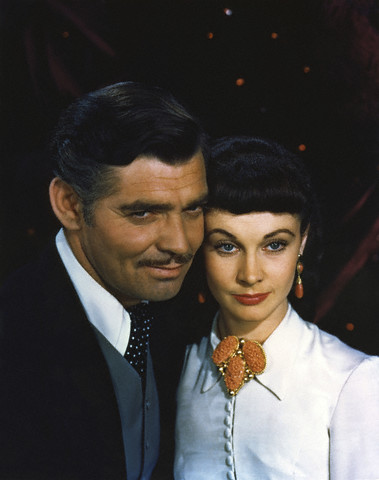
A publicity photo of Clark Gable and Vivien Leigh for "Gone with the Wind" (1939). This photo also appears in Bean's book.

A publicity photo of Clark Gable and Vivien Leigh for “Gone with the Wind” (1939). This photo also appears in Bean’s book.

Reading the page-turning biography is almost like reading “Romeo and Juliet.” Similar to the Shakespeare story that ends in tragedy, you are aware of the impending heartbreak in Leigh’s life. While reading about her successful career and marriage to Laurence Olivier, most readers know the whole time of her heartbreaking divorce, bouts with depression, tuberculosis and Leigh’s early death.

Bean chronicles these events sensitively and through extensive research, quoting interviews throughout the book. She is also the first author to delve into Laurence Olivier’s files. The 272 page book is also filled with gorgeous and rare photos of Leigh.

Bean started her Leigh and Olivier research on her website, VivandLarry.com, before moving from California to England to do more in-depth studying of Leigh’s life and romance with Olivier.

In December, she was kind enough to answer several interview questions for Comet Over Hollywood: 

Comet Over Hollywood: When did your love for Vivien Leigh begin? What started it?
Kendra Bean: I saw Gone With the Wind as a teenager and began reading everything I could get my hands on that would tell me more about the film, including biographies of the stars. The more I read about Vivien, the more interesting she became in my eyes. That’s really what started it. Having a website and online community centered on her and Laurence Olivier has definitely helped keep my interest alive over the years.

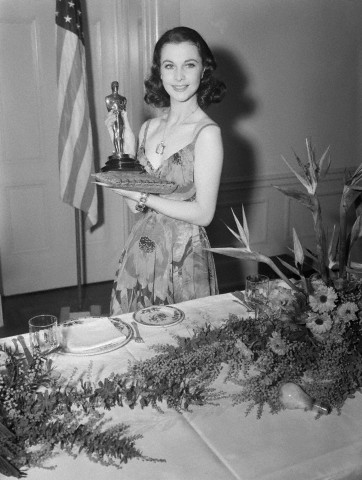
Vivien Leigh proudly holds her Best Actress Oscar on March 2. 1940. She was recognized for her portrayal of Scarlett O'Hara in Gone With the Wind.

Vivien Leigh proudly holds her Best Actress Oscar on March 2. 1940. She was recognized for her portrayal of Scarlett O’Hara in Gone With the Wind.

COH: I have always understood that you moved to England to better study Olivier and Leigh. Is that correct? How difficult of a decision was that? What was that transition like to study something you love?
KB: That was only part of the reason. I actually moved to London for graduate school. I did my BA in Film and Media Studies back in California and then spent the next four years working. But I knew I wanted to be a film historian and to do that, I felt I needed to get a further degree. I wasn’t really satisfied with what I was doing back home, and just felt like I needed a change if I was ever going to actually pursue these interests. I always wanted to live in London for at least a year, so I applied to the Film Studies graduate program at King’s College London. Luckily, they accepted me and offered a couple of scholarships, so off I went!
It was a big change, but I knew some people here already and knew my way around the city. I also made some great friends through the program who I still keep in touch with today. I think the most difficult period was the transition from graduation to whatever was going to happen next. I was determined to make this book project work, but the process of actually getting a publisher was a long one. It was a very stressful period because being on a visa kind of limits things. There were several times when I thought I might well have to move back to the US and that the book would never happen.

COH: You have been working on the book for five years. What all goes into the research that you had to do?
KB: There were two parts to my research: constructing the book and getting it published. Because it’s a coffee table book, a good deal of the process involved locating, sourcing, and licensing photographs (I don’t think a lot of people realize what a lengthy and involved process that is). I also spent a good deal of time in various archives in the UK and in Los Angeles looking for interesting information (fellow fans/research assistants sent me information from New York and Australia, as well), reading through various biographies, tracking down and interviewing people who knew and worked with Vivien, and seeking permission from various estates to quote from letters.
When I first started this project, I had no idea how to get a book published. So, I also had to do a fair bit of research into the actual publication process: how to get an agent, possible marketing angles, crafting a proposal, etc. It was a lot of work, but very much worth it in the end!

COH: What was a misconception you had that came to light during your research?
KB: I think there have been a lot of misconceptions about Vivien’s battle with manic depression (bipolar disorder) and her relationship with Laurence Olivier, in general. One major grey area has always been the infamous 1953 incident, when Vivien had nervous breakdown whilst filming Elephant Walk in 1953. She was flown back to England, legally sectioned, and committed to a mental asylum. The picture I had in my mind from reading previous Leigh biographies was something akin to Frances Farmer getting hauled off to the state institution.
There were also a lot of rumors surrounding this event, including the suggestion that Olivier was having a long affair with actor Danny Kaye and that this set Vivien off. I found no evidence to support any of that. Rather, there was plenty to support the fact that Vivien had been headed toward a mental health crisis for a long time and previous attempts at intervention in 1951/52 were refused by her. Although this was not surprising given the stigma surrounding mental illness in the 1950s, it was still sad to learn that there’s a chance that this particular incident might have been avoided. I was given access to some files pertaining to this incident that hadn’t been by previous biographers (of Leigh or Olivier). What emerged was a clearer picture not only of the harrowing experience that Vivien went through, but also how that experience affected those closest to her – particularly Olivier. It was a very stressful and frightening time for all involved.
Today it seems fashionable to focus on their interpersonal problems; specifically how horrible Olivier was to Vivien. Through moderating vivandlarry.com and the accompanying Facebook page over the years, it seems to me that there’s a tendency to view their relationship in black and white terms. In fact, it was very complicated. How could it not be? They were together for nearly 25 years and she remained obsessed with him for the rest of her life. Their marriage did turn very sour in the 1950s but before that, and I think sometimes during that period, there was actually a lot of love, respect, and camaraderie between them. That notion was reinforced when going through Olivier’s papers, and those of other people who knew them.

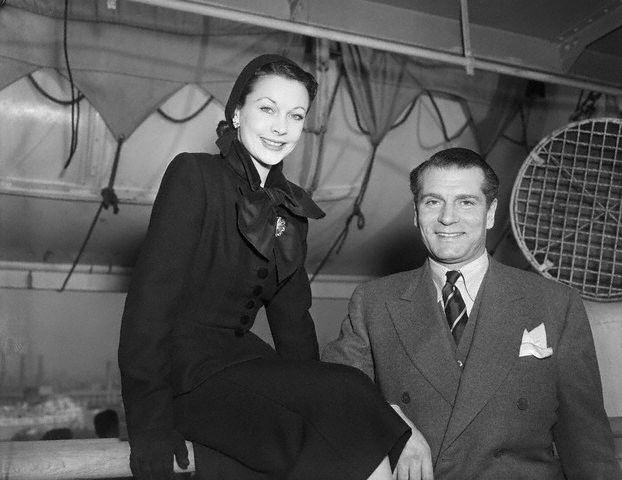
Arriving in New York by boat in 1951.

Arriving in New York by boat in 1951.

COH: Why is it important to study actors like Leigh and Olivier and their relationship?
KB: Because they both made significant contributions to 20th century popular culture. They considered themselves artists and their work deserves to be remembered and reappraised. Unfortunately, their stage work was very ephemeral but luckily their films still remain to be enjoyed and discussed by fans and casual viewers alike. On top of that, they lead interesting lives.

COH: Was there anything you learned that didn’t make it into the book and why?
KB: One of the main tasks of an author is to decide what is important and what isn’t for the story he or she wants to tell. Coffee table books require even more editorializing than standard biographies because they rely just as much – sometimes even more – on visuals as they do text. A couple of examples of things that were left out of Vivien Leigh: An Intimate Portrait: I was told some stories during interviews that I felt were interesting but they ended up being more about the interviewee than Vivien, or I didn’t feel they added anything thematically that hadn’t been said already, so they were left out. I also didn’t spend much time talking about the films she made for Alexander Korda in the 1930s, instead opting to cut to the meat of her fame, which really took off with Gone With the Wind. I did write an essay about these films for the Vivien Leigh Anniversary Collection released in November by Cohen Films though, and that’s something I would definitely expand upon in a full biography.
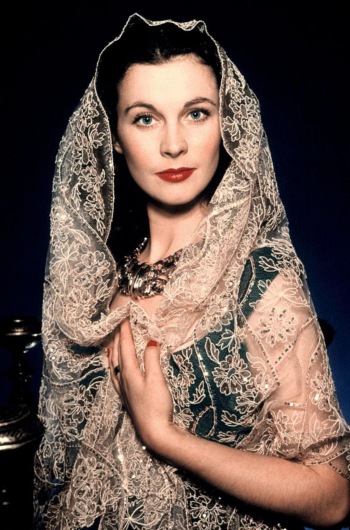
leighOne of the challenges in writing a biography of a famous figure is that many materials are still in copyright and permission is required to publish them if they fall outside of fair use. This meant that, unfortunately, there were some letters and photos that I very much wanted to use, but couldn’t.

COH: Recently you have given several speeches and interviews. What has been your proudest moment since the book has been published?
KB: I think my proudest moment was actually getting the book published. It was such a long and often emotional journey and there were several instances where I worried it wouldn’t come to fruition.
I’m grateful for the opportunities that have arisen from being published. It’s been such a wonderful learning experience and I’ve met some very passionate and intelligent people because of it. I never thought I’d get to curate an exhibit at a major museum, for example, but Terence Pepper (who edited some of my favorite photo retrospectives) asked me to help curate the “Starring Vivien Leigh: A Centenary Celebration” exhibit that’s currently on at the National Portrait Gallery. I also gave my first-ever big lecture to a sold out audience at the NPG. Public speaking has always been one of my worst fears, but this went really well and has given me confidence for the lecture I’m giving at the V&A in February.

COH: Do you see another book in your future?
KB: Yes! Watch this space!

Check out the Comet Over Hollywood Facebook page, follow on Twitter at @HollywoodComet or e-mail at cometoverhollywood@gmail.com

Musical Monday: “Reckless” (1935)

It’s no secret that the Hollywood Comet loves musicals.
In 2010, I revealed I had seen 400 movie musicals over the course of eight years. Now that number is over 500. To celebrate and share this musical love, here is my weekly feature about musicals.

reckless-movie-poster-1935-1020143418This week’s musical:
“Reckless” (1935) –Musical #190

Studio:
MGM

Director:
Victor Flemming

Starring:
Jean Harlow, Franchot Tone, William Powell, May Robeson, Rosalind Russell, Nat Pendleton, Mickey Rooney, Ted Healy, Henry Stephenson, Leon Ames, Allan Jones is a featured singer

Plot:
Musical actress Mona Leslie (Harlow) goes on stage thinking she’s performing for a charity event to find the whole house bought out by heir Bob Harrison (Tone).  Mona falls in love with Bob as he is courting her, and her gambling agent Ned Riley (Powell) sits silently in the background, though he is also in love with Mona. After a drunken evening, Bob and Mona marry and they face the disapproval of Bob’s wealthy society family.

Trivia:

Hungover Franchot Tone isn't too sure about his marriage to Jean Harlow in "Reckless."

Hungover Franchot Tone isn’t too sure about his marriage to Jean Harlow in “Reckless.”

-The film was originally supposed to star Joan Crawford under the title “A Woman Called Cheap.” However, producer David O. Selznick replaced Crawford with Harlow before production to capitalize off of Harlow and Powell’s real-life romance, according to the Darrell Rooney and Mark Vieira book “Harlow in Hollywood: The Blonde Bombshell in the Glamour Capital, 1928-1937.” 
-Dancer Betty Halsey doubled for Jean Harlow in the long shots.
-The film’s plot was very similar to a scandal that occurred two years earlier involving singer Libby Holman and her husband tobacco heir Zachary Reynolds. Similarly to the film, Reynolds drunkenly committed suicide. Holman threatened to sue for libel, but never did. Harlow was also uncomfortable, because the scandal in the movie was similar to the death of her husband Paul Bern. However, Powell convinced her to make the film, according to “Harlow in Hollywood.”
-Version of “Sing, Sinner, Sing” (1933) starring Leila Hyams and “Brief Moment” (1933) starring Carole Lombard.
-Jean Harlow’s singing was dubbed by Virginia Verrill. “She (Jean) realized that I couldn’t have credit for my singing, so she went out of her way to give me a hand whenever she could.”
-“Reckless” was the first Jean Harlow film to lose money.

Highlights:
-A very young Leon Ames marrying Rosalind Russell.

leon ames

Young Leon Ames with Rosalind Russell in “Reckless.”
(Screencapped by Comet Over Hollywood/Jessica Pickens)

Notable Songs:
This isn’t your typical musical. There are really only three musical numbers. Including:
-“Reckless” performed by Jean Harlow and dubbed by Virginia Verrill, written by Jerome Kern and Oscar Hammerstein
-“Trocadero” sung by Allan Jones and danced by Jean Harlow.
-“Hear What My Heart is Saying” performed by Jean Harlow and dubbed by Virginia Verrill

Review:
I guess calling this a musical is a stretch. It’s really a melodrama with three or four songs and dances built into the plot, and none of the songs move the plot along.
However, since it is categorized as a musical, the “That’s Entertainment” documentary features it and it’s Jean Harlow birthday, I decided to highlight the film today.
“Reckless” may be the first Jean Harlow film to lose money, but I don’t think it’s un-watchable. It’s interesting, it kept my attention, the plot keeps moving, but I will say it isn’t Jean Harlow’s best film.
The film is interesting however, since it is shot around the time William Powell and Jean Harlow started their romance.
You also see Rosalind Russell early in her career, though she is not the comedic Russell we are used to seeing. Early in her career, Russell is cast as the other woman or the forgiving, jilted friend- such as in “Evelyn Prentiss,” “China Seas” and “Man-Proof.” Certainly not the comedic lady we later came to know.
Also keep your eyes peeled for a young, line-less and un-credited Leon Ames as he marries Russell.
If you are looking for a musical with show stopping numbers, this isn’t it. But if you enjoy a good MGM melodrama with a few songs sprinkled in starring the original platinum blond, check it out.

Jean Harlow's character Mona Leslie is a musical star in "Reckless."

Jean Harlow’s character Mona Leslie is a musical star in “Reckless.”

Check out the Comet Over Hollywood Facebook page, follow on Twitter at @HollywoodComet or e-mail at cometoverhollywood@gmail.com

Musical Monday: I’ll See You in My Dreams (1951)

It’s no secret that the Hollywood Comet loves musicals.
In 2010, I revealed I had seen 400 movie musicals over the course of eight years. Now that number is over 500. To celebrate and share this musical love, here is my weekly feature about musicals.

ill see you in my dreamsThis week’s musical:
“I’ll See You in My Dreams” (1951)–Musical #180

Studio:
Warner Brothers

Director:
Michael Curtiz

Starring:
Doris Day, Danny Thomas, Frank Lovejoy, Patrice Wymore, James Gleason, Mary Wickes, Jim Backus, Hans Conreid (uncredited)

Plot:
A biographical film about lyricist Gus Khan (Thomas) who wrote several popular songs such as “It Had To Be You,” “Pretty Baby,” “San Francisco,” “The Carioca” and “Tootise” just to name a few. The film Khan as he meets his composing partner Grace (Day) who he eventually marries.
Grace is a song plugger and Gus wanted her help publishing songs. She gave him advice to write a love song:
“Do you know why you write a popular song? Boys and girls don’t know how to say I love you, so you help them with 32 bars of music.”
The film shows the songwriter’s ups and downs in his career from getting started and having his songs in the Ziegfeld Follies to losing everything in the 1929 stock market crash and moving to Hollywood and rebuilding his career. The whole way, his wife is there helping him make the next move in his career. The film starts in 1908 and ends in the 1930s.

Gus (Thomas) missed the birth of his child because he was writing "It Had to Be You." Day wrote this scene made her emotional because of her life experiences.

Gus (Thomas) missed the birth of his child because he was writing “It Had to Be You.” Day wrote this scene made her emotional because of her life experiences.

Trivia:
-When Danny Thomas sings to Doris Day at her maternity bedside in the film, Day got very emotional thinking about how her first husband, Al Jordan was not present when her son Terry was born, she wrote in her autobiography, Doris Day: Her Own Story.
“In the way Danny played the scene, there was a sense of his remorse in having not been with me when the baby came (in the movie. His character was writing a song and lost track of time.),” she wrote. “When Danny started his song, I couldn’t help but cry, for what came to mind was the birth of my own baby, how Al Jorden had not been with me, and how alone and unfulfilled I felt.”

-Grace Kahn, Gus’s wife, was the technical adverser for the film, according to TThe Casablanca Man: The Cinema of Michael Curtiz by James C Robertson.

-Gordon MacRea was director Michael Curtiz’s first choice to play Gus Kahn, according to Robertson’s book.

The real Gus Kahn (left) with composer Arthur Johnson in 1935 at MGM.

The real Gus Kahn (left) with composer Arthur Johnson in 1935 at MGM.

-Grace LeBoy Kahn, who Doris Day portrayed, was still alive when the film was made. Gus Kahn, played by Danny Thomas, died in 1941. The two were married in 1916 until his death. Grace died in 1983.

-“I’ll See You in My Dreams” was Warner Brother’s second top grossing film for 1952 and was Curtiz’s last financial success for the studio, according to Robertson’s book.

-The album soundtrack from this film reached number one on the Billboard charts.


Notable Songs:
-“Gee, I Wish That I Had a Girl” sung by Doris Day
-“My Buddy” sung by Doris Day
-“Pretty Baby” sung by Danny Thomas
-“She’s Nobody’s Sweetheart Now” sung by Doris Day
-“The One I Love (Belongs to Somebody Else) sung by Doris Day
-“It Had to Be You” sung by Danny Thomas
-“Makin’ Whoopee” sung by Doris Day and Danny Thomas
-“Ain’t We Got Fun” played on a record but sung as a duet by Day and Thomas on the album

Review:

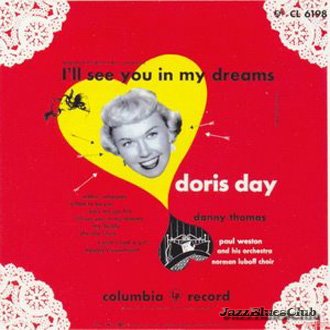
The record my Mom and I nearly wore out.

The record my Mom and I nearly wore out.

I knew all the songs before I saw this movie.
When Mom was in middle school, her father (my grandfather) had a 78 record of the “I’ll See You in My Dreams” soundtrack. He was going to throw it away, so she asked to keep when she saw Doris Day on the album cover. When I began getting interested in Doris Day when I was 13, my mom pulled out the record and I listened to it constantly.
When I first saw this movie back in 2005, Mom and I both knew all the words to the songs Kahn made popular because of that 78 but neither of us had ever seen the movie before.
When Mom and I rewatched this movie on Sunday, we both softly sang along to all of his hit tunes.
Clearly this movie has a special place in my heart.
Sentimentality aside, I love the cast and the music. Mary Wickes is always hilarious and Day and Thomas are wonderful.
Though it is questionable about how accurate biographical films are, this one is still a lot of fun with an excellent score to accompany a fairly touching story.

Check out the Comet Over Hollywood Facebook page, follow on Twitter at @HollywoodComet or e-mail at cometoverhollywood@gmail.com