Watching 1939: Boy Friend (1939)

In 2011, I announced I was trying to see every film released in 1939. This new series chronicles films released in 1939 as I watch them. As we start out this blog feature, this section may become more concrete as I search for a common thread that runs throughout each film of the year. Right now, that’s difficult.

boyfriend21939 film:
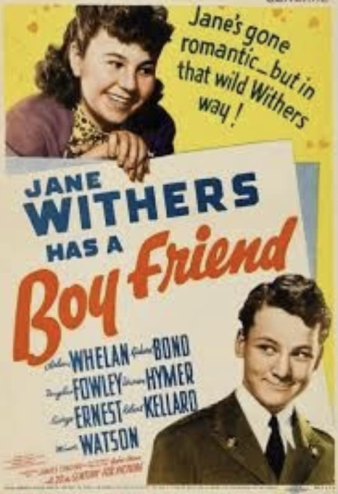
Boy Friend (1939)

Release date:
May 19, 1939

Cast:
Jane Withers, Arleen Whelan, Richard Bond, George Ernest, Douglas Fowley, Warren Hymer, Minor Watson, Robert Shaw, Robert Kellard, Robert Shaw, Ted Pearson, William Conselman Jr., Myra Marsh, Edward Gargan (uncredited), Lillian Yarbo (uncredited)

Studio:
20th Century Fox

Director:
James Tinling

Plot:
Jimmy Murphy (Bond) is in police school. He disappoints everyone when he quits to go work for a gang. When one of Jimmy’s friends and former classmates, Tommy (Kellard) is killed in a robbery, Jimmy’s sister Sally (Withers) and Tommy’s brother Billy (Ernest) try to get to the bottom of it.

Continue reading

Musical Monday: The Toast of New Orleans (1950)

It’s no secret that the Hollywood Comet loves musicals.
In 2010, I revealed I had seen 400 movie musicals over the course of eight years. Now that number is over 600. To celebrate and share this musical love, here is my weekly feature about musicals.

toast of new orleansThis week’s musical:
The Toast of New Orleans (1950) – Musical #86

Studio:
Metro-Goldwyn-Mayer

Director:
Norman Taurog

Starring:
Kathryn Grayson, Mario Lanza, David Niven, J. Carrol Naish, James Mitchell, Rita Moreno, Richard Hageman, Clinton Sundberg

Plot:
Bayou fisherman Pepe Duvalle (Lanza) is discovered for having a beautiful opera singing voice by visiting opera singer Suzette Micheline (Grayson) and her manager Jacques Riboudeaux (Niven). Pepe is rough around the edges and has to be groomed to be presentable for society.

Continue reading

Musical Monday: Easy to Wed (1946)

It’s no secret that the Hollywood Comet loves musicals.
In 2010, I revealed I had seen 400 movie musicals over the course of eight years. Now that number is over 600. To celebrate and share this musical love, here is my weekly feature about musicals.

This week’s musical:
Easy to Wed (1946) – Musical #81

easy to wed

Studio:
Metro-Goldwyn-Mayer

Director:
Edward Buzzell

Starring:
Van Johnson, Esther Williams, Keenan Wynn, Lucille Ball, Cecil Kellaway, Ben Blue, June Lockhart, Grant Mitchell, Josephine Whittell, Paul Harvey, Jonathan Hale, James Flavin
Themselves: Carlos Ramírez, Ethel Smith

Plot:
Connie Allenbury (Williams) and her father (Kellaway) sue The Morning Star newspaper for a $2 million libel suit when a piece of misinformation was published about her. The paper’s business manager Warren Haggerty (Wynn) is asked to postpone is wedding (again) to Gladys (Ball) to get the suit dropped. Haggerty brings in former reporter Bill Chandler (Johnson) to woo Connie, while also getting married to Gladys, so that Connie will be caught in a scandal.

Continue reading

Watching 1939: Tarzan Finds a Son! (1939)

In 2011, I announced I was trying to see every film released in 1939. This new series chronicles films released in 1939 as I watch them. As we start out this blog feature, this section may become more concrete as I search for a common thread that runs throughout each film of the year. Right now, that’s difficult.

1939 film:
Tarzan Finds a Son! (1939)

tarzan finds a son

Release date:
June 16, 1939

Cast:
Johnny Weissmuller, Maureen O’Sullivan, Johnny Sheffield, Ian Hunter, Frieda Inescort, Henry Stephenson, Henry Wilcoxon, Laraine Day, Morton Lowry

Studio:
Metro-Goldwyn-Mayer

Director:
Richard Thorpe

Plot:
When a plane crashes in the jungle, Cheetah the Ape finds there is a baby on board. Bringing the baby to Tarzan (Weissmuller) and Jane (O’Sullivan), they raise the child as their own in the jungle. When five years pass, relatives of the baby bring a search party (Hunter, Inescort, Stephenson) to find survivors of the crash, because an inheritance is at stake.

Continue reading

Musical Monday: Thrill of a Lifetime (1937)

It’s no secret that the Hollywood Comet loves musicals.
In 2010, I revealed I had seen 400 movie musicals over the course of eight years. Now that number is over 600. To celebrate and share this musical love, here is my weekly feature about musicals.

thrill of a lifetime2This week’s musical:
The Thrill of a Lifetime (1937) – Musical #673

Studio:
Paramount Pictures

Director:
George Archainbaud

Starring:
Leif Erickson, Judy Canova, Betty Grable, Buster Crabbe (as Larry Crabbe), Ben Blue, Johnny Downs, Eleanore Whitney, Franklin Pangborn, Anne Canova, Zeke Canova, the Yacht Club Boys (Charles Adler, George Kelly, Billy Mann, Jimmie Kern), Marjorie Reynolds (uncredited),
Themselves: Dorothy Lamour

Plot:
Betty Jane (Whitney) and Judy (Canova) have a sister act with Stanley (Downs). When Stanley and Betty Jane are offered a performing gig without Judy, they decide to go to Camp Romance to find Judy a husband. The camp is for singles looking for love and is run by Howard Nelson (Erickson), who doesn’t believe in love and has written a play called “There Ain’t Not Such Thing as Love.” While Howard doesn’t believe in love, his secretary Gwen (Grable) is in love with him.

Continue reading

Musical Monday: Athena (1954)

It’s no secret that the Hollywood Comet loves musicals.
In 2010, I revealed I had seen 400 movie musicals over the course of eight years. Now that number is over 600. To celebrate and share this musical love, here is my weekly feature about musicals.

athena-movie-poster-1954-1020706063This week’s musical:
Athena (1954) – Musical #77

Studio:
Metro-Goldwyn-Mayer

Director:
Richard Thorpe

Starring:
Jane Powell, Jane Powell, Edmund Purdom, Debbie Reynolds, Vic Damone, Louis Calhern, Virginia Gibson, Jane Fischer, Cecile Rogers, Nancy Kilgas, Dolores Starr, Evelyn Varden, Linda Christian, Ray Collins, Richard Sabre, Henry Nakamura, Steve Reeves, Kathleen Freeman, Bess Flowers (uncredited)

Plot:
The life of stuffy Massachusetts lawyer Adam Shaw (Purdom) is turned upside down when he meets Athena (Powell) and her family. Athena is a numerologist and lives with her grandparents and seven sisters. Her family believes in health, exercise and that life is directed by the stars. Athena finds that she and Adam are a love match through numbers and the stars and works to convince him.

Continue reading

Pages to Screen: Where the Boys Are (1960)

Often, the book is better than the film.

But in the case of WHERE THE BOYS ARE (1960), skip Glendon Swarthout’s book and just enjoy the movie.

The film and book both follow Midwest college girls traveling to Fort Lauderdale, Florida, for their spring vacation in search of love and suntans. But while the movie is fun and charming, the book is frankly vile.

where the boys are dvd book

Bear with me because I have a lot to unpack.

I first watched WHERE THE BOYS ARE when I was 14 and loved it. I was eager to read the book and didn’t until this summer at age 32, and I’m thankful I read this as an adult and not a young teen.

The book was written by Glendon Swarthout and published in 1960, with the movie releasing in Dec. 1960. Swarthout also wrote “They Came from Cordura” and “The Shootist,” which were adapted into films.

To follow the review easily, here is a breakdown of the characters in both the film and movie. Several characters in the book and movie are similar, though they interact differently in the book:

Character Book Movie
Merrit Main character, narrator Played by Dolores Hart
Tuggle Merrit’s friend and travel companion Played by Paula Prentiss
Ryder A love interest of Merrit’s Played by George Hamilton and love interest of Merrit
TV Thompson A love interest of Merrit’s Played by Jim Hutton and the love interest of Tuggle
Basil Jazz musician, love interest of Merrit’s Played by Frank Gorshin and the love interest of Angie (Connie Francis)
Quentin Jazz musician, love interest of Tuggle Not in the movie
Swimming nightclub performer Ramona Named Lola Fandango, played by Barbara Nichols
Angie Character not in book Played by Connie Francis
Melanie Character not in book, but similar to the minor character, Susy Played by Yvette Mimieux

The book is written in the point of view of 18-year-old college freshman, Merrit. So … 41-year-old Swarthout is writing in the POV of a college girl. Now, this has been done successfully in cases like “Gidget” by Frederick Kohner, but his novel came from stories directly from his daughter. I can’t say Swarthout was successful in effectively doing this (in my opinion), though I guess in a way he was since it spurred a hit movie that made Fort Lauderdale a travel destination.

where the boys are

Both the movie and the book focus on sex, but in different ways. The movie mainly asks the question of should you “play house” before marriage and if you can get a man without falling into bed. The book is more about Merrit’s sexual experiences. While in the movie, the three male characters each date different characters, in the book they all want Merrit.

And exactly 33 pages in was when I decided I hated the book.
Rape is very casually mentioned in Swarthout’s book.

Merrit goes on a date with Herbert “TV” Thompson and he tells how he got the nickname “TV”:
TV went on a date with a sorority queen and when she refused to sleep with him, he raped her. He panicked, worried she would report it to the police, so he bought her an $800 color TV. The story got around, so he was called TV and couldn’t get any dates or make friends. “To clap the climax he later learned that the queen had round heels for everyone else.”

“There were tears in my eyes. It was the most heart-rendering story I had ever heard.”

That’s right. TV Thompson tells a story about raping a girl … and Merrit feels sorry for him. And it was okay because she had “round heels,” I guess?

Later, a character named Susy tries to commit suicide after three “Yalies” get her drunk and try to rape her. I would compare this to the character of Melanie in the film, which is treated with more drama and gravity. In the book, the suicide and rape of Susy are treated almost flippantly, calling her a “Suicidal Mermaid,” because she tried to drown herself in the pool.

Before the book got offensive, its crime was that it was boring and confusing.
The book is written in a meandering, scattered stream of consciousness where stories overlap in confusing manners. I guess this is meant to give the impression of how a college girl thinks … in Swarthout’s opinion. The book gets convoluted as Swarthout cuts into the main narrative so Merrit can tell a story to explain something unrelated for several pages. While reading, I would forget why we were discussing this second story and what we were doing prior.

Some examples:
• Merrit first meets Basil while he and his jazz band are playing. Basil comes over to ask her for a date. After agreeing, Merrit describes something she learned in a Core Living class for three pages all in one long paragraph.
• While Merrit and Ryder are kissing, the story halts as she turns to “Incidentally, this is why I had decided in high school to become a teacher.” And for five and a half pages, Merrit describes her teaching experiences before we get back to current time.

Swarthout also uses some storytelling methods that I guess you could call clever, but were frankly annoying.

For example, the girls are having an argument with older tourists. To illustrate the yelling and talking over each other, Swarthout wrote a full page of text with no punctuation. I thought “I’m not reading that” and just skimmed.

Other times, he tried to write words phonetically so the reader would get the idea of an accent. However, he did this with a southern police officer, and as a southerner, I had no idea what words I was supposed to be reading.

where the boys are 2

Film similarities and differences
While the book and movie are fairly different, several tidbits from the book are in the film. But they are simply told in a more charming manner.

The film begins with Merrit in a courtship class taught by elderly Dr. Raunch. Merrit gets in trouble for her discussion on dating and sex. In the book, this is one of the previously mentioned flashbacks that cuts into the story.

In both, TV tells a story about angrily writing a rich lady who complains about her life who sends him money in response. In the book, however, the woman is Barbara Hutton.

Frankly, George Hamilton and Jim Hutton were perfectly cast in the film as Ryder and TV. Paula Prentiss is more how Merrit is described in the book.

In the movie, Merrit is more reserved while she isn’t in the book.

The book is also frankly wild. There is a whole thing about trying to get college kids to go fight in the Cuban revolution — which isn’t in the film.

What was the goal?
The inspiration of the book came when Glendon Swarthout, PhD, then a Michigan State University (MSU) associate English teacher, accepted an invitation to go to Fort Lauderdale with his students. TV Thompson was based on the student who invited him.

“It occurred to me as the week progressed that this would make a very fine novel,” Swarthout told Larry King in a 1985 interview. “I could at the same time write a kind of profile of that particular generation-their aspirations, their hopes, their fears and so on.”

In a 2011 Michigan State article, several MSU professors praise the book for being witty and forward thinking.

For 1960, I will admit that it is forward thinking, especially the depiction of Merrit being sexually active. But at the same time, the female characters face certain consequences for being sexually active, while the boys don’t.

So what was the goal? Was it to slut shame? That sex comes with consequences? Or was it an attempt of saying sex outside of marriage was okay? I’m really not sure.

While the Metro-Goldwyn-Mayer film was criticized as commercial, I’ll soak in those artificial Cinemascope, Joe Pasternak-produced rays any day over reading this book again.

This article is part of the 2021 Classic Film Summer Reading Challenge hosted by Out of the Past.

Check out the Comet Over Hollywood Facebook page, follow on Twitter at @HollywoodComet or e-mail at cometoverhollywood@gmail.com

Musical Monday: Hold On! (1966)

It’s no secret that the Hollywood Comet loves musicals.
In 2010, I revealed I had seen 400 movie musicals over the course of eight years. Now that number is over 600. To celebrate and share this musical love, here is my weekly feature about musicals.

hold on2This week’s musical:
Hold On! (1966) – Musical #241

Studio:
Metro-Goldwyn-Mayer

Director:
Arthur Lubin

Starring:
The Herman’s Hermits: Peter Noone, Keith Hopwood, Karl Green, Derek Leckenby, Barry Whitwam
Shelley Fabares, Sue Anne Langdon, Hebert Anderson, Harry Hickox, Bernard Fox, Hortense Petra

Plot:
When astronauts decide they want to name their next ship after The Herman’s Hermits, NASA employee Edward Lindquist (Anderson) is asked to follow the band to learn more about them. However, the band is kept under close watch of their manager (Fox) and the young band members are bored and Herman (Noone) is lonely. When Herman meets and falls for Louisa (Fabares). The band sneaks out to go to an amusement park and spend time with Louisa, and Edward is accused of kidnapping them.

Continue reading

Watching 1939: Within the Law (1939)

In 2011, I announced I was trying to see every film released in 1939. This new series chronicles films released in 1939 as I watch them. As we start out this blog feature, this section may become more concrete as I search for a common thread that runs throughout each film of the year. Right now, that’s difficult.

within the law1939 film:
Within the Law (1939)

Release date:
March 17, 1939

Cast:
Ruth Hussey, Tom Neal, Paul Kelly, William Gargan, Paul Cavanagh, Rita Johnson, Samuel S. Hinds, Lynne Carver, Sidney Blackmer, James Burke, Frank Orth,

Studio:
Metro-Goldwyn-Mayer

Director:
Gustav Machatý

Plot:
Mary Turner (Hussey) is falsely accused of grand larceny when stolen goods are planted on her. She’s sent to jail for a three year stretch, and while she’s there, she studies law books. When she gets out, she learns how to break the law … but within the law.

Continue reading

Musical Monday: Rhythm on the Range (1936)

It’s no secret that the Hollywood Comet loves musicals.
In 2010, I revealed I had seen 400 movie musicals over the course of eight years. Now that number is over 600. To celebrate and share this musical love, here is my weekly feature about musicals.

rhythm on the rangeThis week’s musical:
Rhythm on the Range – Musical #670

Studio:
Paramount Pictures

Director:
Norman Taurog

Starring:
Bing Crosby, Frances Farmer, Bob Burns, Martha Raye, Samuel S. Hinds, Lucile Gleason, Warren Hymer, James Burke, George E. Stone, Leonid Kinskey
Musical performers: Sons of the Pioneers, Louis Prima

Plot:
Wealthy Doris Halloway (Farmer) is prepared to marry a man she doesn’t love, because it seems like the thing to do. Her Aunt Penny (Gleason) owns a ranch out west and heartily disapproves. When Doris hears her Aunt Penny talk about western women and life, Doris decides she needs to go west. She sneaks onto a cattle car with one of Penny’s ranch hands, Jeff (Crosby) and lies about who she is. Jeff and Doris (or Louis as she tells him) travel across country together in a cattle car with his bull, Cuddles.

Continue reading