It’s no secret that the Hollywood Comet loves musicals. In 2010, I revealed I had seen 400 movie musicals over the course of eight years. Now that number is over 500. To celebrate and share this musical love, here is my weekly feature about musicals.
Starring:
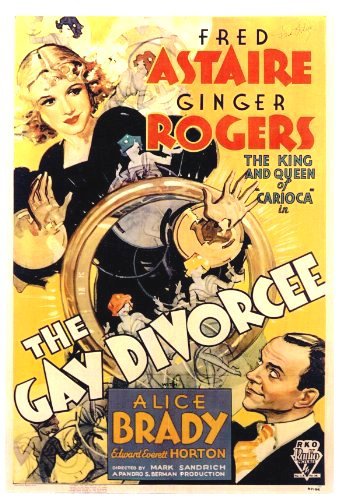
Ginger Rogers, Fred Astaire, Alice Brady, Edward Everett Horton, Eric Blore, Erik Rhodes, William Austin, Betty Grable, Lillian Miles
Plot:
Mimi (Rogers) is traveling with her Aunt Hortense (Brady) and is looking for a
Trivia:
-This was Fred Astaire and Ginger Rogers’ second film together (out of 10 films). Following their success in “Flying Down to Rio” (1933), RKO teamed them together again.
-“The Continental” lasts 17.5 minutes. This was the longest musical number until Gene Kelly’s ballet in “An American In Paris” (1951).
-The Academy Awards for 1934 were the first to include the category for Best Original Song. Con Conrad and Herb Magidson were the first to receive this award for “The Continental.”
-Based on the 1932 Broadway show “The Gay Divorce,” which starred Fred Astaire and Claire Luce. For the film, the title was changed to “Divorcee.” Fred Astaire’s autobiography “Steps in Time” says the change was to show that the film was about the amorous adventures of a woman.
t’s no secret that the Hollywood Comet loves musicals. In 2010, I revealed I had seen 400 movie musicals over the course of eight years. Now that number is over 500. To celebrate and share this musical love, here is my weekly feature about musicals.
This post was updated to reflect the Academy Awards won.
This week’s musical:
“La La Land” (2016)– Musical #561
Director:
Damien Chazelle
Starring:
Ryan Gosling, Emma Stone, John Legend, J.K. Simmons, Tom Everett Scott, Rosemarie Dwitt
Plot:
Living in Los Angeles, Mia (Stone) is an aspiring actress who works as a barista in a coffee shop. Sebastian (Gosling) is an unemployed jazz musician who is bitter that he lost his previous jazz club and plans to open a new club. The two meet, fall in love and encourage each other’s dreams.
But none of them are quite like Debbie Reynolds’ 1983 “Do It Debbie’s Way.” Reynolds’ Hollywood career began when she was 16 in 1948 playing a bit role in the Bette Davis film “June Bride.” In the 1950s, Debbie became one of Metro-Goldwyn-Mayer’s top stars and she continued performing until her last film role in 2013. She passed away in 2016.
Debbie was unstoppable, energetic and unsinkable, and the fact that she jumped on the exercise video bandwagon isn’t all-together surprising. She was a dancer and was slim most of her life.
But her workout video isn’t quite the same as other videos you may be used to.
The always original and over-the-top Reynolds decorates her workout studio with a chandelier, a diaphanous pink backdrop curtain, and lights behind the curtain spelling “DEBBIE” in eight foot tall letters.
“My set, I hope you like it. Usually you would work out in a gym, but I was in MGM for years in musicals so I thought we would do it up sort of pink, not brown,” Reynolds said in the video.
It’s no secret that the Hollywood Comet loves musicals. In 2010, I revealed I had seen 400 movie musicals over the course of eight years. Now that number is over 500. To celebrate and share this musical love, here is my weekly feature about musicals.
Starring:
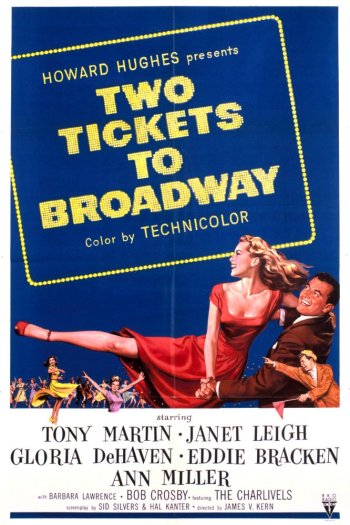
Janet Leigh, Ann Miller, Gloria DeHaven, Barbara Lawrence, Tony Martin, Eddie Bracken, Charles Dale, Joe Smith, Joi Lansing (uncredited), Vera Miles (uncredited)
Themselves: Bob Crosby
Plot:
Nancy Peterson (Leigh) is given a big send off from her hometown, Pelican Falls, as she leaves to get her start on Broadway. On her bus trip to New York, she meets three down-on-their-luck performers: Hannah Holbrook (DeHaven), Joyce Campbell (Miller) and S.F. Rogers (Lawrence). Their agent (and Hannah’s boyfriend), Lew Conway (Bracken) continuously sets them up with dead-end gigs. Nancy also meets (and falls in love with) another down-on-his-luck performer, Dan Carter (Martin). To save face, Lew Conway lies to Dan, Nancy and the three girls; telling them that they have a huge performance spot on Bob Crosby’s TV show. The crew forms an act and starts rehearsing, not knowing that they may not be performing the act anywhere.
It’s no secret that the Hollywood Comet loves musicals. In 2010, I revealed I had seen 400 movie musicals over the course of eight years. Now that number is over 500. To celebrate and share this musical love, here is my weekly feature about musicals.
This week’s musical:
All-American Co-Ed (1941) – Musical #553
Studio:
Hal Roach Studios
Director:
LeRoy Prinz
Starring:
Frances Langford, Johnny Downs, Marjorie Woodworth, Noah Berry Jr., Esther Dale, Harry Langdon, Kent Rogers, Alan Hale Jr., Lillian Randolph, Margaret Roach (uncredited), Marie Windsor (uncredited), Dudley Dickerson, Claire James (uncredited) Themselves: The Tanner Sisters- Mickey Tanner, Betty Tanner, Martha Tanner
Plot:
All-girls horticulture college Mar Bryn is failing to attract new students. They hold a contest to bring in beautiful female students. In an effort for publicity, Mar Bryn’s student newspaper makes fun of the Zeta fraternity at Quincton College. Out of revenge, the boys nominate one of their frat brothers to dress up like a girl and enroll.
It’s no secret that the Hollywood Comet loves musicals. In 2010, I revealed I had seen 400 movie musicals over the course of eight years. Now that number is over 500. To celebrate and share this musical love, here is my weekly feature about musicals.
This week’s musical:
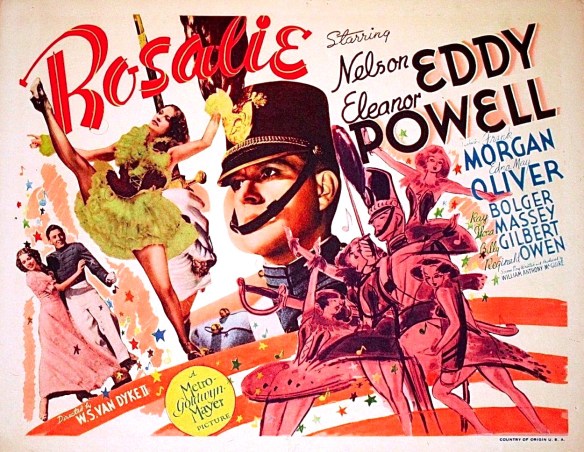
“Rosalie” (1937)– Musical #140
Studio:
Metro-Goldwyn-Mayer
Director:
W.S. Van Dyke
Starring:
Eleanor Powell, Nelson Eddy, Frank Morgan, Edna May Oliver, Ray Bolger, Ilona Massey, Reginald Owen, Virginia Grey, Billy Gilbert, Jerry Colonna, William Demarest, Tommy Bond, Tom Rutherford
Plot:
Rosalie (Powell) is a student at Vassar and also a princess from the country Romanza. She falls for West Point student Dick Thorpe (Eddy), who will be joining the Army after he graduates. When Rosalie is commanded home, she tells Dick to meet her in Romanza at a spring festival. The only problem is that Rosalie is betrothed to Prince Paul (Rutherford).
It’s no secret that the Hollywood Comet loves musicals. In 2010, I revealed I had seen 400 movie musicals over the course of eight years. Now that number is over 500. To celebrate and share this musical love, here is my weekly feature about musicals.
Starring:
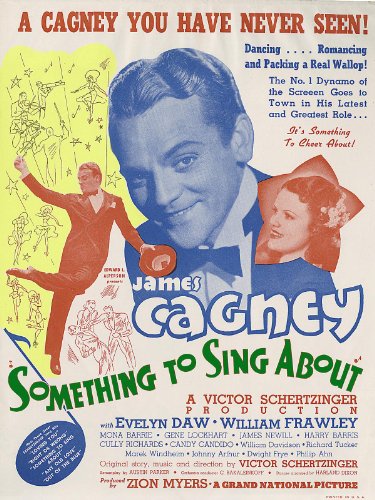
James Cagney, Evelyn Daw, William Frawley, Mona Barrie, Gene Lockhart, Kathleen Lockhart
Plot:
New York bandleader and dancer Terry Rooney (Cagney) goes to Hollywood where they try to remold him into a star. Terry marries his sweetheart and singer of his band, Rita Wyatt (Daw). When they return from their honeymoon they find that Rooney’s contract says that he can’t be married.
Trivia:
-Victor Schertzinger directed, wrote the story and composed the score for “Something to Sing About”
-This film was made at Grand National Pictures, which was known for their B movies. “Something to Sing About” was one of Grand National’s last films and was known as the film that broke the low budget film studio. Hoping James Cagney’s star power would make them a hit, they spent a large sum of money on it and the film flopped. The studio closed in 1939.
Awards and Nominations:
-Nominated for an Academy Award for Best Music, Score by C. Bakaleinikoff (musical director), Score by Victor Schertzinger.
Highlights:
-James Cagney tap dancing, especially at the beginning while instruments mimic what he’s tapping on
Notable Songs:
-“Something to Sing About” performed by Evelyn Daw
My review:
“Something to Sing About” is a light but entertaining film. It’s more of a comedy than a musical, but it’s one of those rare films (i.e. Yankee Doodle Dandy, Footlight Parade) that we have the opportunity to see James Cagney dance.
I enjoy films about Hollywood and this one fits the bill. There are humorous scenes of trying to get Cagney to speak in “pear-shaped tones,” dressing him and giving him a new hairstyle. The studio also hides his marriage and a publicity agent cooks up a romance with a leading lady.
James Cagney and Evelyn Daw
Evelyn Daw is a sweet leading lady but she was only in two films. While her prescience is pleasant, it’s not particularly memorable. “Something to Sing About” was her first film and 1938’s Panamint’s Bad Man was her last film. She has a beautiful, strong operatic voice and was discovered by the director of this film, Victor Schertzinger. There is little more biographical information to be found on Miss Daw, other than the fact that she retired from singing and films when she married her husband, Steward Smith.
“Something to Sing About” flopped and was a partial result to Grand National Pictures shutting down in 1939, but I didn’t think it was all that bad. It is fairly funny and a brisk watch. I revisited this the same weekend I watched some very dramatic mid-1960s films and it was a nice bit of levity.
While “Something to Sing About” isn’t a great film, it does also give you the opportunity to see James Cagney dance which is always a glorious sight to see.
It’s no secret that the Hollywood Comet loves musicals. In 2010, I revealed I had seen 400 movie musicals over the course of eight years. Now that number is over 500. To celebrate and share this musical love, here is my weekly feature about musicals.
Director:
Archie Mayo, Michael Curtiz (uncredited)
Starring:
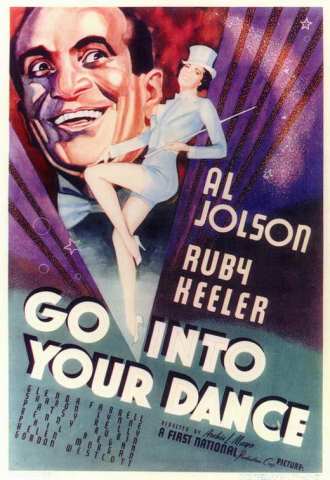
Ruby Keeler, Al Jolson, Glenda Farrell, Barton MacLane, Patsy Kelly, Helen Morgan, Akim Tamiroff, Joyce Compton, Ward Bond (uncredited), Theresa Harris (uncredited),
Themselves: Al Dubin, Harry Warren
Plot:
Famous Broadway performer Al Howard (Jolson) has been blackballed on Broadway after walking out on a successful show. His sister Molly (Farrell) enlists the help of dancer Dorothy Wayne (Keeler) to convince Al to create a duo. After creating an act, a gangster (MacLane) backs a show that will star Howard.
It’s no secret that the Hollywood Comet loves musicals. In 2010, I revealed I had seen 400 movie musicals over the course of eight years. Now that number is over 500. To celebrate and share this musical love, here is my weekly feature about musicals.
This week’s musical:
“Wintertime” (1943) – Musical #560
Studio:
20th Century Fox
Director:
John Brahm
Starring:
Sonja Henie, Cornel Wile, Cesar Romero, Jack Oakie, Carole Landis, S.Z. Cuddles Sakall, Helene Reynolds Himself: Woody Herman
Plot:
Business partners Skip Hutton (Oakie) and Freddy Austin (Wilde) own a struggling Canadian hotel and are on the brink of foreclosure. When a Norwegian millionaire Hjalmar Ostgaard ( Sakall) and his niece Nora (Henie) stay at the hotel, Uncle Hjalmar is conned into buying the hotel. Nora falls in love with Freddy, but she’s mad that he has to spend most of his time with pretty reporter Marion Daley (Reynolds) so that the hotel can get publicity. Nora also starts performing as an ice skater to earn more money. While Nora is chasing Freddy, singers for Woody Herman’s band Flossie and Brad (Landis, Romero) are having love problems of their own.
It’s no secret that the Hollywood Comet loves musicals. In 2010, I revealed I had seen 400 movie musicals over the course of eight years. Now that number is over 500. To celebrate and share this musical love, here is my weekly feature about musicals.
This week’s musical:
“I Love Melvin” (1953)– Musical #167
Studio:
Metro-Goldwyn-Mayer
Director:
Don Weis
Starring:
Debbie Reynolds, Donald O’Connor, Una Merkel, Allyn Joslyn, Richard Anderson, Jim Backus, Noreen Corcoran, Les Tremayne, Barbara Ruick, Steve Forrest (uncredited), Robert Fuller (uncredited as acrobatic cheerleader), Ned Glass (uncredited)
Themselves: Robert Taylor
Plot:
Judy Schneider (Reynolds) is a struggling actress with dreams of becoming a Hollywood star. In the mean time, she’s playing a football in a musical number in a Broadway show. Melvin Hoover (O’Connor) is a Look magazine photographer’s assistant. The two bump into each other in Central Park ,and Melvin exaggerates the importance of his job to impress Judy and her family, who want her to marry Harry Flack (Anderson). Melvin’s exaggerations go too far when he promises to put Judy on the cover of Look magazine. All the while, Judy is daydreaming about her fame.
Trivia:
-The “Lady Loves” number was originally supposed to be performed with Debbie Reynolds in a farm setting, according to “That’s Entertainment III” (1994). It was re-shot with Debbie Reynolds dressed as a sophisticated lady.
-Howard Keel was originally supposed to be the star cameo in Reynolds’ dream, rather than Robert Taylor.
Highlights:
-Robert Taylor’s cameo
-The Football Ballet
-Noreen Corcoran’s song and dance with Donald O’Connor
-Dancers in Fred Astaire and Gene Kelly masks and costumes
Notable Songs:
-A Lady Loves performed by Debbie Reynolds
-Saturday Afternoon Before the Game performed by a chorus
-Where Did You Learn To Dance performed by Debbie Reynolds and Donald O’Connor
-We Have Never Met, As Yet performed by Debbie Reynolds and Donald O’Connor
-Life Has Its Funny Little Ups and Downs performed by Noreen Corcoran and Donald O’Connor
My review:
“I Love Melvin” (1953) is an adorable and joyous little movie. It isn’t a big, serious award-winning extravaganza like “Singin’ in the Rain” or “Seven Brides for Seven Brothers,” but it’s a simple story that’s plain fun.
In his April 10, 1953, review, New York Times film critic Bosley Crowther doesn’t call the film bad or good, but “chromium-plated spun-sugar” and that it lacks substance. Crowther isn’t incorrect. “I Love Melvin” is pure escapism and there’s nothing wrong with that.
And while this isn’t a serious film, the cast is excellent. Donald O’Connor and Debbie Reynolds are on-screen together two years after “Singin’ in the Rain” (1951). The two dance and perform with energy and professionalism. They are wonderful to watch and Reynolds and O’Connor have wonderful chemistry.
The outstanding supporting cast is rounded out by Una Merkel, Allyn Joslyn, Richard Anderson, Jim Backus, and Noreen Corcoran. For fans of the TV show “Emergency!,” actor Robert Fuller dances in the football ballet.
Mr. Crowther also wrote, “The music, while undistinguished, is sufficient to get them around and the decor is in the most splendid and expensive Metro style.”
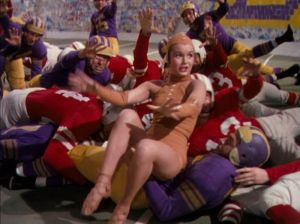
Debbie Reynolds dressed as a football, showing how much she is struggling in her dancing and acting career.
Many of the songs are forgettable but fun. The only real memorable song is “A Lady Loves,” which sometimes gets stuck in my head. The other performances include Noreen Corcoran and Donald O’Connor skating together and Debbie Reynolds is tossed around like a football among dancing football players. The football ballet may be one of the most creative and odd dance numbers I have ever watched. While goofy and bizarre, the football number is meant to be weird to show that Judy is far from fame.
A note to North Carolina football fans: the uniforms, colors and initials of the purple and gold team are similar to East Carolina University in North Carolina. I haven’t been able to find any facts to see if this was intentional.
Along with the football ballet, there are other hilariously goofy scenes as Judy daydreams such as Robert Taylor as her love interest and dancers dressed in Gene Kelly and Fred Astaire costumes.
Debbie Reynolds dreaming that she’s in a film with Robert Taylor
Debbie Reynolds in a daydream with dancers dressed as Gene Kelly and Fred Astaire
While this movie is fun, it is a little sad to watch now. Both child star Noreen Corcoran and actress Debbie Reynolds passed away in 2016. Both are delightful in this movie. This may be one of my favorite Debbie Reynolds films (at least in my top 5).
If you are feeling down, give “I Love Melvin” a watch. The plot is silly and it’s not a serious film, but what does that matter? It’s pure joy.
Donald O’Connor and Debbie Reynolds in “I Love Melvin”

 This week’s musical: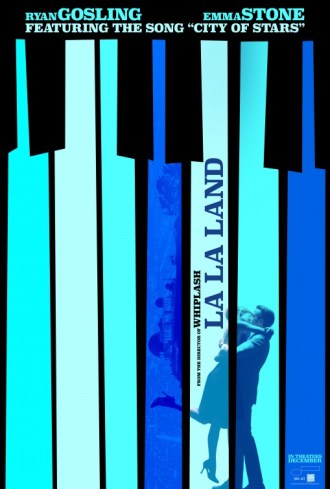
 ” (2016)– Musical #561

 ” (1937) – Musical #439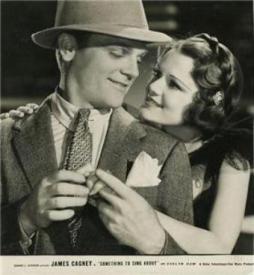




 Comet Over Hollywood