Musical Monday: Little Miss Broadway (1938)

It’s no secret that the Hollywood Comet loves musicals.
In 2010, I revealed I had seen 400 movie musicals over the course of eight years. Now that number is over 500. To celebrate and share this musical love, here is my weekly feature about musicals.

This week’s musical:
Little Miss Broadway –Musical #287

broadway

Studio:
20th Century Fox

Director:
Irving Cummings

Starring:
Shirley Temple, George Murphy, Jimmy Durante, Phyllis Brooks, Edna May Oliver, Donald Meek, Edward Ellis, El Brendel
Themselves: The Brian Sisters- Betty Brian, Doris Brian, Gwen Brian; The Brewster Twins (Barbara and Gloria Brewster)

Plot:
Orphan Betsy Brown (Temple)is adopted by friends of her parents- Pop Shea (Edward Ellis) and his daughter Barbara (Phyllis Brooks) who run a hotel for performers. However, the hotel lead is held by Sarah Wendling (Oliver) and her brother Willoughby (Meek), and Sarah hates the show business tenants and looks for every way to shut down the hotel. However, when Sarah’s nephew Roger (Murphy) meets Betsy, he’s instantly taken with the child and finds himself attracted to Barbara. Roger sets out to help the show business hotel stay open.

Continue reading

Musical Monday: Everybody Sing (1938)

It’s no secret that the Hollywood Comet loves musicals.
In 2010, I revealed I had seen 400 movie musicals over the course of eight years. Now that number is over 500. To celebrate and share this musical love, here is my weekly feature about musicals.

everybody singThis week’s musical:
Everybody Sing –Musical #540

Studio:
Metro-Goldwyn-Mayer

Director:
Edwin L. Marin

Starring:
Allan Jones, Judy Garland, Fanny Brice, Billie Burke, Lynne Carver, Reginald Owen, Reginald Gardiner, Monty Wooley

Plot:
Judy (Garland) is constantly getting in trouble and expelled from her private school. She’s expelled again when she starts singing swing in her music class. When she returns home, she finds her madcap family: her actress mother (Burke), playwright father (Gardner), mother’s protegee (Owen), Russian Maid (Brice), singing cook (Jones), and ambitious older sister (Carver). No one will listen to Judy when she tries to tell them she’s expelled, no one will listen to her and they are too wrapped up in their affairs to pay attention. When her parents try to send her abroad, she escapes and gets a starring role in a musical show.

Continue reading

Musical Monday: Words and Music (1948)

It’s no secret that the Hollywood Comet loves musicals.
In 2010, I revealed I had seen 400 movie musicals over the course of eight years. Now that number is over 500. To celebrate and share this musical love, here is my weekly feature about musicals.

This week’s musical:
Words And Music (1948)– Musical #69

words and music

Studio:
Metro-Goldwyn-Mayer

Director:
Norman Taurog

Starring:
Tom Drake as Richard Rodgers and Mickey Rooney as Lorenz Hart
Also Starring: June Allyson, Cyd Charisse, Perry Como, Vera-Ellen, Judy Garland, Betty Garrett, Lena Horne, Gene Kelly, Janet Leigh, Jeannette Nolan, Richard Quine, Ann Sothern, Clinton Sundberg, Marshall Thompson, Mel Torme

Plot:
Fictional biographical film of the songwriters Richard Rodgers and Lorenz Hart, chronicling their success on Broadway, abroad and in Hollywood.

Songwriters Richard Rodgers and Lorenz Hart in the 1930s. Their career is portrayed in "Words and Music."

Songwriters Richard Rodgers and Lorenz Hart in the 1930s. Their career is portrayed in “Words and Music.”

Trivia:
-The project started in 1946 and was originally titled, “With a Song in My Heart” and then “Easy to Remember,” according to A Ship Without A Sail: The Life of Lorenz Hart by Gary Marmorstein.

-Richard Rodgers hated the movie, according to Marmostein’s book.

-Lyricist Lorenz Hart, who Mickey Rooney plays in the film, died in 1943 at age 48. Richard Rodgers was 46 when this film was released and passed away in 1979. After Hart passed away, Rodgers became songwriting partners with Oscar Hammerstein.

-“Words and Music” was Perry Como’s first film with MGM after signing a seven-year contract. His MGM career ended promptly with this film after he sang happy birthday to Louis B. Mayer and ended it with an insult, according to the book Perry Como: A Biography and Complete Career Record by Malcolm Macfarlane, Ken Crossland.

-Mickey Rooney and Judy Garland’s last on-screen performance.

-Perry Como had two songs deleted from the film: “You’re Nearer” and “Lover,” according to the Malcolm Macfarlane and Ken Crossland book.

-Tom Drake is dubbed by Bill Lee

-Cyd Charisse is dubbed by Eileen Wilson

Highlights:
-The all-star cast
-Judy Garland and Mickey Rooney’s performance of “I Wish I Was in Love Again”

Notable Songs:
-“Manhattan” performed by Mickey Rooney
-“Mountain Greenery” performed by Perry Como
-“Where’s That Rainbow?” performed by Ann Sothern
-“On Your Toes” performed by Cyd Charissed (dubbed by Eileen Wilson) and Dee Turnell
-“Thou Swell” performed by June Allyson
-“The Lady Is A Tramp” performed by Lena Horne
 “I Wish I Were in Love Again” performed by Judy Garland and Mickey Rooney
-“Slaughter on Tenth Avenue” danced by Gene Kelly and Vera-Ellen

My review:
“Nice music, poor plot.”

This was the general consensus among the film critics after “Words and Music” had its New York City premiere on Dec. 8, 1948. And 68 years later, these critics still aren’t wrong.

This movie is in gorgeous Technicolor, has a fantastic cast of nearly all of MGM’s major musical stars, and beautiful songs with breathtaking dances. But somehow it falls short due to the story.

“Words and Music” is a musical film where the plot weaves in and out of a patchwork of musical numbers. While this format is bizarre and a little difficult to follow, it wasn’t uncommon during this time for a musical picture to mainly be a revue of song and dance with a tiny bit of plot sprinkled in. MGM did the same thing (but a little better) in 1946 with the musical “Till the Clouds Roll By”—A film about Jerome Kern. Warner Brothers had a comparable format with their 1943 film “This is the Army,” where the story halts for 45 minutes of a musical show.

But the musical numbers aren’t the problem, in fact they are the high spots of the film. We have the opportunity to see Ann Sothern in the gorgeous Technicolor number “Where’s My Rainbow?,” June Allyson adorably in the “Connecticut Yankee” number “Thou Swell,” and Lena Horne give the best rendition that ever existed of “The Lady is a Tramp.”

Mickey Rooney as Lorenz Hart and Tom Drake as Richard Rodgers

Mickey Rooney as Lorenz Hart and Tom Drake as Richard Rodgers

The issue is the terrible and inaccurate biographical plot line. I like Tom Drake, but he’s not a very strong leading man while playing songwriter Richard Rodger. And Mickey Rooney is over the top and fairly ridiculous as the ill-fated Lorenz Hart.

Hart had a troubled life that involved alcoholism. He also was tormented by the fact that he was only five feet tall and was a homosexual in a time where this was not embraced by society, according to the book A Ship Without A Sail: The Life of Lorenz Hart by Gary Marmorstein.

Ann Sothern gorgeous in Technicolor in the number "Where's My Rainbow" (1

Ann Sothern gorgeous in Technicolor in the number “Where’s My Rainbow” (Comet Over Hollywood screenshot)

Unsurprisingly though, none of this is detailed in the film. “Words and Music” depicts Hart as what New York Times writer Wilfrid Sheed quipped: “a lovelorn dwarf.” In the film, Hart’s character is turned down by a fictional love interest played by Betty Garrett in the 1920s and hasn’t gotten over it 20 years later.

There is even an odd but comical scenes where Mickey Rooney buys elevated shoes to be taller to impress the girl.

Aside from Hart’s personal life, the timeline of this film is confusing. For starters, Hart holds a huge party when he first moves to Hollywood and performs a song with guest Judy Garland.  It’s an energetic and standout scene in the film—until you stop and realize that in real life this didn’t happen. Hart moved to Hollywood in the early 1930s when Garland was still a little girl.

On a bittersweet note—Rooney and Garland’s performance of “I Wish I Were in Love Again” is also memorable because it was their last on-screen performance after starring together in 10 films through the late-1930s and early-1940s.

June Allyson in the number "Thou Swell" with twins Ramon Blackburn and Royce Blackburn

June Allyson in the number “Thou Swell” with twins Ramon Blackburn and Royce Blackburn (Comet Over Hollywood screenshot)

The musical numbers in the film also aren’t in chronological order of the years they opened on Broadway, making the story a little more confusing and “patchwork” like. For example, the film starts with the 1926 play “Peggy Ann,” then goes to the 1936 play “On Your Toes” and then back to a 1926 musical, “The Girl Friend.” While an average 1948 moviegoer may not notice this, it’s a little confusing if you are doing research or know when these musicals were on the stage.

Lastly, audiences have the opportunity to see Perry Como, aka Mr. Cool, in his first and only Metro-Goldwyn-Mayer film. Como plays a fictional pal to Rodgers and Hart at the beginning of the film. However, at the end of the movie during a tribute to Lorenz Hart, Gene Kelly introduces Perry Como as…Perry Como. Someone didn’t think that out well.

While inaccuracies in musical biopics are nothing new, it’s simply that those in “Words and Music” are awfully clumsy. Despite that, “Words and Music” is an excellent showcase of MGM’s talented singers and dancers: from Cyd Charisse, Lena Horne, June Allyson, Gene Kelly, Mel Torme, Vera-Ellen and of course, Judy Garland.

Even grumpy New York Times film critic Bosley Crowther said in his Dec. 10, 1948 review: To be sure, there is much that is appealing—especially to us reminiscent folks—about certain of the musical numbers that sit like islands in the swamp of the plot. It is pleasant to hear Betty Garrett, for a starter, sing “There’s a Small Hotel” or to watch little crinkle-faced June Allyson head a big production rendering of “Thou Swell.” There is melody and magnificence in a richly-staged dance spectacle which packages two or three numbers, notably “The Girl Friend” and “This Can’t Be Love.” And it is nice to watch Perry Como and Cyd Charisse do “Blue Room” in pastels.

If you give this one a chance, I suggest drinking in the Technicolor costumes, catchy songs and mesmerizing dance steps and ignore the plot.

Check out the Comet Over Hollywood Facebook page, follow on Twitter at @HollywoodComet or e-mail at cometoverhollywood@gmail.com

Musical Monday: The Night is Young (1935)

It’s no secret that the Hollywood Comet loves musicals.
In 2010, I revealed I had seen 400 movie musicals over the course of eight years. Now that number is over 500. To celebrate and share this musical love, here is my weekly feature about musicals.

night is young2This week’s musical:
The Night is Young (1935)– Musical #543

Studio:
Metro-Goldwyn-Mayer

Director:
Dudley Murphy

Starring:
Ramon Novarro, Evelyn Lane, Charles Butterworth, Una Merkel, Edward Everett Horton, Donald Cook, Henry Stephenson, Rosalind Russell, Herrman Bing, Mitzi the Mare

Plot:
Archduke Paul Gustave (Novarro) is betrothed to a woman he doesn’t wish to marriage. He is in love with Countess Zarika Rafay (Russell), who his uncle Emperor Franz Josef (Stephenson), disapproves of. However, Emperor Josef allows Paul to have an affair before he gets married. Paul lies and says he’s in love with ballerina, Lisl Gluck (Lane). She agrees to live at the castle so he can continue his relationship with the countess and he will provide her clothing and her friends anything she wants. Paul warms towards Lisl and the two fall in love.

Ramon Novarro and Evelyn Laye in "The Night is Young" (1935)

Ramon Novarro and Evelyn Laye in “The Night is Young” (1935)

Trivia:
-Ramon Novarro broke his contract with MGM after this film, according to an April 9, 1938 article, “Ramon Novarro, Handsome Movie Idol, Quit Films to Follow Yoga Philosophy” by Fredrick Othman.
-Music written by Sigmund Romberg and Oscar Hammerstein. This was one of four films Romberg wrote original operetta for, according to Sigmund Romberg by William A. Everett.
-Based on a story by Vicki Braum, author of “The Grand Hotel”

Notable Songs:
-My Old Mare performed by Charles Butterworth
-The Night is Young performed by Evelyn Laye
-When I Grow Too Old to Dream performed by Evelyn Laye and Ramon Novarro
-There’s a Riot in Havana performed by Evelyn Laye and Ramon Novarro
-Lift Your Glass performed by Evelyn Laye and Ramon Novarro

Edward Everette Horton and Novarro

Edward Everette Horton and Novarro

My review:
This the second musical I have watched with Ramon Novarro and I’m still pleasantly surprised and delighted at how well he sings.

The Night is Young (1935) is a cute and very funny little film. The laughable lines are largely thanks to actor Una Merkel, Charles Butterworth and Edward Everett Horton. Butterworth is an actor who general gets on my nerves, but he’s very funny in this film.

Rosalind Russell in a small role as the countess.

Rosalind Russell in a small role as the countess.

While Rosalind Russell is in this film, she only has three brief scenes. She does not even mention this brief role in her autobiography.

While Ramon Novarro and Evelyn Laye carry the film well, for me, the comedic character actors are what makes this film. However, the comedy drops off a little more than half way through the film and we focus on the romance of Novarro and Laye.

Laye may not be a familiar name to most film watchers. Popular on the stage in England, she only made six films from 1927 to 1935. She didn’t make another film or television appearance until 1957 and made several appearance in the 1970s and 1980s. She has a beautiful voice and is a lovely prescience on screen, but she isn’t as memorable as her co-stars.

While there were lovely songs throughout the film, my favorite was one Butterworth sang about his horse, Mitzi, called “My Old Mare.”

Charles Butterworth and Una Merkel: The comedic relief of "The Night is Young."

Charles Butterworth and Una Merkel: The comedic relief of “The Night is Young.”

While “The Night is Young” is a fun and charming film, it’s ending fairly sad, realistic that it’s almost startling when “The End” appears. I won’t say what happens, but it’s surprising for musical comedy, when most of them seem to end happily.

If you come across this one, watch it. If nothing else, it will make you laugh and smile.

Check out the Comet Over Hollywood Facebook page, follow on Twitter at @HollywoodComet or e-mail at cometoverhollywood@gmail.com

Musical Monday: Four Jacks and a Jill (1942)

It’s no secret that the Hollywood Comet loves musicals.
In 2010, I revealed I had seen 400 movie musicals over the course of eight years. Now that number is over 500. To celebrate and share this musical love, here is my weekly feature about musicals.

173625-four-jacks-and-a-jill-0-230-0-345-cropThis week’s musical:
“Four Jacks and a Jill” (1942) – Musical #197

Studio:
RKO

Director:
Jack Hively

Starring:
Ray Bolger, Anne Shirley, June Havoc, Dezi Arnez, Eddie Foy Jr, Jack Durant, Fritz Feld, Henry Daniell, Marie Windsor (uncredited), Grady Sutton (uncredited)

Plot:
Homeless Karanina “Nina” Novak (Shirley) is taken in by Nifty Sullivan (Bolger) and his four band-mates. Nina helps the band secure a job at a cafe with her singing and saying she is friends with a king she met in England. Taxi driver Steve Satro (Arnez) appears pretending to be the king, because they look similar, and breaks into the romance that’s forming between Nina and Nifty.

Ann Shirley and Dezi Arnez in "Four Jacks and a Jill."

Ann Shirley and Dezi Arnez in “Four Jacks and a Jill.”

Trivia:
-Anne Shirley’s singing was dubbed by Martha Mears.
-Remake of “Street Girl” (1929) and That Girl from Paris (1936).

Notable Songs:
-“I’m in Good Shape” performed by Ray Bolger
-“Karanina” performed by Anne Shirley, dubbed by Martha Mears
-“Boogie Woogie Conga” performed by the chorus
-“I Haven’t a Thing to Wear” performed by June Havoc
-“Wherever You Go” performed by Anne Shirley, dubbed by Martha Mears

Ray Bolger listening to a symphony and stealing the tunes to adapt as swing music.

Ray Bolger listening to a symphony and stealing the tunes to adapt as swing music.

My review:
The title “Four Jacks and a Jill” sounds fun and promising. But unfortunately, the film doesn’t live up to the title, and all I can say is I’m glad this is only a little over an hour.
The main high point in the film are some interesting tap dance numbers by Ray Bolger and the jaunty tune “Boogie Woogie Conga,” but those two things alone can’t save this movie.
While I love Anne Shirley, especially in her 1930s films, “Four Jacks and a Jill” is simply annoying and thankfully brief.

Check out the Comet Over Hollywood Facebook page, follow on Twitter at @HollywoodComet or e-mail at cometoverhollywood@gmail.com

Musical Monday: Sing Your Worries Away (1942)

It’s no secret that the Hollywood Comet loves musicals.
In 2010, I revealed I had seen 400 movie musicals over the course of eight years. Now that number is over 500. To celebrate and share this musical love, here is my weekly feature about musicals.

sing your worries awayThis week’s musical:
“Sing Your Worries Away” (1942)– Musical #202

Studio:
RKO

Director:
A. Edward Sutherland

Starring:
Bert Lahr, June Havoc, Buddy Ebsen, Patsy Kelly, Dorothy Lovett, Sam Levene, Margaret Dumont
Themselves: Alvino Ray, The King Sisters (Alyce, Donna, Yvonne, Luise)

Plot:
Gangsters-being helped by sexy Roxy Rochelle (Havoc)- are after Chow Brewster (Lahr) for his inheritance and are trying to drive him to suicide.

Continue reading

Musical Monday: Sweet Kitty Bellairs (1930)

Image

It’s no secret that the Hollywood Comet loves musicals.
In 2010, I revealed I had seen 400 movie musicals over the course of eight years. Now that number is over 500. To celebrate and share this musical love, here is my weekly feature about musicals.

This week’s musical:
Sweet Kitty Bellairs –Musical #358

Sweet_Kitty_Bellairs_1930_Poster

Studio:
Warner Brothers

Director:
Alfred E. Green

Starring:
Claudia Dell, Ernest Torrence, Walter Pidgeon, Perry Askam, June Collyer

Plot:
Flirtatious Kitty Bellairs (Dell) goes to Bath, England, on holiday and all the men are after her, including Lord Varney (Pidgeon). Though she’s a flirt, she sings “in spite of my thirty or forty affairs, I’ve lost not a bit of my virtue.” On her way to Bath, her carriage is stopped by a robber who says he won’t rob her if he gives her a kiss. While Kitty is visiting her friend Julia (Collyer), her husband Lord Standish (Torrence) leaves her. Kitty gives Julia the advice to gussy up and pretend that she has a lover, which works in making Lord Standish jealous.

Publicity shot of Claudia Dell dressed in costume as Sweet Kitty Bellair

Publicity shot of Claudia Dell dressed in costume as Sweet Kitty Bellair

Trivia:
-This film was announced to be in Technicolor in a April 11, 1930 news brief. “Although it was reported last week, that the production was to be done in black and white, a last minute dispatch from the coast states the final decision to be in Technicolor.” Though the film was shot entirely in Technicolor, only a black and white print survives.

Highlights:
–Walter Pidgeon singing

Notable Songs:
-Highwayman Song performed by Perry Askam
-My Love, I’ll Be Waiting for You performed by Claudia Dell and Walter Pidgeon
-You, I Love But You performed by Claudia Dell
-Dueling Song performed by Ernest Torrence, Perry Askam, Edgar Norton, Lionel Belmore, Douglas Gerrard and others

Walter Pidgeon in costume for "Sweet Kitty Bellair"

Walter Pidgeon in costume for “Sweet Kitty Bellair”

My Review:
Somehow these early talkie films-whether they are musical, drama or comedy- are tiresome to me. “Sweet Kitty Bellairs” is better than most of them, but still not outstanding. It’s a humorous little musical romp lasting only an hour long. I believe it’s brief length is the only reason it’s bearable.
It has the added bonus of seeing early Walter Pidgeon and we get to hear Pidgeon and Ernest Torrence sing.
The story itself got poor reception in 1930 but received high praise for it’s color film.
It’s just disappointing the the Technicolor print no longer exists.

Check out the Comet Over Hollywood Facebook page, follow on Twitter at @HollywoodComet or e-mail at cometoverhollywood@gmail.com

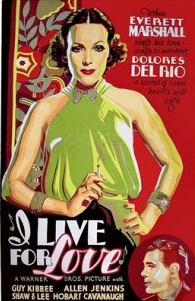
Musical Monday: In Caliente (1935)

It’s no secret that the Hollywood Comet loves musicals.
In 2010, I revealed I had seen 400 movie musicals over the course of eight years. Now that number is over 500. To celebrate and share this musical love, here is my weekly feature about musicals.

in calienteThis week’s musical:
In Caliente” –Musical #404

Studio:
Warner Brothers

Director:
Lloyd Bacon, Busbey

Starring:
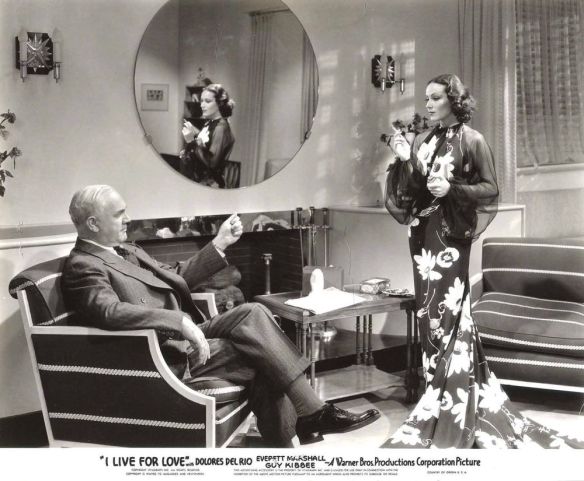
Dolores Del Rio , Pat O’Brien, Edward Everett Horton, Glenda Farrell, Leo Carrillo, Wini Shaw
Themselves: Tony De Marco, Sally De Marco, Judy Canova,

Plot:
Magazine editor Larry MacArthur (O’Brien) is taken by his assistant Harold Brandon (Horton) to Mexico so that MacArthur can get away from his gold digging fiance Clara (Farrell). In Mexico, MacArthur falls in love with the beautiful dancer Rita Gomez (Del Rio), who he once gave a bad review of her dancing in his magazine.

Continue reading

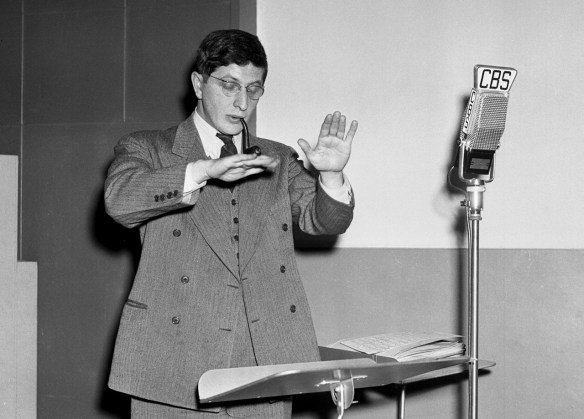
Why Bernard Herrmann left the Academy

Actress Mary Astor presents Bernard Herrmann with the Academy Award for Best Score for "All That Money Can Buy."

Actress Mary Astor presents Bernard Herrmann with the Academy Award for Best Score for “All That Money Can Buy.”

Bernard Herrmann is a name most avid film lovers know.

Even someone with little film knowledge is aware of his Psycho (1960) score.

You might hear film historian Robert Osborne mention his scores in an introduction to a film on Turner Classic Movies, or read an article where a musician discusses Herrmann’s influence on their album. But for someone highly revered today, Herrmann didn’t feel well respected by his contemporaries during a radio and film music career that spanned from 1934 to 1975.

Bernard Herrmann came to Hollywood in 1940 with a bang. In a time when the flowery and lilting film scores of composers like Max Steiner and Erich Wolfgang Korngold were king, Herrmann provided something different.

His first two films—Orson Welles’s Citizen Kane (1941) and William Dieterle’s All That Money Can Buy/The Devil and Daniel Webster (1941)—yielded Academy Award nominations for Best Score. Herrmann won his first and only Oscar for All That Money Can Buy.

Some of Herrmann’s film scores included Jane Eyre (1943), The Ghost and Mrs. Muir (1947), his personal favorite; and The Day the Earth Stood Still (1951) but they also were overlooked by the Academy.

His third Academy Award nomination was for the 1946 film Anna and the King of Siam. For this film, Herrmann did extensive research on Siamese scales and melodic phrases to capture the geographic tone of the film, according to “A Heart at Fire’s Center: The Life and Music of Bernard Herrmann” by Steven Smith.

Bernard Herrmann with director William Dieterle looking over the Academy Award winning "All That Money Can Buy" score.

Bernard Herrmann with director William Dieterle looking over the Academy Award winning “All That Money Can Buy” score.

But the Academy Award for Best Score that year went to Hugo Friedhofer score for the post-World War II drama Best Years of Our Lives. It was 29 years before Herrmann was nominated again for an Academy Award, and then it would be posthumously.

Some of Herrmann’s most famous scores include those he created when he teamed with director Alfred Hitchcock for Vertigo, Psycho and North by Northwest. This proved to be Herrmann’s greatest artistic collaboration. However, none of those were every recognized by the Academy of Motion Picture Arts and Sciences. Hitchcock himself was nominated five times, but never received an Academy Award for Best Director. The only Academy Award Hitchcock received was the Irving G. Thalberg Memorial Award in 1968.

While he worked as a film music composer, Herrmann perceived himself as a failure, because he never felt he reached his full potential by being a world-class symphony conductor. Film music was low-brow to Herrmann. However, he did see the value in film music.

“Movies need the cement of music: I’ve never seen a movie better without it,” he said. “Music is as important as photography.”

As his career advanced into the 1960s, Herrmann started to distance himself from Hollywood. Herrmann and Hitchcock had a disagreement and parted ways, never to work together again. More films were calling for pop standard-like film scores to sell records, and Herrmann wasn’t willing to lower his artistic standards to make a buck.

“If I were starting my career now, I’d have no career in films,” Herrmann said. “I don’t like the new look in film scores. They have nothing to do with the movie.”

Composer Bernard Herrmann with director Alfred Hitchcock, one of his top artistic collaborators who he later had a falling out with.

Composer Bernard Herrmann with director Alfred Hitchcock, one of his top artistic collaborators who he later had a falling out with.

All of these changes moved Herrmann to resign from the Academy of Motion Picture Arts and Sciences in 1967, because he “did not approve of music being listed as a technical credit,” according to Smith’s book.

“There’s no point to belonging to an organization in which one is judged by one’s inferiors—not one’s peers,” Herrmann was quoted in the Los Angeles Times. “It was Tolstoy who said ‘Eagles fly alone and sparrows fly in flocks.’ But I’m afraid we eagles of the world are being pushed into sanctuaries.”

Herrmann experienced a career resurgence in the 1970s, when new directors like Brain De Palma and Martin Scorsese sought him out. He passed away on Christmas Eve in 1975 after completing recording for Taxi Driver.

In 1977, Bernard Herrmann was posthumously nominated for Academy Award for Best Score for the films Taxi Driver and Obsession. Jerry Goldsmith won the award for The Omen.

“I remember Charles Ives (composer and Bernard Herrmann’s friend) saying ‘Prizes are for boys, and I’m a grown-up,” said Bernard Herrmann’s daughter, Dorothy in Smith’s book. “I believe Daddy had that same attitude.”

Dorothy said many years later when her father came across his Academy Award, he looked surprised “as if he had forgotten he had even won it.”

Listing of Herrmann’s Academy Award nominations: 

Year Award Film
1942 Nominated for Best Music, Scoring of a Dramatic Picture Citizen Kane (1941)
1942 Won for Best Music, Scoring of a Dramatic Picture All That Money Can Buy (1941)
1947 Nominated for Best Music, Scoring of a Dramatic or Comedy Picture Anna and the King of Siam (1946)
1977 Nominated for Best Music, Original Score Taxi Driver (1976)
1977 Nominated for Best Music, Original Score Obsession (1976)

To learn more about Bernard Herrmann, follow the upcoming documentary Lives of Bernard Herrmann on Twitter and Facebook

Comet Over Hollywood is taking part in the 31 Days of Oscar event

Check out the Comet Over Hollywood Facebook page, follow on Twitter at @HollywoodComet or e-mail at cometoverhollywood@gmail.com

Musical Monday- Academy Award Winner: Seven Brides for Seven Brothers (1954)

It’s no secret that the Hollywood Comet loves musicals.
In 2010, I revealed I had seen 400 movie musicals over the course of eight years. Now that number is over 500. To celebrate and share this musical love, here is my weekly feature about musicals.

seven-brides-for-seven-brothersThis week’s musical:
Seven Brides for Seven Brothers” (1954)– Musical #4

Studio:
Metro-Goldwyn-Mayer

Director:
Stanley Donen

Starring:
Jane Powell, Howard Keel, Russ Tamblyn, Jeff Richards, Tommy Rall, Julie Newmar, Ruta Lee, Ian Wolfe, Marc Platt, Matt Mattox, Jacques d’Amboise, Nancy Kilgas, Betty Carr, Virginia Gibson, Norma Doggett

Plot:
Set in 1850 in the backwoods of Oregon, Adam Pontipee (Keel) heads to the city looking for a wife. He finds Milly (Powell), who agrees to marry him. Little does Milly know that Adam is one of seven brothers and she is more of a glorified housekeeper than a wife. She tries to refine the brothers-encouraging bathing and teaching them how to read and dance. They are all eager to find wives of their own and decide to use the story of Romans kidnapping the Sabine women as an example.

Adam (Keel) and his new bride Milly (Powell) who has no idea what she's in for.

Adam (Keel) and his new bride Milly (Powell) who has no idea what she’s in for.

Milly (Powell) inspects the hands of the usually dirty Pontipee brothers before heading to a barn raising social

Milly (Powell) inspects the hands of the usually dirty Pontipee brothers before heading to a barn raising social

Continue reading