Musical Monday: Small Town Girl (1953)

Image

It’s no secret that the Hollywood Comet loves musicals.
In 2010, I revealed I had seen 400 movie musicals over the course of eight years. Now that number is over 500. To celebrate and share this musical love, here is my weekly feature about musicals.
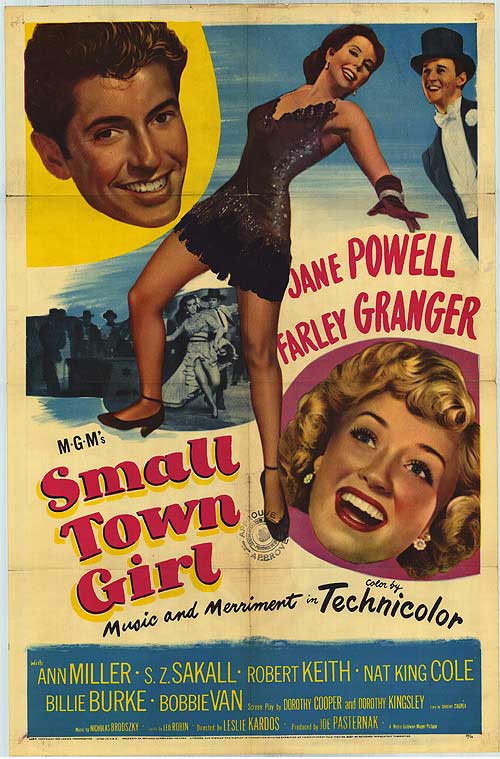
b70-14305This week’s musical:
Small Town Girl” (1953)– Musical #76

Studio:
Metro-Goldwyn-Mayer

Director:
László Kardos

Starring:
Jane Powell, Farley Granger, Ann Miller, Fay Wray, Billie Burke, S.Z. Sakall, Bobby Van, Robert Keith, Robert Hyatt, Chill Wills (uncredited)
Themselves: Nat King Cole

Plot:
Judge Kimbell (Keith) throws big city hotshot Rick Livingston (Granger) in jail for going 80 miles per mile in a small town with his Broadway girlfriend Lisa Bellmount (Miller). The judge’s daughter Cindy (Powell) ends up falling for Rick.

Trivia:
-Nicholas Brodszky and Leo Robin were nominated for an Academy Award for Best Music, Original Song for the song “My Flaming Heart.”
-Dances choreographed by Busby Berkeley.
-Ann Miller’s “I’ve Gotta Heart That Beat” performance has 86 instruments up through the floor and the musicians are hidden beneath the floor, according to The Rough Guide to Film Musicals by David Parkinson
-Musical director is André Previn.
-Costumes by Helen Rose.

Highlights:
-Nat King Cole’s appearance and performance
-Ann Miller’s “I’ve Gotta Hear that Beat” number
-Bobby Van’s exhausting 3-minute jump through town.

Notable Songs:
I’ve Gotta Hear That Beat performed by Ann Miller tap dancing and hands coming out of the floor playing drums and holding saxophones, clarinets and violins.
My Flaming Heart performed by Nat King Cole

My review:
“Small Town Girl” is a fun, colorful musical with an outstanding cast. However, of Jane Powell’s MGM films, this is not her best. The storyline isn’t a bad one and it has some cute, humorous moments, but I prefer other Powell films such as “Luxury Liner” and “Holiday in Mexico.”

Farley Granger plays the arrogant, rich playboy well but is a poor romantic match for Powell.

While Jane Powell is known for her beautiful, operatic voice, she doesn’t have many notable songs or musical numbers. The real stand out musical numbers come from the supporting cast of Ann Miller, Bobby Van and an appearance from singer Nat King Cole as himself.

Ann Miller’s Busby Berkeley choreographed “Gotta Hear That Beat that Beat” is a visually amazing piece. The number is complete with Miller’s high-speed tap dancing feet and instruments being played by bodiless hands.

A second impressive, though exhausting, number is Bobby Van jumping through his small town. While this is quite a feat, it also makes my knees hurt just watching him bound down the street, shaking hands and jumping across hedges.

Also, while Van’s jumping is interesting, his character is fairly annoying.

For Nat King Cole fans, you also have the opportunity to see the velvet voice singer during a nightclub scene, which is a real treat.

The film has a terrific supporting cast with Robert Keith and Fay Wray as Powell’s parents, Billie Burke as Farley Granger’s mother, and S.Z. “Cuddles” Sakall as Van’s father. You also get the comical Chill Wills as the jailer.

Once big stars of the 1930s Burke and Wray seem wasted in this film as they both have less than 10 or 15 minutes of screen time.

For me, Robert Keith and Cuddles Sakall provided the most comedic entertainment and were honestly my favorite part of this film.

While I enjoy “Small Town Girl,” but I wouldn’t suggest it as a “must see,” unless you are a huge fan of any of the stars in this movie.

Publicity photo of Farley Granger, Jane Powell and Bobby Van for "Small Town Girl."

Publicity photo of Farley Granger, Jane Powell and Bobby Van for “Small Town Girl.”

Check out the Comet Over Hollywood Facebook page, follow on Twitter at @HollywoodComet or e-mail at cometoverhollywood@gmail.com

Halloweek Musical Monday: Bedknobs and Broomsticks (1971)

It’s no secret that the Hollywood Comet loves musicals.
In 2010, I revealed I had seen 400 movie musicals over the course of eight years. Now that number is over 500. To celebrate and share this musical love, here is my weekly feature about musicals.

bedknobs_and_broomsticks_xlgThis week’s musical:
Bedknobs And Broomsticks” (1971)– Musical #534

Studio:
Walt Disney Studios

Director:
Robert Stevenson

Starring:
Angela Lansbury, David Tomlinson, Roddy McDowall, Sam Jaffe, John Ericson, Reginald Owen,Cindy O’Callaghan, Roy Snart, Ian Weighill

Plot:
Set in England in during World War II in 1940, Miss Price (Lansbury) is learning how to become a witch when she has to take in three children who were sent to the country and away from the bombing in London. Because of the war, the Witch’s College-run by Emelius Brown (Tomlinson) closes so Miss Price and the children travel on a flying bed to London to learn a spell that will help England in the world.

Trivia:
-“Bedknobs and Broomsticks” was an attempt to recapture the popularity and success of “Mary Poppins” (1964), according to The World of Musicals: An Encyclopedia of Stage, Screen, and Song, and Song by Mark A. Robinson
-Julie Andrews was originally asked to play the lead. Andrews turned down the road but then reconsidered, but the role was already offered to Lansbury, according to Julie Andrews: An Intimate Biography by Richard Stirling. According to the American Film Institute, Andrews later had second thoughts about turning down the film, since Disney helped her get her start with “Mary Poppins.”
-Lynn Redgrave, Judy Carne and Leslie Caron were also offered the lead role in the film, according to the American Film Institute.
-Based on the novels “The Magic Bed-Knob or How to Become a Witch in 10 Easy Lessons” and “Bed-Knob and Broomstick” by Mary Norton.
-Debut for child actors Cindy O’Callaghan, Roy Snart and Ian Weighill.
-Songwriting brothers Richard and Robert Sherman wrote the songs for the film. The Sherman brothers said in an interview that the song “The Beautiful Briny” was originally written for “Mary Poppins ” (1964) but wasn’t used.
-Walt Disney bought the film rights to the first Mary Norton story in 1945, according to the American Film Institute.
-Alan Maley, Eustace Lycett and Danny Lee won an Academy Award for Best Effects, Special Visual Effects
-The film was also nominated for an Academy Award for Best Art Direction-Set Decoration, Best Costume Design, Best Music, Original Song, “The Age of Not Believing,” Best Music, Scoring Adaptation and Original Song Score
-Angela Lansbury was nominated for a Golden Globe for Best Motion Picture Actress for a Musical/Comedy

David Tomlinson referees  a cartoon soccer game.

David Tomlinson referees a cartoon soccer game.

Notable Songs:
-“Portobello Road” performed by an ensemble
-“The Age of Not Believing” performed by Angela Lansbury
-“The Beautiful Briny” performed by Angela Lansbury and David Tomlinson

My review:
“Bedknobs and Broomsticks” starts out with great potential.

An excellent cast with Angela Lansbury, David Tomlinson, Roddy McDowall, Sam Jaffe and Reginald Owen. A seemingly adorable premise of child World War II refugees paired with an unlikely host who dislikes children and happens to be an apprentice witch.

But after the first 20 minutes, the movie starts to go downhill.

When the Witch’s College closes down due to the war, Lansbury and the three children search out the school’s professor, played by David Tomlinson, to learn the last spell to help England during the war.

This hunt for the last spell takes the cast into an exhausting 20 or 30 minute bit in cartoon land, playing soccer with lions and dancing with fish.

I was relatively interested in the film until they hopped into cartoon land. The mix of live action and cartoon was an innovative feature at the time, was popular with film critics and won an Academy Award. However, once the film goes into the cartoon portion, it seems to lose direction, not make much sense and drags everything to a halt.

Along with the overly long cartoon portion of the film, half the cast in this film is wasted. I was excited to see Roddy McDowall, Reginald Owen and Sam Jaffe in the credits, but collectively, they are only in the two hour film for 10 minutes.

While this movie was trying to recapture the magic of “Mary Poppins,” it simply falls flat. The children lack the charm of the kids in “Mary Poppins” and the songs aren’t as catchy, though they are also written by the wonderful Sherman brothers.

One notable feature is the dance number for “Portobello Road.” It’s lengthy but impressive. The only irksome feature is that the female hair and costumes are not accurate for war era England.

Angela Lansbury does end up being able to hold off Nazis, ready to attack the small English village, in a rather…creative way that is also a little creepy.

Overall, while the film has a lovely cast and starts off having a cute storyline, it really is overly long and could do without the cartoons. This is a good example as how Disney films were declining in quality after Walt Disney’s death.

bedknobsandbroomsticks1

Check out the Comet Over Hollywood Facebook page, follow on Twitter at @HollywoodComet or e-mail at cometoverhollywood@gmail.com

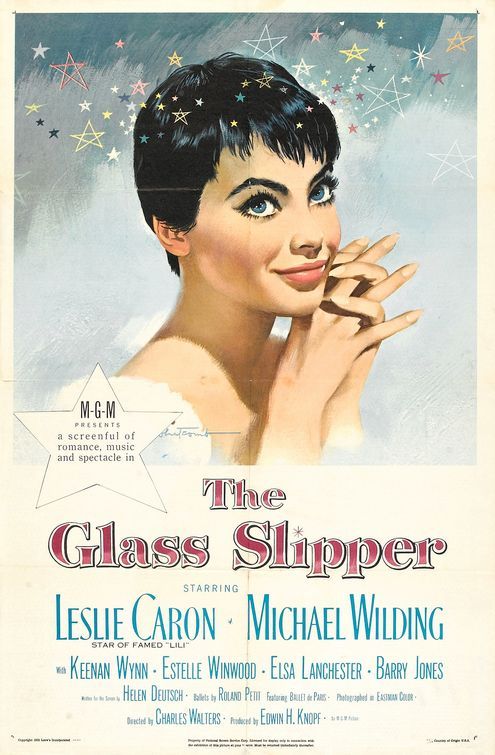
Musical Monday: The Glass Slipper (1955)

Image

It’s no secret that the Hollywood Comet loves musicals.
In 2010, I revealed I had seen 400 movie musicals over the course of eight years. Now that number is over 500. To celebrate and share this musical love, here is my weekly feature about musicals.

the glass slipperThis week’s musical:
“The Glass Slipper” (1955)– Musical #90

Studio:
Metro-Goldwyn-Mayer

Director:
Charles Walters

Starring:
Leslie Caron, Michael Wilding, Keenan Wynn, Elsa Lanchester, Estelle Winwood, Amanda Blake, Lurene Tuttle, Lisa Daniels, Barry Jones
Narrator: Walter Pidgeon

Plot:
Adaptation of the story of Cinderella. Ella (Caron), nicknamed Cinderella for her filthy appearance, is lonely and rebellious. She is the servant to her stepmother (Lanchester) and two stepsisters (Blake, Daniels), who are in a tizzy over the return of Prince Charles (Wilding) and are preparing for his ball. While sitting by her favorite secret spot by the river, Ella meets dizzy Mrs. Toquet, who everyone says is crazy. Ella also meets the prince by the river but doesn’t know he’s royalty. Mrs. Toquet helps Ella get ready for the ball without magic but through creative means.

Trivia:
-Choreography by Roland Petit.
-According to TCM host Robert Osborne, Michael Wilding was cast to keep his wife-MGM contract player Elizabeth Taylor-happy because Michael kept complaining that he wasn’t being given any roles.
-Leslie Caron wrote in her memoir “Thank Heaven,” Michael Wilding was so unhappy in his role as the prince that he begged Caron to throw a tantrum and say that she wanted a new co-star. She didn’t feel like she could make such demands. However, Caron said she and Wilding got along and she was always in awe of Elizabeth Taylor’s beauty, who was married to Wilding at the time.
-Michael Wilding was dubbed by Gilbert Russell.
-Dancers Tommy Rall, Jacques d’Amboise and James Mitchell were considered for the role of Prince Charming.

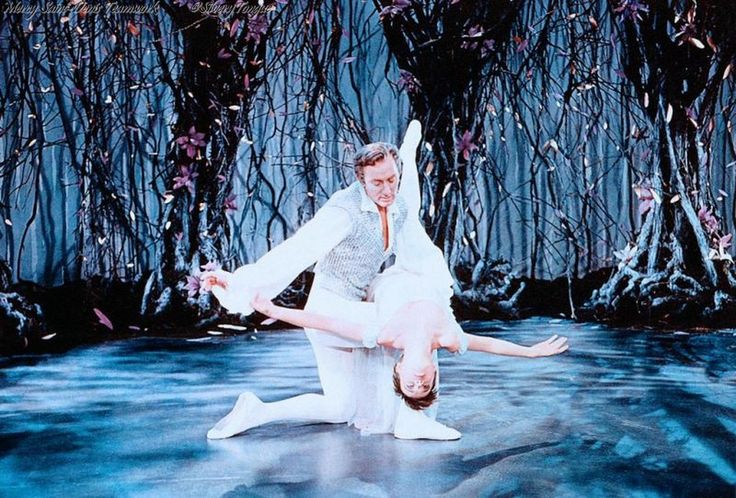
Leslie Caron and Michael Wilding in

Leslie Caron and Michael Wilding in “The Glass Slipper”

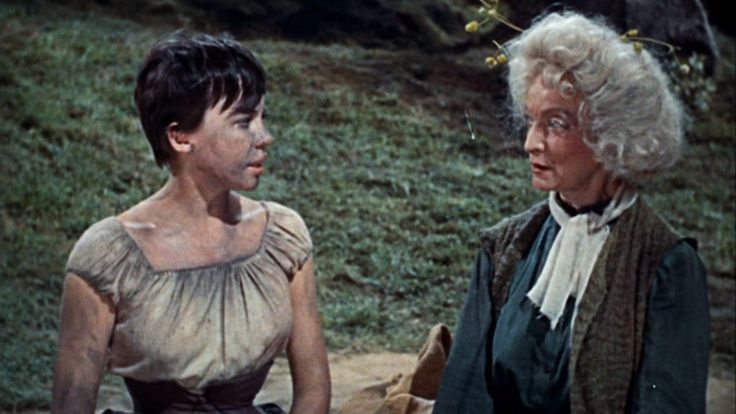
Leslie Caron and Lurene Tuttle in

Leslie Caron and Lurene Tuttle in “The Glass Slipper”

Highlights:
-Walter Pidgeon as the narrator
-Ballet numbers performed by Leslie Caron

Notable Songs:
This film was more about ballet numbers rather than songs.

My review:
“The Glass Slipper” is a glittering, charming and enchanting take on the classic story of Cinderella.
Set against a colorful, storybook land, the film has a remarkable supporting cast that includes Keenan Wynn, Elsa Lanchester and Amanda Blake.

“The Glass Slipper” isn’t your typical song and dance musical. There is only one song that is performed by a dubbed Michael Wilding, but the other numbers are beautiful ballet numbers daydreamed by Cinderella. There are three major ballet numbers in the film, exhibiting Caron’s lovely talent. I enjoyed watching her precise and perfect ballet steps, because I love dance and dancing. However, I can see how this could be dull for someone that isn’t interested in ballet.

Leslie Caron’s version of “Ella,” or Cinderella, is different than the sweet, sad character we are used to from the Rogers and Hammerstein musicals or the 1950 Walt Disney cartoon. Caron’s Ella is a bit of a tomboy and exhibits her loneliness and sadness through rebellion, talking back and scoffing at anyone who is rude to her.

Her fairy godmother is different from the traditional godmother who makes the evening happen with a magic wand. Played by Lurene Tuttle, rather than using magic, she steals…or borrows. She gathers the gown and glass slippers which she will return and makes a bargain with a driver of a carriage who has to take Cinderella home by 12 a.m. because his group is heading home at 1 a.m.

As for Ella’s stepfamily, rather than being evil, they are just lazy social climbers. Elsa Lanchester in her role as the evil stepmother is particularly hilarious.

But the person that makes the whole movie and that steals the show isn’t even shown on screen! I LOVE Walter Pidgeon as the narrator. He has the perfect delivery and warm tone to tell a fairy tale, but he is also hilarious! I laughed out loud many times at his dialogue.

The only downside of the film is Michael Wilding as the prince. He’s not bad but I feel sorry for him because he looks so uncomfortable. He’s in two of the dance numbers, and it’s obvious the choreographer worked to add Wilding into the dances without really doing anything. For example, Wilding stirs a pot in one number or stands while Caron dances around him. He looks so uncomfortable. Had a dancer such as James Mitchell or Tommy Rall been cast, it would have been appropriate, but studio politics cast Wilding instead. Acting wise, Wilding is fine.

“The Glass Slipper” is a lovely, magical film. When I originally saw this movie more than 10 years ago, I wasn’t enthralled. I’m glad I visited it again, because it found me enchanted.

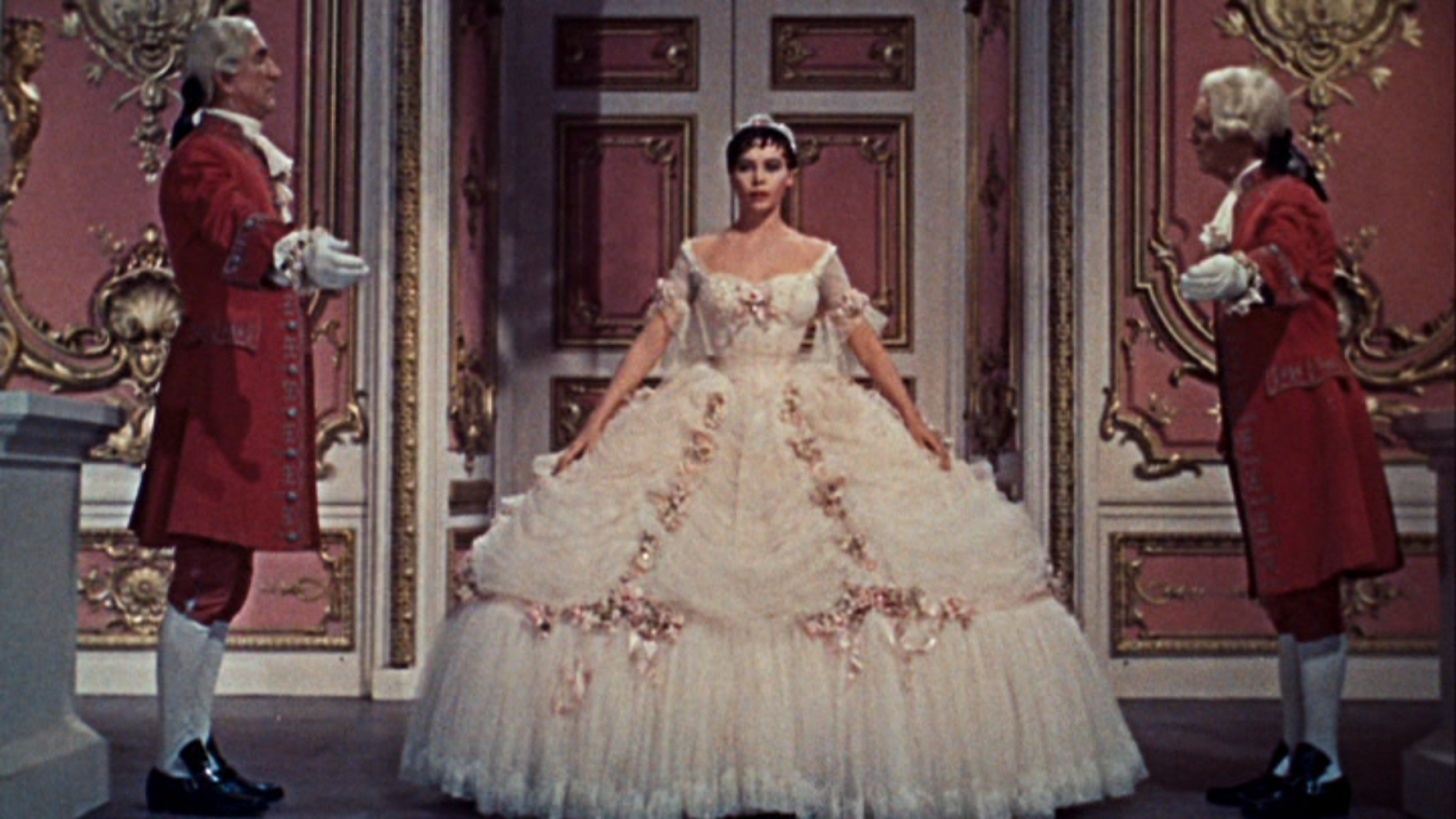
Leslie Caron as Cinderella arriving at the ball in

Leslie Caron as Cinderella arriving at the ball in “The Glass Slipper.”

Check out the Comet Over Hollywood Facebook page, follow on Twitter at @HollywoodComet or e-mail at cometoverhollywood@gmail.com

Musical Monday: Rock Around the Clock (1956)

Image

It’s no secret that the Hollywood Comet loves musicals.
In 2010, I revealed I had seen 400 movie musicals over the course of eight years. Now that number is more than 500. To celebrate and share this musical love, here is my weekly feature about musicals.

Rock-Around-Clock-PosterThis week’s musical:
“Rock Around the Clock” (1956) – Musical #528

Studio:
Columbia Pictures

Director:
Fred F. Sears

Starring:
Johnny Johnston, Alix Talton, Lisa Gaye, John Archer, Henry Slate, Robert Banas (uncredited)
Themselves: Bill Haley and the Comets, The Platters, Ernie Freeman Combo, Tony Martinez and His Band, Alan Freed

Plot:
Fictional film about how rock and roll music is discovered. Band manager Steve Hollis (Johnston) observes how a band with a new sound draws teenage dancers when they felt dance bands were dead. The band the kids are dancing to is Bill Haley and the Comets and Hollis sets out to promote them. However, booking manager Corinne Talbot (Talton), who was jilted by Steve, is set to have the band fail.

Trivia:
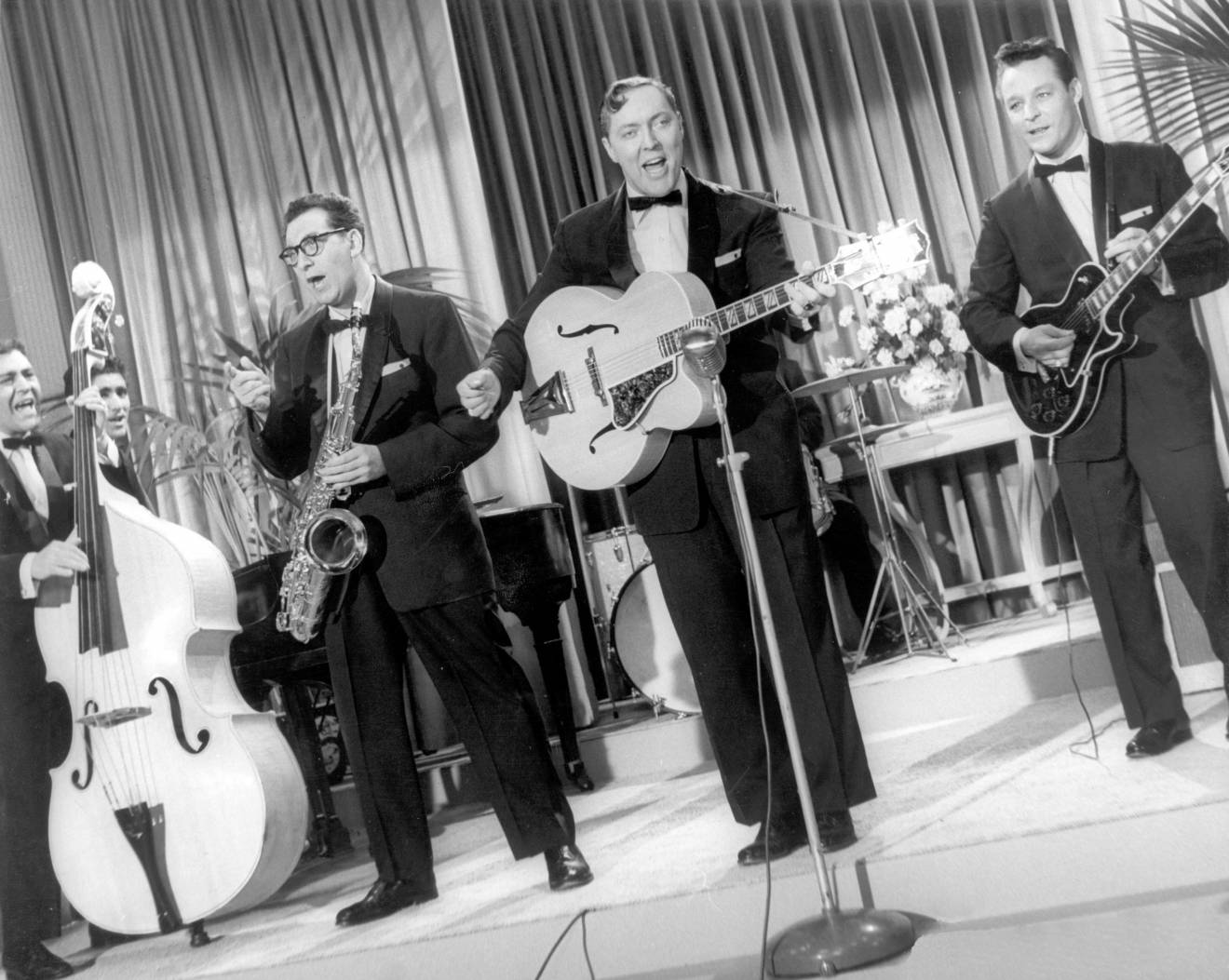
-This is considered the first major rock and roll musical.
-Queen Elizabeth II requested a print of this film to learn more about rock n’ roll after the movie was released. While on vacation in Scotland at Balmoral Castle,she asked for it to be flown in for a special showing. The film was banned in some British cities before Queen Elizabeth saw it, according to a Sept. 22, 1956, Louella Parson’s article by Louella Parsons. Bill Haley later performed for Queen Elizabeth in 1979.
-The New York Times wrote there were teenage riots when the film was released. In Great Britain and America, teens danced in the aisles, clapped to the music, tore up the seats and shouted they wanted “We want Bill,” according to the book Cliff: An Intimate Portrait of a Living Legend by Stafford Hildred, Tim Ewbank. In Oslo, Norway there were teen riots outside the theater and in Belgium, Germany, teens through tomatoes and eggs at the police station, according to Rebels and Chicks: A History of the Hollywood Teen Movie by Stephen Tropiano
-Haley starred in a sequel to this film called “Don’t Knock Rock” the same year.

Johnny Johnston, Alan Freed and Lisa Gaye in "Rock Around the Clock"

Johnny Johnston, Alan Freed and Lisa Gaye in “Rock Around the Clock”

Notable Songs:
-Rock Around the Clock performed by Bill Haley and the Comets
-Razzle Dazzle performed by Bill Haley and the Comets
-The Great Pretender performed by The Platters
-Only You performed by The Platters
-See You Later, Alligator performed by Bill Haley and the Comets

My review:
If you are a fan of 1950s rock and roll or music history, “Rock Around the Clock” should be added to your must-see list.

The plot is fairly thin but ties in well with the musical performances. It’s also relevant for that time. While rock and roll seems pretty common place now, there was some push back and it was seen as rebellion from teens to adults. The riots and banning of this film when it was released exhibits this idea.

The plot looks at how mainstream band managers and booking managers were reluctant to take a chance on such a radical departure from the dance bands of the 1940s and early 1950s, which were dying out in popularity by this time.

Though qualified as a b-film, “Rock Around the Clock” is also important as film’s first rock and roll musical and was notable enough for Queen Elizabeth to screen the movie to learn what rock and roll is all about.

The lead actors in this film-Johnny Johston, Alix Talton and Lisa Gaye-aren’t anything to write home about but are adequate enough to carry the plot.

But the real stars of the film are the musical performers: Bill Haley and the Comets, The Platters and the Bellhops.

The only musical performances I was not keen on was Tony Martinez and His Band. After listening to Xavier Cugat for years, Tony Martinez sounded like noise.

“Rock Around the Clock” has great music and terrific jive dance numbers; a must see for music lovers.

Bill Haley and his Comets in the film "Rock Around the Clock" (1956)

Bill Haley and his Comets in the film “Rock Around the Clock” (1956)

Check out the Comet Over Hollywood Facebook page, follow on Twitter at @HollywoodComet or e-mail at cometoverhollywood@gmail.com

Musical Monday: Ten Thousand Bedrooms (1957)

Image

It’s no secret that the Hollywood Comet loves musicals.
In 2010, I revealed I had seen 400 movie musicals over the course of eight years. Now that number is over 500. To celebrate and share this musical love, here is my weekly feature about musicals.

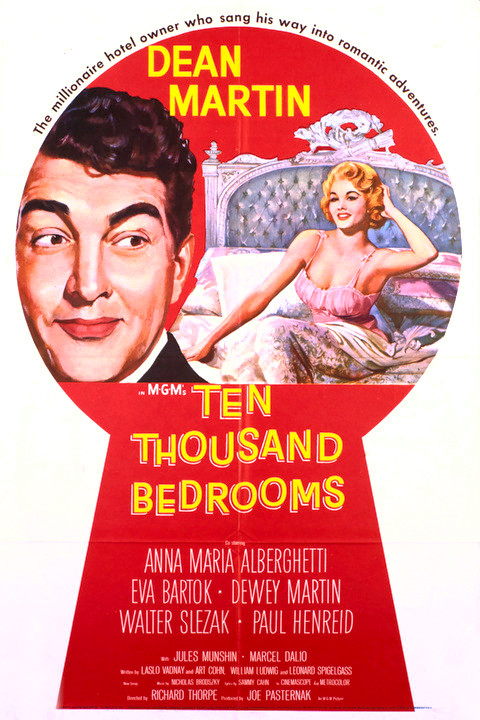
p721_p_v7_aaThis week’s musical:
Ten Thousand Bedrooms (1957) – Musical #520

Studio:
Metro-Goldwyn-Mayer

Director:
Richard Thorpe

Starring:
Dean Martin, Anna Maria Alberghetti, Paul Heinreid, Walter Slezak, Eva Bartok, Dewey Martin, Jules Munshin, Dean Jones

Plot:
Wealthy American Ray Hunter (Martin) owns a successful chain of hotels all over the world. The latest hotel he buys is in Rome where Nina Martelli (Alberghetti) works as a stenographer. Nina the youngest with three older sisters, the oldest-Maria (Bartok) who also is smitten with Ray. When Ray proposes to Nina, her father (Slezak) says there’s no way the youngest can get married be before her older sisters get married first. Ray gets to work on finding husbands for the other girls.

Trivia:
-Filmed on location in Rome, Italy
-The first film made after Dean Martin and Jerry Lewis’s partnership started to dissolve.

Notable Songs:
-Only Trust Your Heart performed by Dean Martin and Anna Marie Alberghetti

My review:
“Ten Thousand Bedrooms” is a cute, colorful musical with a great array of stars.
However, it didn’t fair too well in the box offices, resulting in a $1,196,000 for MGM. This was also a disappointment for Dean Martin. This was his first film after his split with Jerry Lewis. While Lewis’s career continued to with hit after hit, Martin wasn’t having as much luck.

Martin’s songs in the film were all fairly forgettable and seemed “safe” for a singer of his caliber. The worst of his songs is called “Money is a Problem,” a duet with Jules Munshin.

The most disappointing part of “Ten Thousand Bedrooms” for me is that we only here Anna Maria Alberghetti sing one song, and it’s only a few lines of the song.

Alberghetti has a beautiful operatic voice and which is completely wasted by not being utilized in the film.

The added bonus of this film is Paul Henreid. His part is small, but Henreid adds something special to all of his films.

The only other downside is that the film is a tad long at two full hours for as fluffy of a plotline.

For a colorful bit of cute escapism, check out “Ten Thousand Bedrooms,” just don’t expect any show stopping songs from either of the leads.

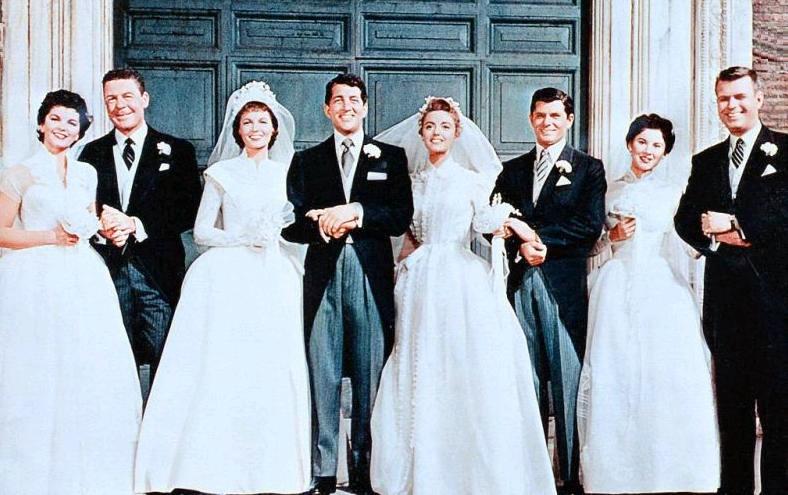
All of the brides in "Ten Thousand Bedrooms"

All of the brides in “Ten Thousand Bedrooms”

Check out the Comet Over Hollywood Facebook page, follow on Twitter at @HollywoodComet or e-mail at cometoverhollywood@gmail.com

Musical Monday: Ding Dong Williams (1946)

It’s no secret that the Hollywood Comet loves musicals.
In 2010, I revealed I had seen 400 movie musicals over the course of eight years. Now that number is over 500. To celebrate and share this musical love, here is my weekly feature about musicals.

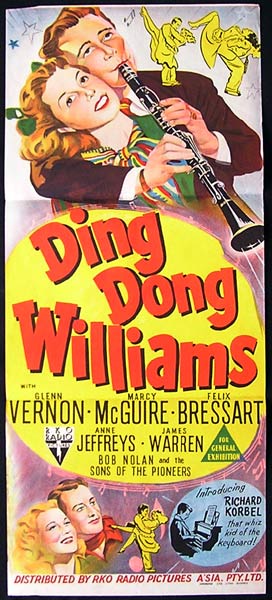
DINGDONGWILLIAMSThis week’s musical:
“Ding Dong Williams” (1946)– Musical #525

Studio:
RKO Radio Pictures

Director:
William Berke

Starring:
Anne Jeffreys, Glen Vernon, Felix Bressart, Marcy McGuire, Tommy Noonan, Cliff Nazarro, James Warren, William B. Davidson, Myrna Dell, Jason Robards, Sr.
As themselves: Bob Nolan, Sons of the Pioneers, Richard Korbel (Introducing 11-year Old Concert Pianist)

Plot:
Hugo Meyerheld (Bressart) is the head of music for a film studio and is told the music he wrote for a film is too antiquated. His adopted daughter Angela (McGuire) has the idea to get jazz clarinet player Ding Dong Williams (Vernon) to write the music. The only problem is that everything he plays is improvised and he doesn’t know how to read or write music.

Trivia:
-Based off short story from Collier’s Magazine, Strictly Ding Dong by Richard English.

-The child piano player Richard Korbel, was supposedly this was the first time in film history that was billed as himself in his first picture, according to a Sept. 27, 1945, article called “Baby Piano Genius Play Self on Screen-a Hollywood First.” This was also Korbel’s only film. Korbel was signed to the picture after receiving high praise after a Carnegie Hall performance.

-Glen Vernon is dubbed by Barney Bigard on the clarinet. Bigard was the clarinet player for Duke Ellington’s band and one of Louis Armstrong’s All-Stars.

Notable Songs:
-Cool Water performed by the Sons of Pioneers
-Candlelight and Wine performed by Anne Jeffreys
-I Saw You First performed by Marcy McGuire

The Sons of the Pioneers performing in "Ding Dong Williams" (1946).

The Sons of the Pioneers performing in “Ding Dong Williams” (1946).

My review:
“Ding Dong Williams” is a simple, pleasant B-musical with the added bonus of only being an hour long.

Set on a Hollywood studio, the film’s plot isn’t much but it’s filled with entertaining songs and jazz music.

The highlight for me was the appearance and performance by the Sons of the Pioneers, known for usually performing with Hollywood cowboy, Roy Rogers.

Though I had never heard of child pianist Richard Korbel prior to this movie, which was his only film, it was interesting to see him perform a few impressive numbers. While his appearance was an interesting novelty, Korbel got quite the media build up for his appearance in this film. He was signed to the film after a successful performance at Carnegie Hall. The magnificent clarinet music in this film was also dubbed by notable clarinet player Barney Bigard of Duke Ellington and Louis Armstrong, which was amazing.

I also always enjoy North Carolina native Anne Jeffreys in her films and the plucky performance of teenage Marcy McGuire.

If you enjoy 1940s jazz music and like films that go by quickly, I suggest the fun, brief and entertaining “Ding Dong Williams.”

Check out the Comet Over Hollywood Facebook page, follow on Twitter at @HollywoodComet or e-mail at cometoverhollywood@gmail.com

Musical Monday: Wabash Avenue (1950)

It’s no secret that the Hollywood Comet loves musicals.
In 2010, I revealed I had seen 400 movie musicals over the course of eight years. Now that number is over 500. To celebrate and share this musical love, here is my weekly feature about musicals.

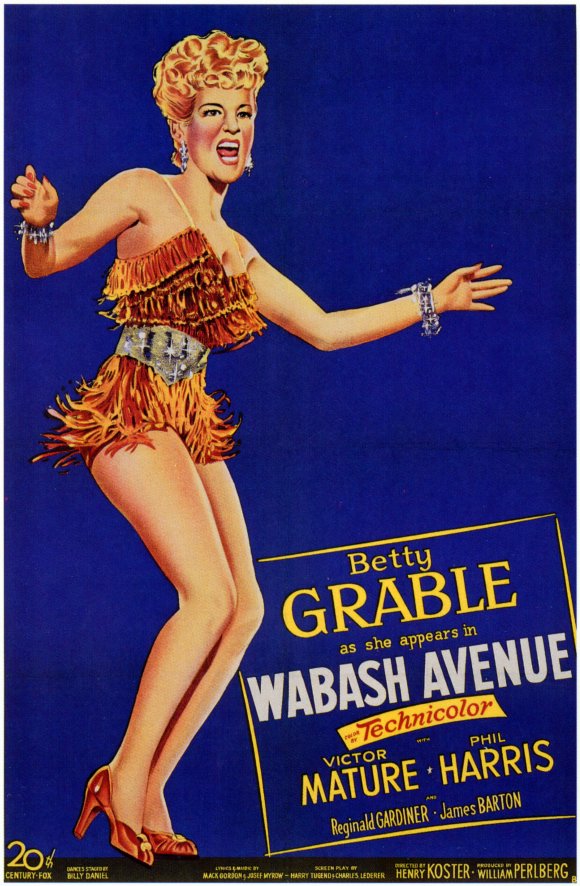
wabash-avenue-movie-poster-1950-1020197109This week’s musical:
Wabash Avenue” (1950)– Musical #522

Studio:
20th Century Fox

Director:
Henry Koster

Starring:
Betty Grable, Victor Mature, Reginald Gardner, Phil Harris, James Barton, Barry Kelley, Margaret Hamilton

Plot:
In 1892, Ruby Summers (Grable) is the queen of burlesque with her rousing songs, outlandish costumes and shaking of hips. The owner of her dance hall, Mike Stanley (Harris) has cheated Andy Clark (Mature) out of his half ofthe business, and Andy is set to get even. Andy works to ruin Mike’s business and make Ruby into a lady while also making her fall for him.

Trivia:
-Remake of Betty Grable film, “Coney island” (1943), which co-starred George Montgomery and Cesar Romero.
-Josef Myrow and Mack Gordon were nominated for Best Music, Original Song for the song “Wilhelmina”

Notable Songs:
-“I Wish I Could Shimmy Like My Sister Kate” performed by Betty Grable
-“May I Tempt You With a Big Red Rosey Apple” performed by Betty Grable
-“Honey Man” performed by Betty Grable
-“Baby Won’t You Say You Love Me” performed by Betty Grable
-“Wilhelmina” performed by Betty Grable

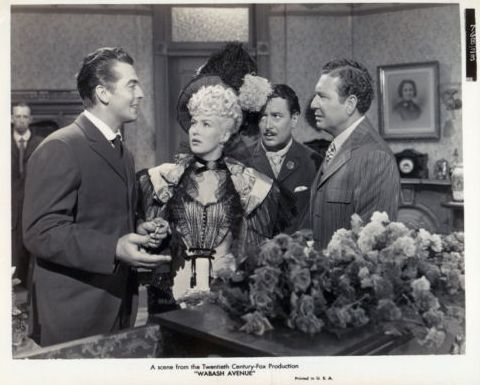
Victor Mature, Betty Grable, Reginald Denny and Phil Harris in

Victor Mature, Betty Grable, Reginald Denny and Phil Harris in “Wabash Avenue.”

My review:
It was rumored that all screenwriters did was take 1943’s “Coney Island,” which also starred Betty Grable, and put a new title page on it to create “Wabash Avenue.”

While I don’t actually think this is the case, “Wabash Avenue” is very similar and nearly is a scene-by-scene remake. I’m not sure why 20th Century Fox decided to remake the same film with the same lead actress, but it’s almost a little off putting.

However, in any film with Betty Grable, it’s difficult not to be drawn to her energetic delivery of a song and dance and “Wabash Avenue” is no exception. In this film, Grable’s Technicolor costumes and songs are fantastic and entertaining.

I of course still enjoyed this film, because I also liked “Coney Island,” but of the two, I prefer “Coney Island” due to the superior male co-stars of Cesar Romero and George Montgomery.

It’s hard to believe that Betty Grable would have anything romantic with Phil Harris-also if you have knowledge of Grable’s friendship with his wife Alice Faye. Though Victor Mature is believable for a grifting cad.

However, “Wabash Avenue” still offers Technicolor fun, regardless of its puzzling similarities to “Coney Island.”

Check out the Comet Over Hollywood Facebook page, follow on Twitter at @HollywoodComet or e-mail at cometoverhollywood@gmail.com

Musical Monday: The Jazz Singer (1952)

It’s no secret that the Hollywood Comet loves musicals.
In 2010, I revealed I had seen 400 movie musicals over the course of eight years. Now that number is over 500. To celebrate and share this musical love, here is my weekly feature about musicals.

Poster_of_the_movie_The_Jazz_SingerThis week’s musical:
Jazz Singer (1952) – Musical #431

Studio:
Warner Brothers

Director:
Michael Curtiz

Starring:
Danny Thomas, Peggy Lee, Eduard Franz, Mildred Dunnock, Allyn Joslyn, Tom Tully

Plot:
Korean War veteran Jerry Golding (Thomas) returns home from the war. His father (Franz) has dreams of Jerry becoming a Jewish Cantor, but Jerry wants to become a famous jazz singer.

Trivia:
-Remake of the 1927 Al Jolson film The Jazz Singer, but with new songs.
-Doris Day was originally offered Peggy Lee’s role, but Day turned down the role. Just coming from “I’ll See You in My Dreams” with Danny Thomas, she felt it was too soon for them to be recast, according to TCM host Robert Osborne.
-Danny Thomas did not make another film after this movie, according to Osborne.
-Ray Heindorf and Max Steiner were nominated for an Academy Award for Best Music, Scoring of a Musical Picture

Notable Songs:
-What Are New Yorkers Made Of performed by Peggy Lee and Danny Thomas
-This Is a Very Special Day performed by Peggy Lee and Danny Thomas

Danny Thomas and Peggy Lee in

Danny Thomas and Peggy Lee in “The Jazz Singer” remake.

My review:
This lengthy, full sound and Technicolor remake of the 1927 “Jazz Singer” is visually lovely but is a tad dull story wise. In my opinion, the original film is dull but is important because of its influence on sound in music. But this 1952 remake doesn’t really pack any sort of punch and is overly long.

The songs by Sammy Fain, Cole Porter, Richard Rodgers and Lorenz Hart are toe-tapping-worthy, but all seemed like pretty safe songs for well-known, talented singers like Peggy Lee and Danny Thomas.

While Doris Day didn’t take the role, Peggy Lee seems to have been groomed to sound like her. While Lee talked and sang, I could picture Day in the role.

I also love Danny Thomas and adore the film “I’ll See You in my Dreams,” but he never seemed as comfortable in his films as he did in television, where he ultimately his largest success.

While this movie it’s a terrible movie, it’s not one that I would want to watch over and over again mainly due to how long Warner Brothers dragged out the story. I feel many of the early-1950s Warner Brothers color musicals-particularly the biopics- like this one tried too hard and ended up falling flat.

Check out the Comet Over Hollywood Facebook page, follow on Twitter at @HollywoodComet or e-mail at cometoverhollywood@gmail.com

Musical Monday: Way Down South (1939)

It’s no secret that the Hollywood Comet loves musicals.
In 2010, I revealed I had seen 400 movie musicals over the course of eight years. Now that number is over 500. To celebrate and share this musical love, here is my weekly feature about musicals.

way-down-south-posterThis week’s musical:
Way Down South” (1939)– Musical #518

Studio:
RKO Pictures

Director:
Leslie Goodwins and Bernard Vorhaus

Starring:
Ralph Morgan, Bobby Breen, Clarence Muse, Alan Mowbray, Sally Blane, Edwin Maxwell, Steffi Duna, Matthew ‘Stymie’ Beard, Willie Best

Plot:
When plantation owner Timothy Reid, Sr. (Morgan) dies, his son Timothy, Jr. (Breen) inherits the plantations and all of the slaves. However, lawyer Martin Dill (Maxwell) is the executor of the will and begins selling the property and keeping the money for himself. When Timothy learns Dill plans on selling all of the slaves, who were never sold or beaten during the life of Reid, Timothy enlists help from friendly inn owners to prove Dill is corrupt.

Trivia:
-The film was written by Clarence Muse-who was in the film-and poet, writer and activist Langston Hughes. Several of the songs were also written by Muse and Hughes.
-This film is credited as the first mainstream film written by an African American, according to the book “EVERY STEP A STRUGGLE: Interviews with Seven Who Shaped the African-American Image in Movies” by Frank Manchel.
-Clarence Muse wrote a book called “Way Down South” and producer Sol Lesser wanted to use the title so he bought the book from Muse. The original 1932 book portrayed slaves in a dignified manner.
“He didn’t use any of the stuff on the inside. Then he paid me to do the ensemble, and I wrote the screenplay with Langston Hughes. It came out and we had a ball,” Muse said in an interview published in Manchel’s book.
-Victor Young was nominated for an Academy Award for Best Music, Scoring

Bobby Breen, Alan Mowbray and Sally Blane in

Bobby Breen, Alan Mowbray and Sally Blane in “Way Down South.”

Notable Songs:
-Good Ground written by Muse and Hughes, performed by the Hall Johnson Choir
-Louisiana written by Muse and Hughes, performed by Bobby Breen and Alan Mowbray
-Didn’t My Lord Deliver Daniel? performed by Muse and the Hall Johnson Choir
-Sometimes I Feel Like a Motherless Child performed by Breen and the Hall Johnson Choir

My review:
If you have ever seen little known B-film “Way Down South,” you can say you have seen a film written by celebrated writer and activist Langston Hughes.

Clarence Muse dresses as Bobby Breen's aunt as he tries to help him escape. This is a publicity photo with Muse and Edwin Maxwell.

Clarence Muse dresses as Bobby Breen’s aunt as he tries to help him escape.

Made in the grand year of 1939, this hour long B-musical is nothing to write home about and is most interesting because of it’s screenwriters Hughes and Muse. One of the screenwriters, Clarence Muse, also was one of the leads in the film.

Langston Hughes was criticized for his involvement in this film, however.

Hughes did not defend any racial representations but noted that he tried to highlight morals. He got involved with the film so that he could pay for his mother’s cancer treatments and her funeral, as well as other debts. It also allowed him to buy his first new clothes in three years, according to Which Sin to Bear?: Authenticity and Compromise in Langston Hughes by David Chinitz.

This movie was my first introduction to singing child star Bobby Breen, who acted in films from 1936 to 1942. I wasn’t a huge fan of Breen’s acting or singing, but it was interesting to be introduced to another child actor of the golden era. Though Breen’s singing didn’t grab me, the performances from the Hal Johnson choir are beautiful.

Along with Muse, Alan Mowbray’s role as a New Orleans inn owner was one of the more interesting characters. We also see Loretta Young’s sister, Sally Blane, in a very brief role as Mowbray’s wife.

It’s always interesting to discover forgotten films from Hollywood’s most celebrated year but this one is simply worth seeing due to its two screenwriters.

Check out the Comet Over Hollywood Facebook page, follow on Twitter at @HollywoodComet or e-mail at cometoverhollywood@gmail.com

Musical Monday: College Holiday (1936)

It’s no secret that the Hollywood Comet loves musicals.
In 2010, I revealed I had seen 400 movie musicals over the course of eight years. Now that number is more than 500. To celebrate and share this musical love, here is my weekly feature about musicals.

college holidayThis week’s musical:
“College Holiday” (1936)– Musical #527

Studio:
Paramount Pictures

Director:
Frank Tuttle

Starring:
Jack Benny, Gracie Allen, George Burns, Marsha Hunt, Martha Raye, Mary Boland, Leif Erickson, Ben Blue, Johnny Downs, Eleanore Whitney, Olympe Bradna, Mischa Auer (uncredited), Ellen Drew (uncredited), Eddie Foy, Jr. (uncredited), Dorothy Lamour (uncredited), Marjorie Reynolds (uncredited)

Plot:
Dick Winters (Erickson) meets Sylvia Smith (Hunt) at an east coast college dance and falls in love. But before he can learn her name she has to quickly leave to head home and help her father who is having financial problems with their California hotel. Nutty heiress Carola P. Gaye (Boland) owns the mortgage to the hotel and has an interest in eugenics; believing that ancient Greeks were the “super race.” In order for the Smiths to keep the hotel, J. Davis Bowster (Benny) gathers entertainers to perform at the hotel, making Gaye believe that they are there for experiments. The downside is that the male and female students can’t fraternize, because it will anger Gaye and ruin her experiments. This hinders Dick’s goal to better get to know Sylvia.

George Burns, Jack Benny, Gracie Allen, Mary Boland

George Burns, Jack Benny, Gracie Allen, Mary Boland

Trivia:
-Costumes by Edith Head
-Film features Dorothy Lamour as an uncredited dancer.

Notable Songs:
-The Sweetheart Waltz
-(Enchanted) I Adore You performed by Marsha Hunt & Leif Erickson
-A Rhyme for Love performed by Johnny Downs and Eleanore Whitney
-So What? performed by Martha Raye

My review:
While many college themed films are a bit silly, I usually go out of my way to see them.

“College Holiday” fits of the bill of being goofy but it’s bizarre plot sets it apart from other collegiate films. In fact, this may be the only comedic pre-World War II film that I have ever seen that deals with eugenics and superior races. Mary Boland walks around dressed in ancient Greek garb and discussing the “super race” and tries experiments, such as setting the mood to get mismatched college students to fall in love. Many classic collegiate films deal with football games, dances, and fraternities serenading sororities.

As Turner Classic Movies host Robert Osborne noted, this type of storyline wouldn’t be used just a few years after this films release due to Adolf Hitler’s views on the superior race.

Gracie Allen and George Burns all provide humorous, though sometimes tiresome, scenes. But he real treat to me was the casting of the lovely Marsha Hunt, who I always love to see in films.

Audiences also have the pleasure of seeing tap dance performances by young actors Johnny Downs and Eleanore Whitney. The downside is that their second number has the two college students in blackface.

Jack Benny also has funny scenes and pulls out his violin a few times. At the end of the movie, Benny breaks the fourth wall, addressing the audience while playing the same role and character that he portrayed on the radio.

While “College Holiday” isn’t an amazing film and has a few irritating parts involving Gracie Allen, it’s still a fairly entertaining film.

Marsha Hunt and Leif Erickson

Marsha Hunt and Leif Erickson

Check out the Comet Over Hollywood Facebook page, follow on Twitter at @HollywoodComet or e-mail at cometoverhollywood@gmail.com