Musical Monday: “Paddy O’Day” (1935) *St. Patrick’s Day Edition*

It’s no secret that the Hollywood Comet loves musicals.
In 2010, I revealed I had seen 400 movie musicals over the course of eight years. Now that number is over 500. To celebrate and share this musical love, here is my weekly feature about musicals.

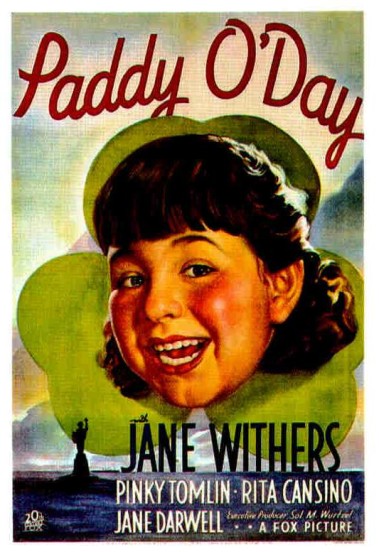
paddy o'dayThis week’s musical:
Paddy O’Day” –Musical #480

Studio:
20th Century Fox

Director:
Lewis Seiler

Starring:
Jane Withers, Jane Darwell, Pinky Tomlin, Rita Hayworth (as Rita Casino), Russell Simpson, Vera Lewis, Louise Carter

Plot:
Paddy O’Day (Withers) is an Irish orphan who travels from Ireland to the United States to live with her mother. When she arrives, she learns that her mother is dead. With the help of some friends Paddy make along the way, she is able to stay in the United States and not return to Ireland.

Trivia:
-This is one of four films Jane Withers made in 1935. The others were “The Farmer Takes a Wife,” “Ginger” and “This is the Life.”
-Rita Hayworth’s sixth film role. Rita is credited as Rita Cansino. She changed her last name to “Hayworth” the next year.
-This is Rita Hayworth’s firs prominent film role.
-Jane Withers and Rita Hayworth became friends while making this movie. Withers gave the eulogy at Hayworth’s funeral in 1987.
-Judy Garland was considered for a performance in this film, according to Judy: A Legendary Film Career by John Fricke

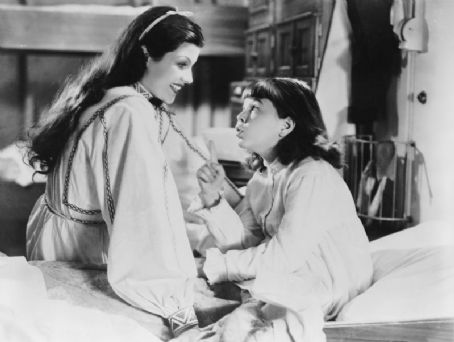
Rita Hayworth and Jane Withers in "Paddy O'Day" (1935)

Rita Hayworth and Jane Withers in “Paddy O’Day” (1935)

Highlights:
-Young Rita Hayworth dancing at the very beginning of the film.

Notable Songs:
-Keep the Twinkle in Your Eye sung by Jane Withers (three times)
-Changing My Ambitions sung by Pinky Tomlin
-I Like a Balalaika sung by Jane Withers

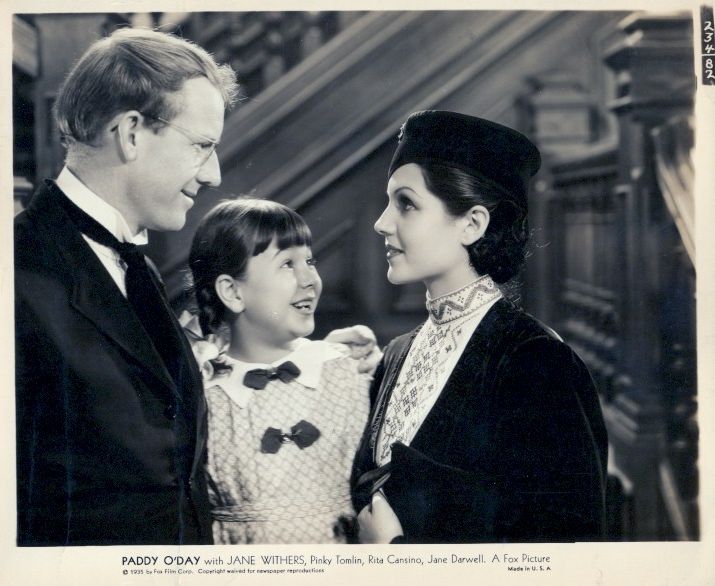
Pinky Tomlin, Jane Withers and Rita Hayworth in "Paddy O'Day" (1935)

Pinky Tomlin, Jane Withers and Rita Hayworth in “Paddy O’Day” (1935)

My Review:
Paddy O’Day” is an adorable film and a good example of the type of films child star Jane Withers starred in at Fox. While Shirley Temple made the big budget, glittering A films at Fox, Withers was in the B movies at Fox.
However, she was very popular because she seemed like a regular kid and was more relatable, said TCM Primetime host Robert Osborne.
The only issue in this film is that Withers has a cringe worthy Irish accent. But she’s so adorable that you can look past it. I also wish Jane Darwell had a larger role.
It’s also fun to see 16-year-old Rita Hayworth dancing in the movie, looking young, fresh and not yet glamorized.
One interesting note: Jane Withers didn’t have a major crying scene. This is unusual for a 1930s child star. Most child stars boasted their crying talents.
Happy Saint Patrick’s Day with this Irish themed, fun film!

Check out the Comet Over Hollywood Facebook page, follow on Twitter at @HollywoodComet or e-mail at cometoverhollywood@gmail.com

Musical Monday: “Muscle Beach Party” (1964)

It’s no secret that the Hollywood Comet loves musicals.
In 2010, I revealed I had seen 400 movie musicals over the course of eight years. Now that number is over 500. To celebrate and share this musical love, here is my weekly feature about musicals.

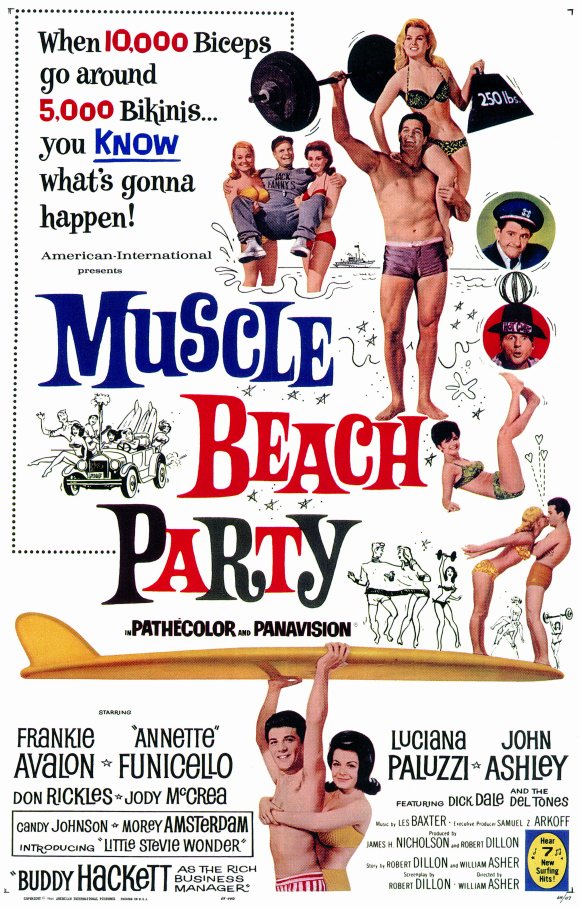
muscle-beach-party-movie-poster-1964-1020144107This week’s musical:
Muscle Beach Party” –Musical #298

Studio:
American International Pictures

Director:
William Asher

Starring:
Annette Funicello, Frankie Avalon, John Ashley, Don Rickles, Jody McCrea (son of Joel McCrea and Frances Dee), Dick Dale, Donna Loren, Candy Johnson, Morey Amsterdam, Stevie Wonder, Buddy Hackett, Peter Lorre, Luciana Paluzzi, Peter Lupus

Plot:
Frankie (Avalon) and Dee Dee (Funicello) head to the beach for Easter vacation with their friends to surf, dance and have fun. Once they get to the beach they meet Jack Fanny (Rickles) and his group of muscle bound body builders. When Contessa Julie (Paluzzi) can’t woo Flex (Lupus), she tries to steal Frankie from Dee Dee.
Cheesy gags, music and dancing are sprinkled throughout the plot line.

Trivia:
-Stevie Wonder was 13 when he appeared in this film and was billed as “Little Stevie Wonder.”
-“Muscle Beach Party” cost $300,000 to make and grossed $12 million, according to The Encyclopedia of Surfing by Matt Warshaw
-The second beach movie directed by William Asher, following “Beach Party” (1964). This film was followed by “Bikini Beach” (1964), “Beach Blanket Bingo” (1965) and “How to Stuff a Wild Bikini ” (1965), all directed by Asher.
-The only beach movie that doesn’t feature Eric Von Zipper and his gang.
-Larry Scott, the body builder who played Rock, was an actual bodybuilder and was the first Mr. Olympia.

Muscle men in "Muscle Beach Party" (Comet Over Hollywood/Screen capped by Jessica P)

Muscle men in “Muscle Beach Party” (Comet Over Hollywood/Screen capped by Jessica P)

-Peter Lorre died two days before “Muscle Beach Party” premiered on March 25.
-In all of the beach movies, Annette Funicello wore more conservative bathing suits. That was out of her respect to Walt Disney who asked her to keep up a clean image, Funicello said in an interview.
-Donna Loren was signed to a multi-picture deal. The heads of American International were impressed with her duet with Dick Dale, Drive-In Dream Girls: A Galaxy of B-Movie Starlets of the Sixties by Tom Lisanti.
-During one scene, Peter Lorre and Frankie Avalon say the other looks familiar. This is a joke referencing their previous film they made together, “Voyage to the Bottom of the Sea” (1961).
-Most of the beach films only took two weeks to make, according to Beyond the Stars 2: Plot Conventions in American Popular Film edited by Paul Loukides, Linda K. Fuller

Frankie and Annette "surfing" in "Muscle Beach Party" (Comet Over Hollywood/Screen capped by Jessica P.)

Frankie and Annette “surfing” in “Muscle Beach Party” (Comet Over Hollywood/Screen capped by Jessica P.)

Highlights:
-Cartoon opening credits
-Surfing footage, especially when we are supposed to believe the stars are surfing.
-Candy Johnson’s 1960s dancing in her tasseled outfits
-Guitarist Dick Dale performing
-Cheesy humor like a cartoon cupid playing a harp beside Luciana Paluzzi as she’s looking at the bodybuilders.

Credits with Candy Johnson dancing and Stevie Wonder dancing:

Notable Songs:
-Muscle Bustle performed by Donna Loren and Dick Dale
-Happy Street performed by Stevie Wonder
-A Boy Needs a Girl sung by Annette Funicello (I noted this because it’s Annette’s only solo. It’s not her best song ever and ends abruptly, but worth noting). Reprised later by Frankie Avalon
-Muscle Beach Party sung by Dick Dale and the Del Tones
-Runnin’ Wild sung by Frankie Avalon

Jody McCrea (Joel McCrea's son), Dick Dale, John Ashley, Frankie Avalon and Annette Funicello in "Muscle Beach Party"

Jody McCrea (Joel McCrea’s son), Dick Dale, John Ashley, Frankie Avalon and Annette Funicello in “Muscle Beach Party”

My Review:
I’m always surprised how Frankie and Annette end up together at the end of each film when she has to win him back from another girl.
So obviously none of the beach films have a serious, ground breaking plot and “Muscle Beach Party” isn’t excluded. All the silly plots also all occasionally blend together.
However, they are a great deal of fun. The outfits are great, the music is awesome and the dancing sequences on the beach are my favorite (especially if it involves Candy Johnson and Donna Loren). It’s a great snapshot of culture in the early 1960s. And Annette is one of my favorites so I can’t hate any of her films.
Compared to several of the films, I would say “Muscle Beach Party,” “Beach Party” and “Beach Blanket Bingo” are my three favorites.
So if you are looking for brainless, RIDICULOUS, hair-brained fun, check out this film…or any other beach movie.

Check out the Comet Over Hollywood Facebook page, follow on Twitter at @HollywoodComet or e-mail at cometoverhollywood@gmail.com

Musical Monday: “Reckless” (1935)

It’s no secret that the Hollywood Comet loves musicals.
In 2010, I revealed I had seen 400 movie musicals over the course of eight years. Now that number is over 500. To celebrate and share this musical love, here is my weekly feature about musicals.

reckless-movie-poster-1935-1020143418This week’s musical:
Reckless” (1935) –Musical #190

Studio:
MGM

Director:
Victor Flemming

Starring:
Jean Harlow, Franchot Tone, William Powell, May Robeson, Rosalind Russell, Nat Pendleton, Mickey Rooney, Ted Healy, Henry Stephenson, Leon Ames, Allan Jones is a featured singer

Plot:
Musical actress Mona Leslie (Harlow) goes on stage thinking she’s performing for a charity event to find the whole house bought out by heir Bob Harrison (Tone).  Mona falls in love with Bob as he is courting her, and her gambling agent Ned Riley (Powell) sits silently in the background, though he is also in love with Mona. After a drunken evening, Bob and Mona marry and they face the disapproval of Bob’s wealthy society family.

Trivia:

Hungover Franchot Tone isn't too sure about his marriage to Jean Harlow in "Reckless."

Hungover Franchot Tone isn’t too sure about his marriage to Jean Harlow in “Reckless.”

-The film was originally supposed to star Joan Crawford under the title “A Woman Called Cheap.” However, producer David O. Selznick replaced Crawford with Harlow before production to capitalize off of Harlow and Powell’s real-life romance, according to the Darrell Rooney and Mark Vieira book “Harlow in Hollywood: The Blonde Bombshell in the Glamour Capital, 1928-1937.” 
-Dancer Betty Halsey doubled for Jean Harlow in the long shots.
-The film’s plot was very similar to a scandal that occurred two years earlier involving singer Libby Holman and her husband tobacco heir Zachary Reynolds. Similarly to the film, Reynolds drunkenly committed suicide. Holman threatened to sue for libel, but never did. Harlow was also uncomfortable, because the scandal in the movie was similar to the death of her husband Paul Bern. However, Powell convinced her to make the film, according to “Harlow in Hollywood.”
-Version of “Sing, Sinner, Sing” (1933) starring Leila Hyams and “Brief Moment” (1933) starring Carole Lombard.
-Jean Harlow’s singing was dubbed by Virginia Verrill. “She (Jean) realized that I couldn’t have credit for my singing, so she went out of her way to give me a hand whenever she could.”
-“Reckless” was the first Jean Harlow film to lose money.

Highlights:
-A very young Leon Ames marrying Rosalind Russell.

leon ames

Young Leon Ames with Rosalind Russell in “Reckless.”
(Screencapped by Comet Over Hollywood/Jessica Pickens)

Notable Songs:
This isn’t your typical musical. There are really only three musical numbers. Including:
-“Reckless” performed by Jean Harlow and dubbed by Virginia Verrill, written by Jerome Kern and Oscar Hammerstein
-“Trocadero” sung by Allan Jones and danced by Jean Harlow.
-“Hear What My Heart is Saying” performed by Jean Harlow and dubbed by Virginia Verrill

Review:
I guess calling this a musical is a stretch. It’s really a melodrama with three or four songs and dances built into the plot, and none of the songs move the plot along.
However, since it is categorized as a musical, the “That’s Entertainment” documentary features it and it’s Jean Harlow birthday, I decided to highlight the film today.
Reckless” may be the first Jean Harlow film to lose money, but I don’t think it’s un-watchable. It’s interesting, it kept my attention, the plot keeps moving, but I will say it isn’t Jean Harlow’s best film.
The film is interesting however, since it is shot around the time William Powell and Jean Harlow started their romance.
You also see Rosalind Russell early in her career, though she is not the comedic Russell we are used to seeing. Early in her career, Russell is cast as the other woman or the forgiving, jilted friend- such as in “Evelyn Prentiss,” “China Seas” and “Man-Proof.” Certainly not the comedic lady we later came to know.
Also keep your eyes peeled for a young, line-less and un-credited Leon Ames as he marries Russell.
If you are looking for a musical with show stopping numbers, this isn’t it. But if you enjoy a good MGM melodrama with a few songs sprinkled in starring the original platinum blond, check it out.

Jean Harlow's character Mona Leslie is a musical star in "Reckless."

Jean Harlow’s character Mona Leslie is a musical star in “Reckless.”

Check out the Comet Over Hollywood Facebook page, follow on Twitter at @HollywoodComet or e-mail at cometoverhollywood@gmail.com

Musical Monday: I’ll See You in My Dreams (1951)

It’s no secret that the Hollywood Comet loves musicals.
In 2010, I revealed I had seen 400 movie musicals over the course of eight years. Now that number is over 500. To celebrate and share this musical love, here is my weekly feature about musicals.

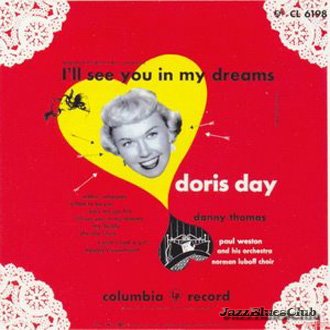
ill see you in my dreamsThis week’s musical:
I’ll See You in My Dreams” (1951)–Musical #180

Studio:
Warner Brothers

Director:
Michael Curtiz

Starring:
Doris Day, Danny Thomas, Frank Lovejoy, Patrice Wymore, James Gleason, Mary Wickes, Jim Backus, Hans Conreid (uncredited)

Plot:
A biographical film about lyricist Gus Khan (Thomas) who wrote several popular songs such as “It Had To Be You,” “Pretty Baby,” “San Francisco,” “The Carioca” and “Tootise” just to name a few. The film Khan as he meets his composing partner Grace (Day) who he eventually marries.
Grace is a song plugger and Gus wanted her help publishing songs. She gave him advice to write a love song:
“Do you know why you write a popular song? Boys and girls don’t know how to say I love you, so you help them with 32 bars of music.”
The film shows the songwriter’s ups and downs in his career from getting started and having his songs in the Ziegfeld Follies to losing everything in the 1929 stock market crash and moving to Hollywood and rebuilding his career. The whole way, his wife is there helping him make the next move in his career. The film starts in 1908 and ends in the 1930s.

Gus (Thomas) missed the birth of his child because he was writing "It Had to Be You." Day wrote this scene made her emotional because of her life experiences.

Gus (Thomas) missed the birth of his child because he was writing “It Had to Be You.” Day wrote this scene made her emotional because of her life experiences.

Trivia:
-When Danny Thomas sings to Doris Day at her maternity bedside in the film, Day got very emotional thinking about how her first husband, Al Jordan was not present when her son Terry was born, she wrote in her autobiography, Doris Day: Her Own Story.
“In the way Danny played the scene, there was a sense of his remorse in having not been with me when the baby came (in the movie. His character was writing a song and lost track of time.),” she wrote. “When Danny started his song, I couldn’t help but cry, for what came to mind was the birth of my own baby, how Al Jorden had not been with me, and how alone and unfulfilled I felt.”

-Grace Kahn, Gus’s wife, was the technical adverser for the film, according to TThe Casablanca Man: The Cinema of Michael Curtiz by James C Robertson.

-Gordon MacRea was director Michael Curtiz’s first choice to play Gus Kahn, according to Robertson’s book.

The real Gus Kahn (left) with composer Arthur Johnson in 1935 at MGM.

The real Gus Kahn (left) with composer Arthur Johnson in 1935 at MGM.

-Grace LeBoy Kahn, who Doris Day portrayed, was still alive when the film was made. Gus Kahn, played by Danny Thomas, died in 1941. The two were married in 1916 until his death. Grace died in 1983.

-“I’ll See You in My Dreams” was Warner Brother’s second top grossing film for 1952 and was Curtiz’s last financial success for the studio, according to Robertson’s book.

-The album soundtrack from this film reached number one on the Billboard charts.


Notable Songs:
-“Gee, I Wish That I Had a Girl” sung by Doris Day
-“My Buddy” sung by Doris Day
-“Pretty Baby” sung by Danny Thomas
-“She’s Nobody’s Sweetheart Now” sung by Doris Day
-“The One I Love (Belongs to Somebody Else) sung by Doris Day
-“It Had to Be You” sung by Danny Thomas
-“Makin’ Whoopee” sung by Doris Day and Danny Thomas
-“Ain’t We Got Fun” played on a record but sung as a duet by Day and Thomas on the album

Review:

The record my Mom and I nearly wore out.

The record my Mom and I nearly wore out.

I knew all the songs before I saw this movie.
When Mom was in middle school, her father (my grandfather) had a 78 record of the “I’ll See You in My Dreams” soundtrack. He was going to throw it away, so she asked to keep when she saw Doris Day on the album cover. When I began getting interested in Doris Day when I was 13, my mom pulled out the record and I listened to it constantly.
When I first saw this movie back in 2005, Mom and I both knew all the words to the songs Kahn made popular because of that 78 but neither of us had ever seen the movie before.
When Mom and I rewatched this movie on Sunday, we both softly sang along to all of his hit tunes.
Clearly this movie has a special place in my heart.
Sentimentality aside, I love the cast and the music. Mary Wickes is always hilarious and Day and Thomas are wonderful.
Though it is questionable about how accurate biographical films are, this one is still a lot of fun with an excellent score to accompany a fairly touching story.

Check out the Comet Over Hollywood Facebook page, follow on Twitter at @HollywoodComet or e-mail at cometoverhollywood@gmail.com

Musical Monday: Week-End in Havana (1941)

It’s no secret that the Hollywood Comet loves musicals.
In 2010, I revealed I had seen 400 movie musicals over the course of eight years. Now that number is over 500. To celebrate and share this musical love, here is my weekly feature about musicals.

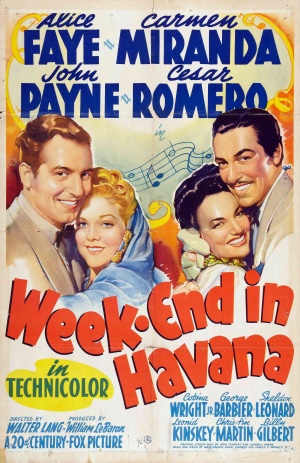
Week-end_in_havanaThis week’s musical:
Week-End in Havana” (1941)–Musical #479

Studio:
20th Century Fox

Director:
Walter Lang

Starring:
Alice Faye, John Payne, Cesar Romero, Carmen Miranda, Cobina Wright, Leonid Kinskey, George Barbier

Plot:
Macy’s shop girl Nan Spencer (Faye) saves up her money to go on her first cruise to Havana. The only problem is, the ship hits a sandbar in Florida and the ship company has to reimburse everyone and offer them another trip. When ship employee Jay Williams (Payne)-who is also engaged to the boss’s daughter- is sent to reimburse the passengers and have them sign waivers, Nan isn’t satisfied with a check. She saved for years for this trip and also knows what the captain was doing when the ship crashed, which could threaten a lawsuit for the company.
Jay’s company sends Nan on an all expenses paid trip to Havana so she will sign the company’s waiver. Jay has to go along-postponing his wedding- to make sure Nan has a good time. Along the way she falls for Monte Blanca (Romero), who is the boyfriend/manager of Rosita Rivas (Miranda). Monte thinks Nan is wealthy and thinks he is using her to pay off his gambling debts.

Trivia:
-This is one of many films made in the 1940s with a “good neighbor” feel to it. Several films visited Latin American countries such as Cuba, Argentina or Brazil to showcase these countries and strengthen United States relations with Latin American government.
-Carmen Miranda’s second film.
-This was the second of three films Miranda and Faye made together. The other two films were “That Night in Rio” (1941) and “The Gang is All Here” (1943).

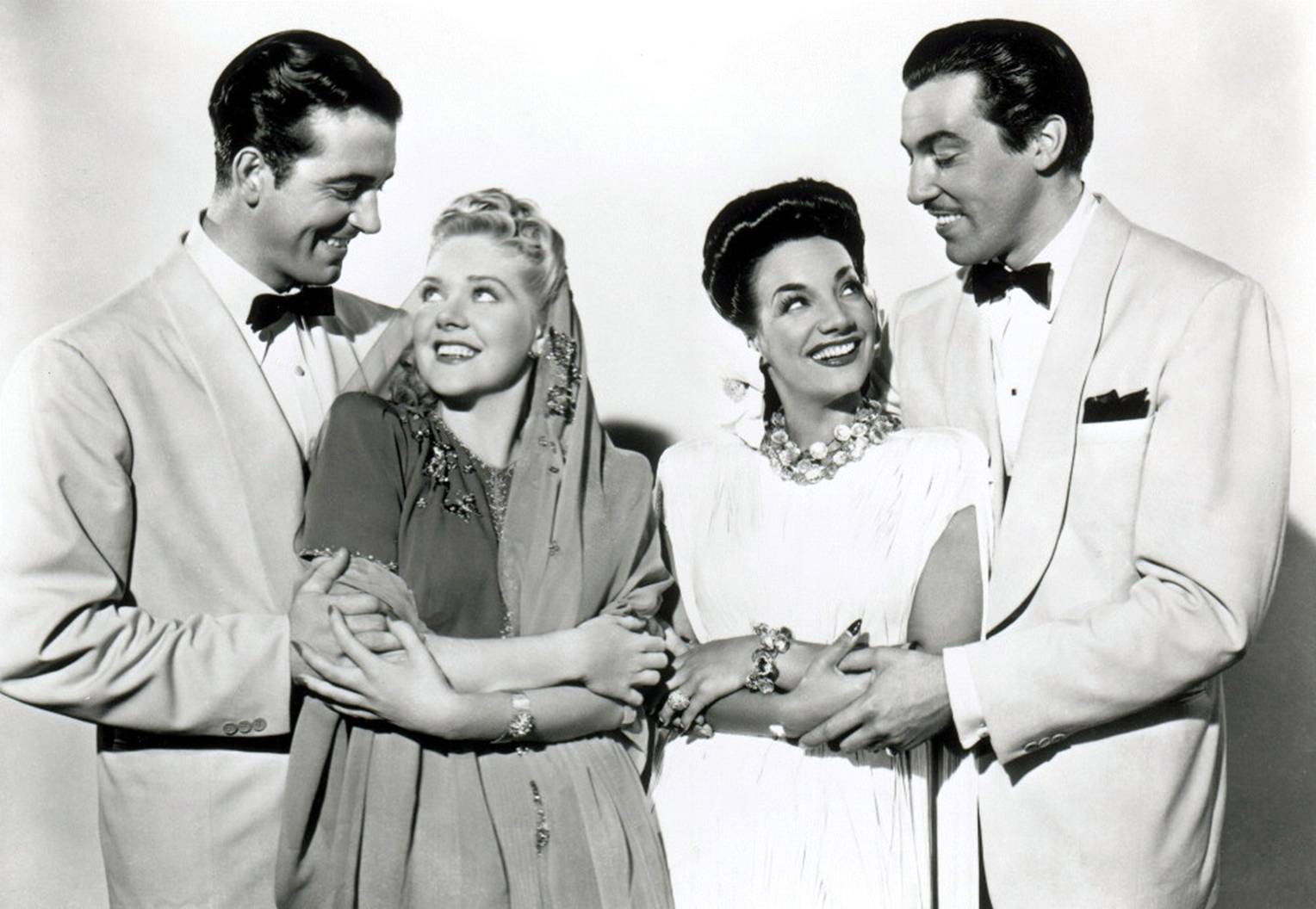
John Payne, Alice Faye, Carmen Miranda and Cesar Romero in "Week-End in Havana."

John Payne, Alice Faye, Carmen Miranda and Cesar Romero in “Week-End in Havana.”

Highlights:
-Every colorful Carmen Miranda performance
-Alice Faye and Cesar Romero dancing to “Romance and Rhumba.” It gives the audience an opportunity to see Romero’s smooth dance moves.

Notable Songs:
-Tropical Magic sung by Alice Faye and John Payne
-Rebola a Bola sung by Carmen Miranda
-The Ñango sung by Carmen Miranda complete with a lavish dance number
-Romance and Rhumba sung by Alice Faye and Cesar Romero

Review:
Alice Faye once said her singing voice was deeper than the plots of the films she made.
This may be the case with “Week-End in Havana,” but this film is a lot of fun. The colorful costumes and scenery are gorgeous in Technicolor, Carmen Miranda and Alice Faye are equipped with catchy songs and the two leading men are nice to look at.
The four leads seem to have fairly equal screen time- each delivering witty lines and offering scenes filled with charm.
Week-End in Havana” is a lighthearted 1940s “good neighbor” film, that is full of color and fun.

Check out the Comet Over Hollywood Facebook page, follow on Twitter at @HollywoodComet or e-mail at cometoverhollywood@gmail.com

Musical Monday: One in a Million (1936)

It’s no secret that the Hollywood Comet loves musicals.
In 2010, I revealed I had seen 400 movie musicals over the course of eight years. Now that number is over 500. To celebrate and share this musical love, here is my weekly feature about musicals.

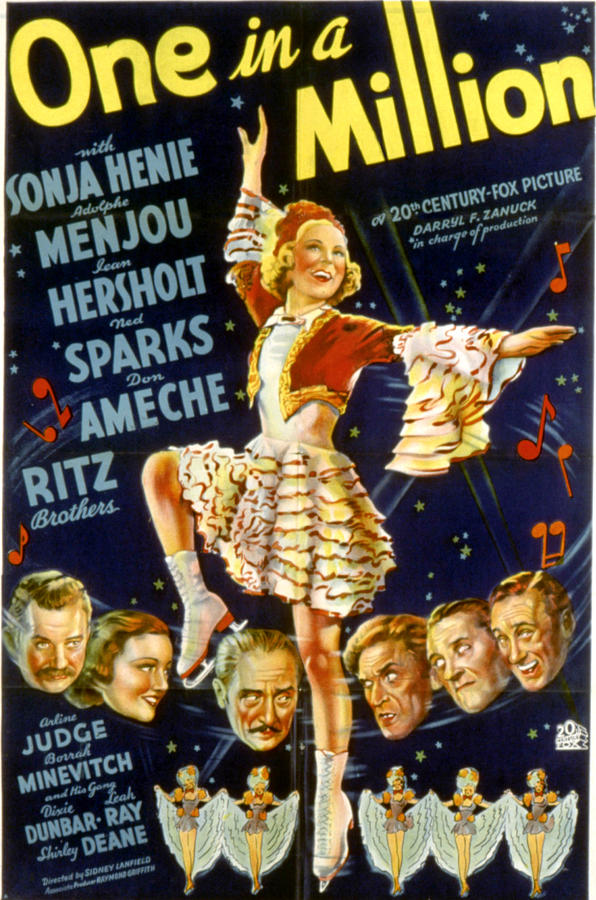
one-in-a-million-sonja-henie-1936-everettThis week’s musical:
One In A Million” (1936)–Musical #478

Studio:
20th Century Fox

Director:
Sidney Lanfield

Starring:
Sonja Henie, Don Ameche, Adolph Menjou, Jean Hersholt, Ned Sparks, June Wilkins, the Ritz Brothers

Plot:
Tad Spencer (Menjou) is broke and takes his female band (including his wife) to the Swiss Alps. They come to an inn run by Henriech Muller (Hersholt) and his daughter Greta (Henie). Greta is a figure skater training for the Winter Olympics. Henriech lost out on a figure skating medal in 1908 and has been training his daughter as a skater. Tad sees dollar signs when he see her skate and wants him in her act. The only problem is Greta is being paid for a nightclub act would hurt her amateur standing in the games. Bob Harris (Ameche) and his photographer Danny Simpson (Sparks), also arrives at the hotel to investigate a fire that may have been an assassination attempt.

Continue reading

Musical Monday: “Cairo” (1942)

It’s no secret that the Hollywood Comet loves musicals.
In 2010, I revealed I had seen 400 movie musicals over the course of eight years. Now that number is over 500. To celebrate and share this musical love, here is my weekly feature about musicals.

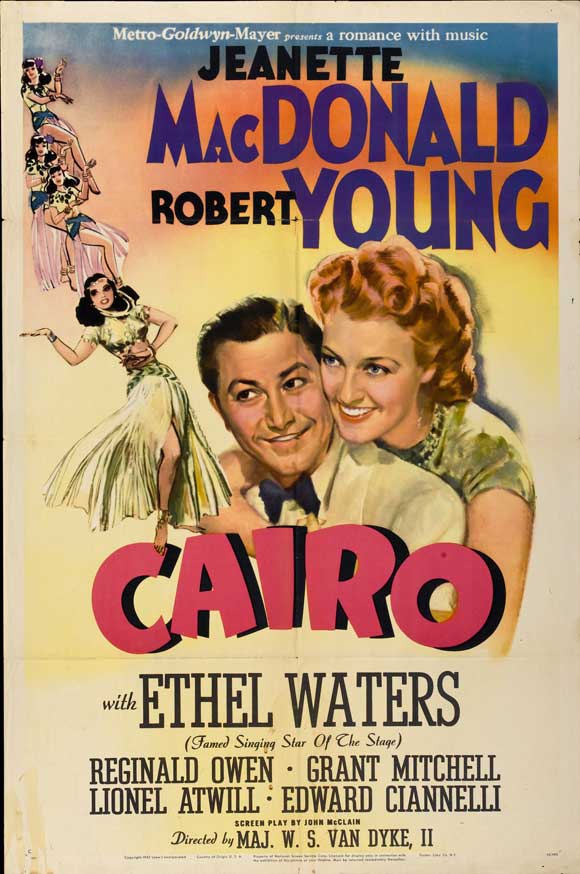
cairoThis week’s musical:
Cairo” (1942)–Musical #477

Studio:
Metro-Goldwyn-Mayer

Director:
W.S. Van Dyke
Starring:
Jeannette MacDonald, Robert Young, Ethel Waters, Reginald Owen, Grant Mitchell, Lionell Atwill, Rhys Williams, MonaBarrie

Plot:
Small town reporter Homer Smith (Young) is picked to travel abroad to cover the war after his newspaper is chosen as “America’s Typical Small Town Newspaper.” On his way to Cairo, his ship sinks and he floats along the ocean with another survivor (Owen) who gives him a message to deliver if they both survive. Hence, Homer gets mixed up in a spy ring. Once the message is delivered, Homer becomes convinced that singer and movie star Marcia Warren (MacDonald) is also a spy and begins working as her butler so he can investigate her. Marcia also believes Homer is a spy. While they investigate each other, the real spy ring is working to explode an Allied convoy.

Trivia:
-Director W.S. Van Dyke is credited as “Maj. W.S. Van Dyke.” Dyke was promoted to Major prior to World War II and set up a Marine Corps recruiting center in his MGM office. He convinced several actor to join up.

-Lena Horne was originally cast as the Ethel Water’s role as MacDonald’s maid. However, Horne refused to play roles that made her domestic servants, according to Leading Ladies: The 50 Most Unforgettable Actresses of the Studio Era

-The movie was originally to be shot in Technicolor but was switched to black and white, according to TThe Espionage Filmography by Paul Mavis.

-Jeannette MacDonald’s film that she was fully the star.

-One of Jeanette MacDonald’s least popular films, according to The Hollywood Musical Goes to War by Allen Woll. (Even more than I Married an Angel?)

-Jeannette MacDonald singing “Les Filles de Cadiz” in the credits and on the movie screen is edited footage from the 1937 film “Maytime.”

Jeanette MacDonald is worried Robert Young has fallen into hands of spies. Also pictured- Ethel Waters and Rhys Williams.

Jeanette MacDonald is worried Robert Young has fallen into hands of spies. Also pictured- Ethel Waters and Rhys Williams.

Highlights:
-Ethel Waters sings operatically in response to Jeanette’s singing.

-Robert Young’s hilarious fake English accent he uses to get a job as MacDonald’s butler.

Funny quotes such as:
-Robert: Have you ever been in San Francisco?
Jeanette MacDonald: Yes. Once with Gable and Tracey and the joint fell apart.

Notable Songs:
-Buds Won’t Bud sung by Ethel Waters and Dooley Wilson
-Waiting for Robert E. Lee sung by Jeanette MacDonald and Ethel Waters (notable for the fact that MacDonald lets loose and isn’t singing in an opera voice)
-Les Filles de Cadix sung by Jeanette MacDonald. (We only hear this song over the credits and see footage of MacDonald singing it in “Maytime,” but I love this song and had to add it).
-“Il Bacio” sung by Jeanette MacDonald in a bathtub and Ethel Waters echoing back in a faux opera voice. Hilarious.
-From the Land of the Sky-Blue Water sung by Jeanette MacDonald
-Beautiful Ohio sung by Jeanette MacDonald

Review:
This is not your typical Jeanette MacDonald musical where she is singing with Nelson Eddy as a princess, opera singer or duchess. In fact, this is a lot more fun. Really, this is more an MGM comedy with a few songs added in for MacDonald and Ethel Waters.

I really enjoyed seeing MacDonald in a comedic role. She was funny, down to Earth, had great comedic delivery and I wish she made movies like this. There are even jokes in the film picking fun of MacDonald’s films such as “San Francisco.” The ever underrated Robert Young is also a delight, as always. Waters is hilarious as well and we get the opportunity to hear her sing.

Plain and simple, I loved this film.  No, there is real no message or heartfelt moment and it is one of Jeanette MacDonald’s least popular films but….I found it enjoyable. There is just something about a W.S. Van Dyke directed film. It had several laugh out loud moments and I plan on buying it on DVD very soon.

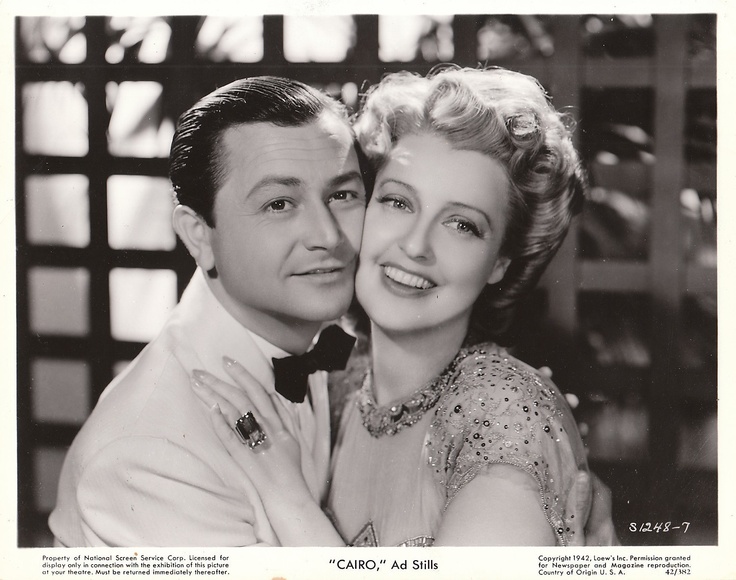
Publicity photo of Robert Young and Jeanette MacDonald for "Cairo."

Publicity photo of Robert Young and Jeanette MacDonald for “Cairo.”

Check out the Comet Over Hollywood Facebook page, follow on Twitter at @HollywoodComet or e-mail at cometoverhollywood@gmail.com

Musical Monday: “Can-Can” (1960)

It’s no secret that the Hollywood Comet loves musicals.
In 2010, I revealed I had seen 400 movie musicals over the course of eight years. Now that number is over 500. To celebrate and share this musical love, here is my weekly feature about musicals.

Can_CanThis week’s musical:
Can-Can” (1960) — Musical #506

Studio:
20th Century Fox

Director:
Walter Lang

Starring:
Frank Sinatra, Shirley MacLaine, Maurice Chevalier, Louis Jourdan, Juliet Prowse

Plot:
Set in 1896 France, Simone Pistache (MacLaine) owns a nightclub that continuously is raided by police for performing the lewd can-can dance.  Simone is in love with her lawyer François Durnais (Sinatra) and helps keep her out of jail. Judge Philipe Forrestier is the one who keeps getting the club raided, but Philipe ends up falling in love with Simone and the two are engaged, jilting Francois.

Trivia:
-During the filming, USSR leader Nikita Khrushchev visited the set and was shocked by the film. He called it “immoral.” He said, “The face of humanity is prettier than it’s backside,” and Shirley MacLaine said he was just mad that the dancers were wearing underwear during the can-can dance. The incident gained the film national publicity, according to Shirley MacLaine.

Shirley MacLaine performs like a Can Can girl for Soviet Premier Nikita Khrushchev at the 20th Century Fox Studios. Left to right: Louis Jourden, Mr. Khrushchev, Shirley MacLaine, Mrs. Khrushchev, Maurice Chevalier, and Frank Sinatra.

Shirley MacLaine performs like a Can Can girl for Soviet Premier Nikita Khrushchev at the 20th Century Fox Studios. Left to right: Louis Jourden, Mr. Khrushchev, Shirley MacLaine, Mrs. Khrushchev, Maurice Chevalier, and Frank Sinatra.

-Juliet Prowse’s first film.
-Frank Sinatra requested Shirley MacLaine for this film, requiring 20th Century Fox to buy out her Columbia Pictures contract for “Who’s That Lady?” that Janet Leigh eventually starred in, according to Sinatra in Hollywood by Tom Santopietro.
-Frank Sinatra didn’t like to work before noon so they worked “French hours” when shooting the film. During the World Series, no one would know where Sinatra was until they would see him on TV in a box watching the game at the stadium, according to Shirley MacLaine.
-The original play opened on Broadway in 1953 and ran for 892 performance. Gwenn Verdon won the 1954 Tony Award for Supporting or Featured Actress in a Musical.
The film was rather different from the stage version which gave it some bad reviews: “The music has been reduced to snatches, the book has been weirdly changed and the dances-well they have been knocked out by some tired jigs, knocked out by Hermes Pan,” said the New York Times in 1960.
-Nominated for an Academy Award for Best Costume Design by Irene Scharaff and Best Music, Scoring of a Musical Picture by Nelson Riddle.

Highlights:
-A man walks up, slaps Shirley MacLaine, rips off her skirt and then they start a strange dance of dragging each other around. This is the Apache Dance. I’m not saying this is a good dance, it’s just random and notable because of its oddness.
-The Garden of Eden Ballet is the best part of the film, aside from the dancers dressed as bunnies and monkeys. It gives us a chance to actually see the dancing talents of Juliet Prowse, Marc Wilder and Shirley MacLaine.

Shirley MacLaine and Marc Wilder dance the "Garden of Eden" ballet

Shirley MacLaine and Marc Wilder dance the “Garden of Eden” ballet

Notable Songs:
The movie is filled with famous Cole Porter songs such as “It Was Just One of Those Things,” “Let’s Do It” and “You Do Something to Me.” However, while Sinatra, Chevalier and Jourdan sing the songs well,  the song placements seem awkward.

My Review:
Why is there so much screaming when the can-can is danced?
But that’s besides the point.
This movie is overly long and the majority of the stars are miscast. Basically, the two leads are a mess, in my opinion. Shirley MacLaine is a fine dancer, her singing is only okay and her acting in this film is mediocre. Frank Sinatra seems silly as a Frenchman, but has good vocals. Louis Jourdan, as handsome as ever, and Maurice Chevalier-reunited together two years after “Gigi” (1958)- are just fine and fit into the plot well. A star-studded cast with Cole Porter songs shouldn’t go wrong, but it did.
I enjoy plenty of films that are full of fluff, but this one seems overly long for the plot we are given. While the score is chock-full of excellent Cole Porter songs, they just….seem oddly placed.
Visually, the movie is gorgeous with Louis Jourdan’s good looks and lovely costumes by Irene Scharff. The Garden of Eden Ballet is also gorgeous and the best part of the film.
When a five minute dance is the best part of a 131 minute film, this is a problem.

Check out the Comet Over Hollywood Facebook page, follow on Twitter at @HollywoodComet or e-mail at cometoverhollywood@gmail.com

Musical Monday: “Follow the Fleet” (1936)

It’s no secret that the Hollywood Comet loves musicals.
In 2010, I revealed I had seen 400 movie musicals over the course of eight years. Now that number is over 500. To celebrate and share this musical love, here is my weekly feature about musicals.

follow the fleet 2This week’s musical:
Follow the Fleet” (1936) — Musical #155

Studio:
RKO

Director:
Mark Sandrich

Starring:
Fred Astaire, Ginger Rogers, Randolph Scott, Harriet Hilliard, Betty Grable, Lucille Ball

Plot:
Bake Baker (Astaire) joined the Navy after his former dance partner Sherry Martin (Rogers) turned him down when he asked her to marry him.
Now he’s back on shore leave and he meets her by chance at a 10 cents a dance joint.
Sherry’s bookish sister Connie (Hilliard) meets Bake’s sea mate Bilge Smith (Scott) and falls in love with him. But Bilge isn’t read to settle down and starts running around with a rich divorcee.

follow the fleet

Ginger Rogers and Fred Astaire dance to “Let Yourself Go”

Trivia:
-This movie was made after the success of “Roberta.” RKO wanted to bring Randolph Scott and Irene Dunne back together again for another film with Fred Astaire and Ginger Rogers as the secondary leads, according to TCM host Robert Osborne. Dunne’s contract expired with RKO and she went on to star in “Showboat” (1936). New comer Harriet Hilliard was selected to fill the Irene Dunne role, Osborne said.
-The beaded dress Ginger Rogers wears in “Let’s Face the Music and Dance” was very heavy. Fred Astaire said the dress was too heavy to be made for dancing. During the first take, a long sleeve hit Astaire in the face. After 20 more takes, Astaire felt like the first take was their best, said Robert Osborne.
-Fred Astaire and Ginger Rogers’ fifth film together.
-The couple in the dance contest with Astaire and Rogers were unknowns picked by choreographer Hermes Pan.
-Lucille Ball and Betty Grable have small roles in the film.
-Actor/singer Tony Martin has an uncredited role in the film.
-Irving Berlin wrote “Get Thee Behind Me, Satan” was originally written for “Top Hat.”
-Adapted from the play “Shore Leave.”

Highlights:
-Ginger Rogers and Fred Astaire in the dance contest. They do impressive dance steps and Rogers is wearing pants so you can actually see the dance moves she’s doing.

Notable Songs:
All the songs are quality because the score is written by Irving Berlin but my favorites are:
-“Let Yourself Go” sung by Ginger Rogers
-“I’m Putting All My Eggs in One Basket” sung by Fred Astaire and Ginger Rogers
-“Let’s Face the Music and Dance” sung by Fred Astaire

Harriet Hilliard and Randolph Scott in "Follow the Fleet"

Harriet Hilliard and Randolph Scott in “Follow the Fleet”

My Review:
While this was following the success of “Roberta,” it isn’t quite as good as “Roberta.” Harriet Hilliard is fine, but I would have loved to see Irene Dunne in the role.
The music in this Astaire and Rogers film is terrific since the score is written by Irving Berlin. It is also a real treat that all but one of Rogers’ dance performances are done in pants so you can see her footwork better than when she is wearing a ballgown.
The plot isn’t bad but some of the lines said in the film could be bothersome to the contemporary viewer. Such as Ginger Rogers saying you have to be dumb to get a man. Or that Harriet salvages a boat for a man she doesn’t even know.
Regardless of my issues with silly parts of the plot, if you are a Fred Astaire and Ginger Rogers fan, this is definitely a movie you should see. 

Check out the Comet Over Hollywood Facebook page, follow on Twitter at @HollywoodComet or e-mail at cometoverhollywood@gmail.com

Musical Monday: “Monte Carlo” (1930)

It’s no secret that the Hollywood Comet loves musicals.
In 2010, I revealed I had seen 400 movie musicals over the course of eight years. Now that number is over 500. To celebrate and share this musical love, here is my weekly feature about musicals.

monte carloThis week’s musical:
Monte Carlo” (1930) –Musical #276

Studio:
Paramount Pictures

Director:
Ernst Lubitsch

Starring:
Jeanette MacDonald, Jack Buchanan, Zasu Pitts

Plot:
Countess Helene (MacDonald) flees minutes before her wedding and heads to Monte Carlo. The penniless countess hopes to win money at the Roulette wheel or find a wealthy man. Count Rudolph (Buchanan) takes a liking to Helene and gets closer to her by posing as the hairdresser that she hires. She falls in love with him but doesn’t want to marry what she thinks is a penniless man.

Trivia:
-Ernst Lubitsch had a crush on Jeanette MacDonald and expressed this to her. She thought he was joking and he was angry by her response, straining their relationship, according to Turner Classic Movies Host Ben Mankiewicz.
-Director Ernst Lubitsch’s second sound film.
-Actor Jack Buchanan’s American film debut. His next American film was “The Band Wagon” in 1953.

Jack Buchanan poses as a hairdresser to get closer to Jeannette MacDonald.

Jack Buchanan poses as a hairdresser to get closer to Jeannette MacDonald.

Notable Songs:
-Many of the songs don’t stick with you during the film. However “Beyond the Blue Horizon” sung by Jeanette MacDonald is the best song in the film.

My Review:
Lubitsch musicals are different from other musicals. Rather than having a show stopping tune, the songs usually add to the plot and sometimes is like sing-song talking.
Though I love Ernst Lubitsch and actress Jeanette MacDonald, I did not love this film. Jack Buchanan is wonderful in “The Band Wagon” (1953) but lackluster in this film. In most of the MacDonald-Lubitsch teamings, Maurice Chevalier was MacDonald’s leading man. Buchanan just didn’t fit as a romantic leading man.
I also felt like the movie dragged a bit. Though I struggled to get through this one, I will suggest it if you enjoy Lubitsch films. The shots are beautiful and all have “the Lubitsch touch.”

Check out the Comet Over Hollywood Facebook page, follow on Twitter at @HollywoodComet or e-mail at cometoverhollywood@gmail.com