Audrey Hepburn: The Sorority Girl’s Pin-Up

You may see this image on a daily basis if you go to college.

On a college campus you can’t miss the familiar outline of Holly Golightly from Breakfast at Tiffany’s (1961) with her cigarette holder while wearing a long black gown on the back of a sorority T-shirt. And of course under that photo will be Chanel’s quote “A girl should be two things: classy and fabulous.” (Though that is completely ironic, because Givenchy dressed Hepburn in most of her films).

If you don’t believe me, scroll through this blog that describes itself as a “celebration of Greek Life.” There are at least 4 posts about both Audrey Hepburn and Coco Chanel.

Sororities have taken the stylish, gamine star and are using her as their unofficial spokes person for the pay-for-your-friends groups.

Photoshopped Audrey Hepburn head on an ADPI body.

She is on their t-shirts, event fliers, posters in their dorm rooms, coffee cups, keychains and Facebooks. Miss Hepburn helps announce fall and spring recruitment, formals and bake sales they have to raise money for their charities. If Audrey Hepburn was a business, it would be one of the wealthiest companies in the United States.

Once in my photography class, I even heard a boy ask who Audrey Hepburn was and my friend Dominic Beamer responded, “You know, she’s that lady who is on the back of all of the sorority t-shirts.”

But why pick on Audrey Hepburn? At the start of her career, she was described as having enormous eyebrows, rat chewed bangs and horse teeth. Does that sound glamorous or sexy?

I think a large part is the Givenchy outfits in “Breakfast at Tiffany’s.”  Who can forget the black dress she wears in front of Tiffany’s, the pink party dress she wears when Fred dies or even her brown trench coat?  However, Givenchy also designed the clothes for “Sabrina“, “Charade” and “How to Steal a Million.” Why don’t we see an outline of Audrey in that crazy helmet hat from “How to Steal a Million” or the dress she wows the Lamarees with at the exclusive dinner party in “Sabrina.”

Audrey Hepburn was one of my first favorite actresses when my movie love began. My love with her started with “Sabrina” and then Funny Face.”  I eventually made my way around to “Breakfast At Tiffany’s.”

When I first saw it in the 8th grade I had no clue what was going on: Why is she getting arrested? Why did he give her $50 to go to the powder room? What is Patricia Neal’s deal?  Now that I’m older, I understand the drug and sexual references; “Breakfast At Tiffany’s” is covering some pretty serious stuff.  I often wonder if these girls who say it’s their favorite movie watch it for the glamour of Givenchy’s clothes and George Preppard’s good looks or if they have even seen it at all.  Are they looking at the deeper meaning that Truman Capote wrote about in his novel: a woman toying with the idea of bisexuality?  Audrey Hepburn even felt like she was miscast in the role.

An example of Audrey Hepburn on a T-shirt.

Audrey Hepburn was glamorous in the movies, but like most actresses, didn’t have a fabulous personal life.
•She hid in a cellar from the Nazi’s during World War 2. She and her mother lived in occupied Holland and were forced to eat tullip bulbs and grass. This is what lead to her eating disorder later on in life.
• She wanted to be a ballerina but was told that she was too tall.
• Audrey had a difficult time getting pregnant. She was pregnant at the start of the movie “The Unforgiven” but was thrown from the horse and suffered a miscarriage-along with a broken back.
• Audrey had two failed marriages: One with actor Mel Ferrer and another with Andrea Dotti who cheated on her.
• While filming “My Fair Lady,” Hepburn worked very hard learning the songs and desperately wanted to sing. In the end she was dubbed my Marnie Nixon. Hepburn later said she wouldn’t have agreed to the film had she known this.
• She was constantly self conscious about her flat chest, thinness and looks. She was very uncomfortable and unhappy during the movie “Funny Face” and wanted Mel Ferrer with her during all times.
• Robert Wolders lived with her at the end of her life….(I feel like he was someone who just swooned the older actresses and wanted their money).

Standard Coco Chanel quote

However, Audrey Hepburn also was a wonderful woman who had a love for gardens and spent the end of her life  doing work with UNICEF. She was also a great actress who won an Oscar for “Roman Holiday.” It’s a shame to me that she has her image defamed on brainless, comic sans-fonted sorority t-shirts.

Check out the Comet Over Hollywood Facebook page 
Attractive Stranger: RIP Farley Granger

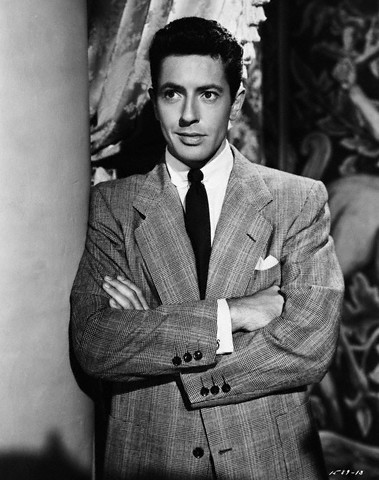
Farley Granger in 1953

In the shadows of Elizabeth Taylor’s death, Farley Granger died on March 27, at age 85.

Sometimes I think that Farley Granger was forgotten. He wasn’t as dynamic as other 1950s actors like Marlon Brando, and he was pretty awkward compared to suave Cary Grant, but Mr. Granger was one of my passing crushes when I first dove into classic film at the age of 14.

I’m not sure what attracted me to the tall, lanky and usually angry Farley Granger, but he was one of the many random actors (along with John Kerr, Peter McEnery and James Darren) that I had fleeting crushes on.

My favorite scene in “Strangers in a Train.” Farely is in the background holding on for dear life.

Granger was also in two of Hitchcock’s most well known films: the odd film adpatation of the play “Rope” and the thrilling “Strangers On A Train.”

I think the first film I ever saw Granger in was “Strangers On A Train” (1951). It’s funny that Granger has been so overlooked when he starred in one of Hitchcock’s most important and best films. “Strangers On A Train” is one of my all time favorite. I was intrigued by several of Hitchcock’s camera angles, particularly the shot through Miriam’s glasses at the fair.  It’s hard to find a flaw in “Strangers On A Train” because it is perfect-though I would have preferred another love interest over Ruth Roman.

I next saw Granger in “Hans Christian Andersen” (1952) with Danny Kaye. It’s such a quirky, silly movie but I love it. The etherial song “Wonderful Copenhagen” and the adorable “No Two People” had me enchanted.  Granger plays an angry fellow who is mean to Danny Kaye and locks him in a closet!  Granger then goes on to play an equally hot tempered man in “Small Town Girl” with Jane Powell.  I’m not sure why Granger was always cast as a hot head, but he could play a grouch very well.

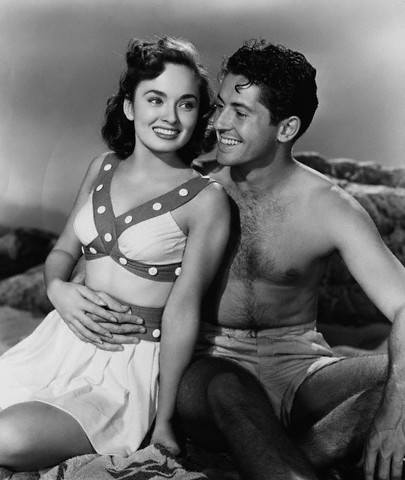
Farley Granger and Ann Blyth in “Our Very Own”

A few of my other favorite films of his are “Our Very Own” where Ann Blyth finds out she was adopted, and, one of his first films, the war film “Purple Heart.”

Granger’s film career petered off in the mid-1950s and he acted mainly on television and then made a few films in the 1970s.  It’s sad that he entered and exited the film scene so quickly.  He only had substantial roles in half of them, while several of his others were small supporting characters.

Regardless of his screen time, I am sad that yet another star has risen. Farewell Farley Granger, you will be missed.

Check out the Comet Over Hollywood Facebook page and Radio Waves Over Hollywood Facebook page.

Lovely Liz: Goodbye to Elizabeth Taylor

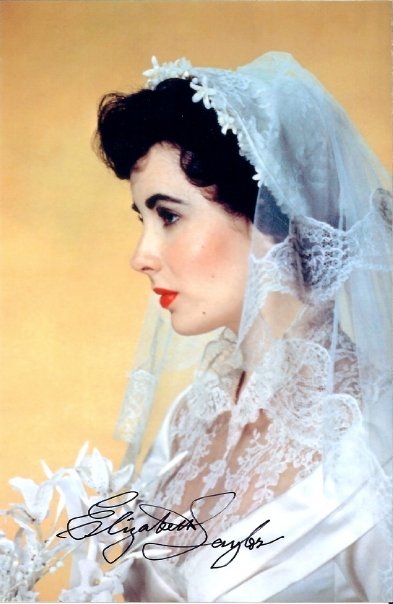
Miss Taylor was gracious enough to sign my photo when I wrote her in 2008.

I got out of yoga this morning around 10 a.m. ET and had four texts telling me Liz died. I have to admit I teared up a bit when I called my mom about it after that. One of my professors even said he was surprised I wasn’t wearing all black today.  No, Elizabeth Taylor isn’t one of my all time favorite actresses.  She isn’t one of the actresses I’m trying to see all of her movies, but only because I don’t care to see most of late 1960s, 1970s and 1980s films. I have seen all of her movies made up until the early 1960s.

I’m not going to go on about how Liz was married so many times.  Or  her work for AIDS, though I admire her work that she did for her friend Rock Hudson. I just plain want to celebrate Liz’s life and career.

She first caught our attention as Priscilla, Nigel Bruce’s granddaughter in “Lassie Come Home” (1943).  She stole our hearts-and kept them for decades- with her sparkling blue-purple eyes, adorable smile and her plead to her grandfather to keep Lassie the collie in his dog kennels. Originally wanted for the role of Bonnie Blue Butler in “Gone with the Wind,” Taylor’s father wanted to keep her out of movies, however, I wonder if he anticipated how big a star she would become.

Liz with her green eyeshadow in “A Date with Judy”

Taylor was one of the few actors who gracefully transitioned from child actor to teenager to successful adult actor. She was allowed to look like a grown up young lady in “A Date with Judy” with green eye shadow, grown up gowns and older Robert Stack. Jane Powell, who was still the same age, said she was a little jealous of this as she still dressed like a teenager in the film.

Miss Taylor grew up quickly. Taylor went from a sophisticated young woman to a sexy, shapely and independent woman in the mid and late 1950s.

I think Liz looked her prettiest in “Cat on a Hot Tin Roof” and then, for me, she started to go downhill. She started gaining weight, the 1960s began and movies started to change.  I start to lose interest in her films once you get past “Butterfield 8.”  “The Sandpiper” is lousy, “The VIPs” is star studded but overly dramatic and I couldn’t even finish “The Comedians” out of boredom.  However, I haven’t seen “Who’s Afraid of Virginia Woolf?” yet, but I have it taped and plan to watch it when I get the chance.

In her white gown in “Ivanhoe” with Robert Taylor

My favorite movies of Taylor’s are “Giant”, “A Date with Judy,” “Cynthia” and “Father of the Bride,” but there are so many other great ones.   She is a great bratty, selfish Amy in “Little Women” and   looks beautiful in “Ivanhoe,” especially the white dress she wears. “Father of the Bride” and “Father’s Little Dividend” are family favorites at my house. My dad is the only man in our family (3 daughters, mom and our female dachshund) so he sympathizes with Spencer Tracy.

Elizabeth Tayor was the last really big super star of the Golden Era.  Though Doris Day, Lauren Bacall and Esther Williams are still living, they aren’t on the same scale as Miss Taylor. Taylor was Hollywood royalty with her highly publicized life and two Oscar winning roles. No one was quite like her or ever will be.

So I bow down to the last royalty of the Golden Age. Farewell, Miss Taylor. You will be greatly missed.

Check out the Comet Over Hollywood Facebook page and Radio Waves Over Hollywood Facebook page.
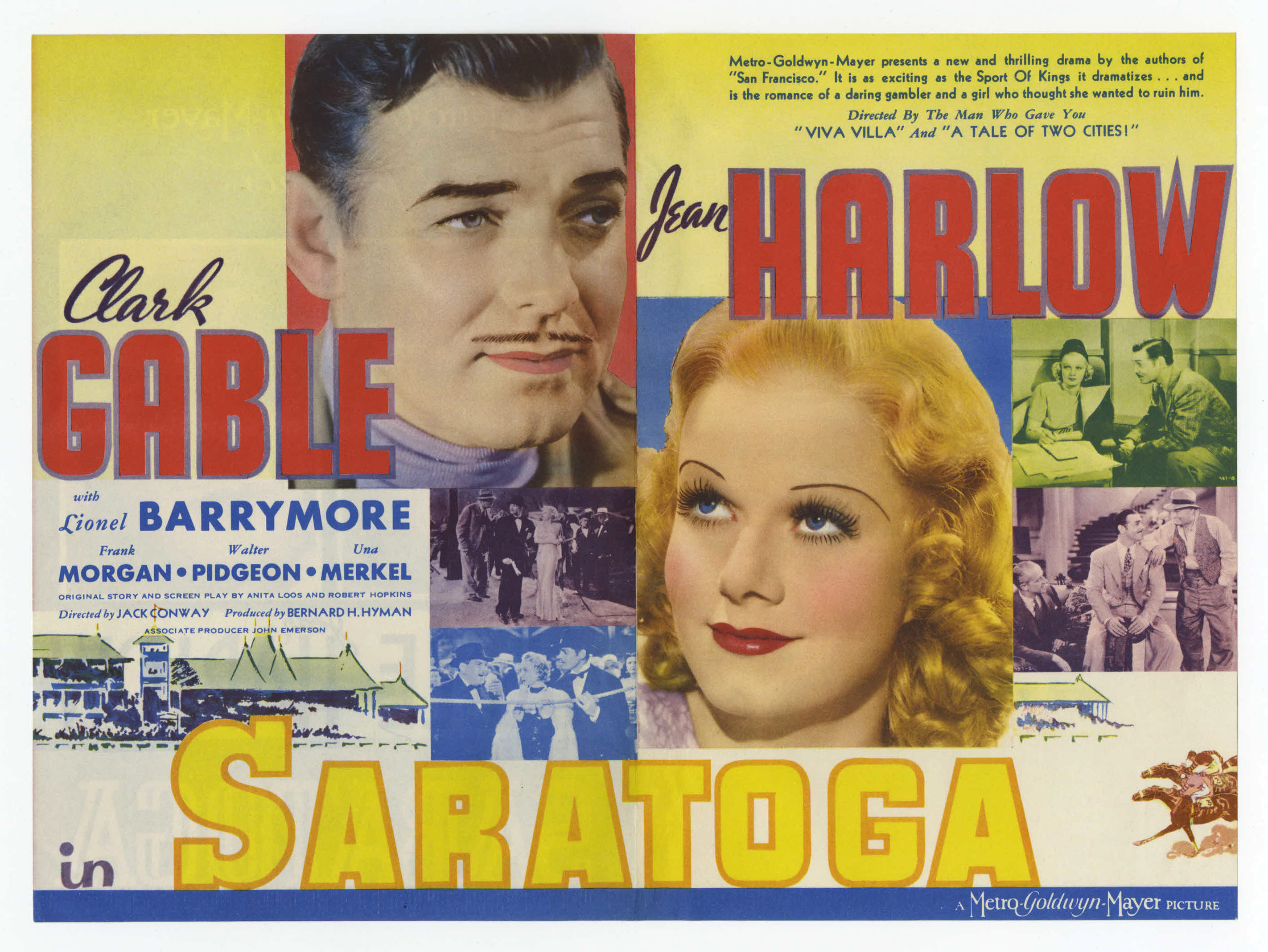
Saratoga: Harlow’s last curtain call

Jean Harlow’s death in 1937 at the age of 26 came to a shock to many; particularly those working on her last film, “Saratoga.”

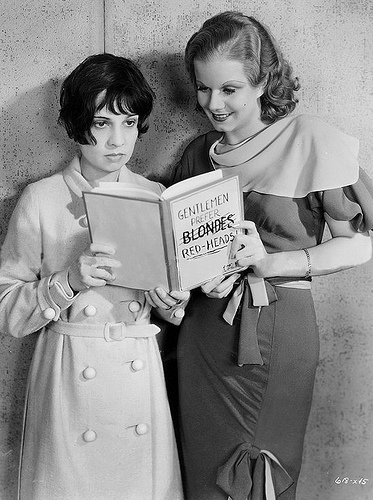
Jean Harlow and Anita Loos worked on several movies together, such as “Red-Headed Woman.”

Anita Loos described in her 1977 book “Cast of Thousands: A Pictorial Memoir of the Most Glittering Stars in Hollywood,”  waiting on the set with Clark Gable and other stars in the film for Jean Harlow to get out of the hospital.  Loos wrote the screenplay for “Saratoga,” along with several other Jean Harlow films like “Red-Headed Woman.”  The book is divided up into different sections about several different actors that Loos encountered during her time in Hollywood, and a large portion is dedicated to working with Jean, Jean’s marriage to Paul Bern, and her death.

The stars were under the impression that Harlow would get well again, the film would be completed, and they would continue on with their usual business.  If I recall correctly, Loos said Harlow had been off the set for a few days, and they continued shooting the scenes without her.  When they received the phone call of her death, they were shocked, and close friend Clark Gable (who nicknamed her Sis) was devastated.

I saw “Saratoga” two summers ago and thought it was entertaining but rather disturbing.  The film was incomplete when Harlow died, so several of her scenes had to be shot with her double Mary Dees and a voice double.

The scenes after Jean’s death are weird and uncomfortable to watch for a couple of reasons:

1. The fact that you know she is dead, even though you saw her before at the beginning of the movie
2. The covering of the face, the irritating fake voice and the thin scenes the double is in are disconcerting.  The voice drives me up the wall and part of you is like “Turn around, I want to see Jean’s face” though you know darn well it’s not her.  The scenes with the double are so brief and fleeting that you can tell the crew was saying, “Let’s wrap this up as quickly and painlessly as possible.”
3. The fact that Jean is in the last scene singing with Clark Gable on the train.  I guess this scene was shot earlier, but you almost think, “Oh, there’s Baby, she’s okay.”

Here are scenes that someone put together of Jean’s double taking over for the rest of “Saratoga”:

Here is a video of Jean acting in “Red Dust” (1932) so you can compare the voices:

Regardless of the double, the general plot of “Saratoga” is good, and it has a strong cast, including Jean Harlow, Clark Gable, Walter Pidgeon, Frank Morgan and  Lionel Barrymore.  Clark Gable is his usual scoundrel, playing a gambler this time, who wins a ranch in a bet from Lionel Barrymore.  Now that he’s won Barrymore’s ranch, Clark is now trying to win over his daughter Jean Harlow. This was Harlow and Clark’s sixth and last film together.

With the star power here, this clearly wasn’t a B movie that they were throwing Jean in because they thought she was washed up. There was a lot of money at stake.  After Jean’s death, there were talks about shelving the movie and reshooting her parts with Virginia Bruce or Jean Arthur.  However, fans pleaded with MGM to let them get one last chance to see their Baby, according to IMDB.

Gable and Harlow in their last film together.

I have mixed feelings about reshooting with another actress or keeping Jean’s parts in the movie.  Jean and Clark have terrific chemistry, like always.  But frankly, the plot is predictable and typical of a Clark Gable movie.  I personally think it was only saved by Jean Harlow’s comedic wit and beauty.  Jean Arthur would have been terrible in the role, and Virginia Bruce would have been just as predictable. The film would have fallen flat.

But at the same time, I almost wish the film had been shelved, much like Marilyn Monroe’s unfinished movie “Something’s Got to Give” (Though the difference is “Saratoga” nearly done and Monroe’s film just starting).  I’m not saying that I’m not thankful to see one last glimpse of Jean alive and well, but it’s heartbreaking to watch.  You see her at the beginning of the movie very beautiful and very much alive.  It’s like watching someone on the street, knowing they are about to die, but they have no clue.

After 74 years, Jean Harlow is still loved and missed, and “Saratoga” is still a bit disturbing. We love you, Jean; happy 100th birthday.

E-mail us at CometOverHollywood@Gmail.com, or check out the Comet Over Hollywood Facebook page
Our Kind of Woman: RIP Jane Russell

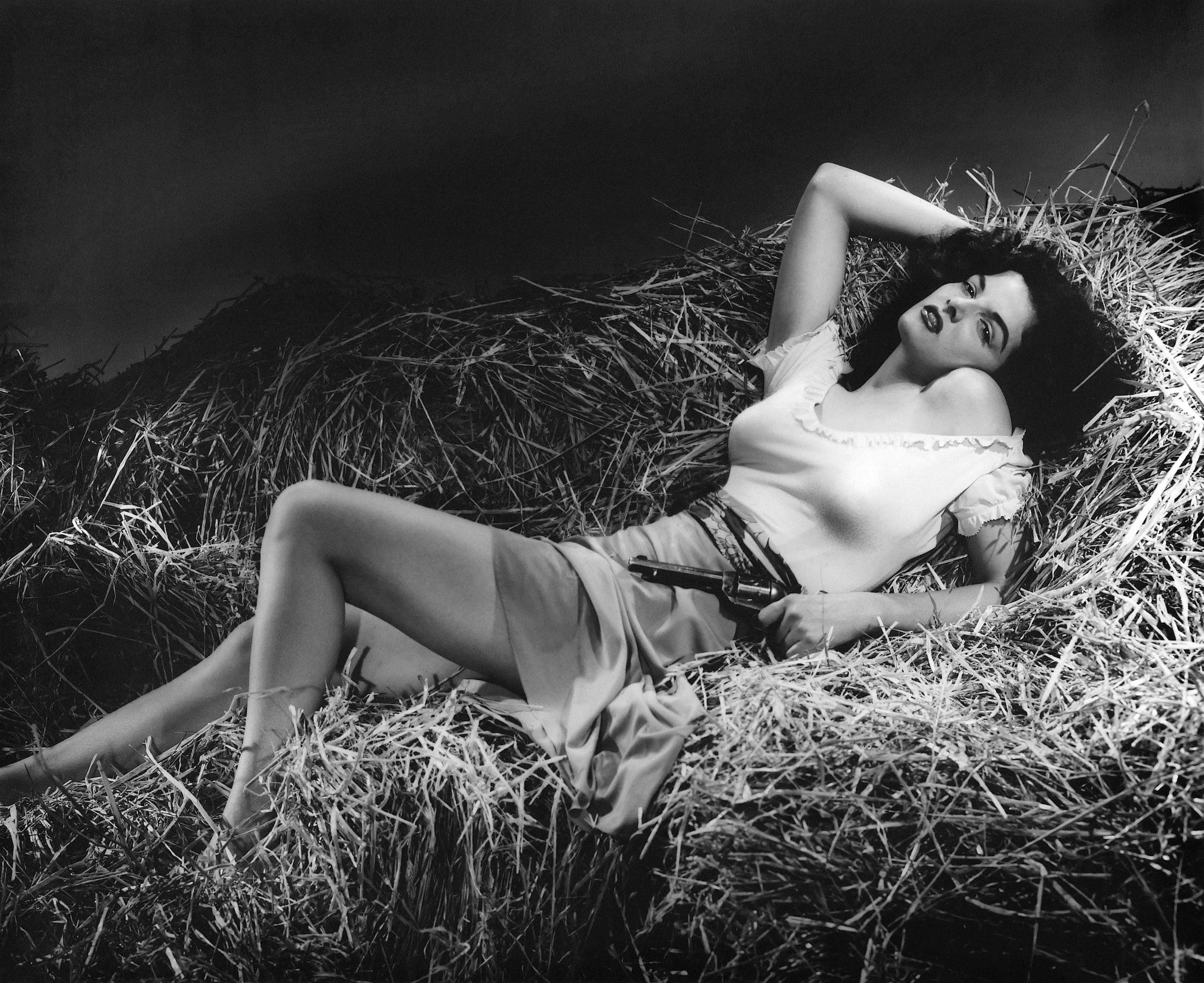
Jane Russell in “The Outlaw” (1942)

When I watched “Gentlemen Prefer Blondes,” it wasn’t Marilyn Monroe that I enjoyed watching, it was Jane Russell.  Russell had all the wit, charm and sarcasm that the movie needed to be bearable.

In an era where legs reigned (Betty Grable or Rita Hayworth), Jane Russell made it big with her own assets.  I think its safe to say that she paved the way to accentuated chests during the 1950s.  Just like Betty’s over the shoulder glance and Rita’s bed perching; it was Jane’s photo of her lounging on the haystack with her off the shoulder blouse for “The Outlaw” (1942) that started her off as a star.

But unlike so many other sexy, pin-ups of the 1950s like Mamie Van Dorean, Marilyn Monroe or Jayne Mansfield; Jane wasn’t like the rest.  For one she had brown hair and was a big woman. Russell wasn’t fat, but she was tall. Let’s just say, I wouldn’t wanted to make her angry. For another, she seemed to have brains and wouldn’t be pushed around.

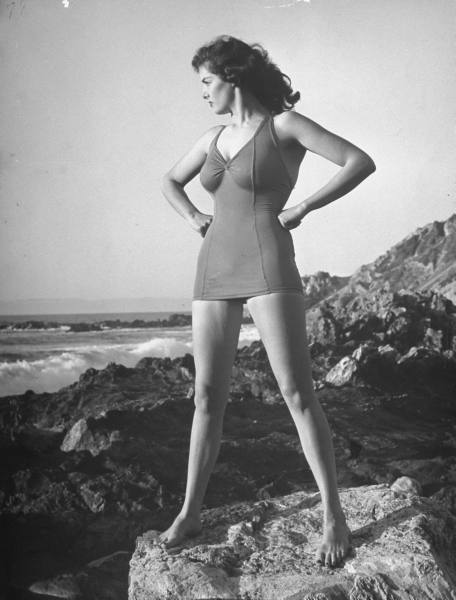
Jane Russell in a LIFE photo from 1942 by Eliot Elisofon

In a 1995 “Turner Classic Movie Private Screenings” with Robert Osborne and Robert Mitchum-who frustrated Osborne with his lack of talking-Russell shared stories of publicity photo shoots.  She said the camera man would give her something a watering pail while she was wearing a nightgown and get her to bend over so that you could see her cleavage.

“Sometimes the photographers would pose me in a low-necked nightgown and tell me to bend down and pick up the pails. They were not shooting the pails.”

Her response? “Up your’s buddy.”

Anyone would have to be smart, tough and fun to be able to costar several times with Robert Mitchum. Other actresses like Greer Garson and Katherine Hepburn starred with Mitchum, but didn’t hit it off too well with the well-known tough guy.

But Russell and Mitchum became a well known screen team, starring in “Macao” and “His Kind of Woman” while also being friends. Their friendship to me shows the down to earth, relaxed person that she probably was.

One reason I have always enjoyed Russell’s films are because they are fun and she is usually believable in her parts. As silly as it sounds, one of my favorite movies of her’s is “The French Line” (1953) where she plays a wealthy oil heiress from Texas who goes on an undercover vacation to make sure men love her for more than her money. The plot isn’t very thick, Gilbert Roland is sort of sleazy and the first several minutes of the movies involves her singing in a bathtub, but it is a fun, colorful movie.

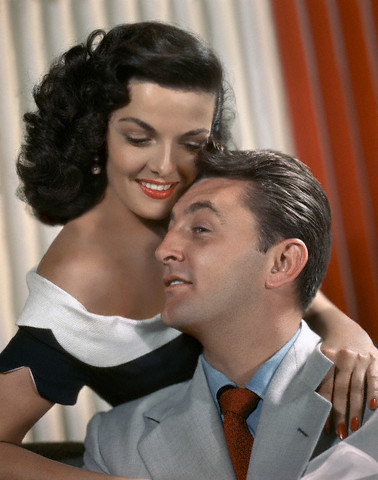
Jane Russell and Robert Mitchum in “His Kind of Woman” (1951)

I also really enjoy the Russell Mitchum movies: “His Kind of Woman” (1951) and “Macao” (1953).  She looks beautiful in both, the films are intriguing and exciting, but there are even slightly humorous parts like with Vincent Price in “Macao.”  As a screen team, I never got a mushy, gushy vibe from them either. While you can tell they care about each other in movies, they generally aren’t falling all over themselves.

I also will admit, I have seen her early role in “The Young Widow” (1942) which Russell hated. In 1996, she said “The Young Widow should have died with her husband.”  I didn’t think it was a terrific movie but not as bad as Russell thought.

Up until her death, Miss Russell was still very visible and commenting on movies, her career and politics. It’s encouraging to see a classic movie star who tries to stay active rather than dying silently in their home.

Miss Russell was part of one of the best era’s in Hollywood and I’m glad that she was here to share her experiences with us for so long.

“I really think the 1940s were the best generation for Hollywood. Everybody was patriotic then. Nobody was talking the way they do now, against the soldiers. It was a different era, a different Hollywood then, and we respected our country, our leaders and our fighting men,” Russell said. “Sure, I’ll admit, I’m a mean-spirited, politically conservative old actress. I’m not bigoted against any race, just those idiots who want to spit on our soldiers’ hard work or remove the Ten Commandments from our schools and courtroom walls.”

Jane Russell will be missed, but certainly not forgotten. Rest in peace, Miss Russell.

Check out the Comet Over Hollywood Facebook page and Follow on Twitter at @HollywoodComet

Another star faded: Betty Garrett

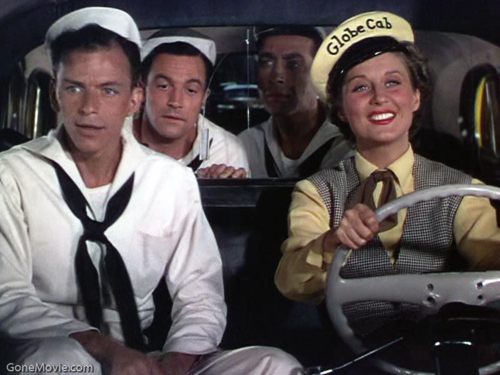
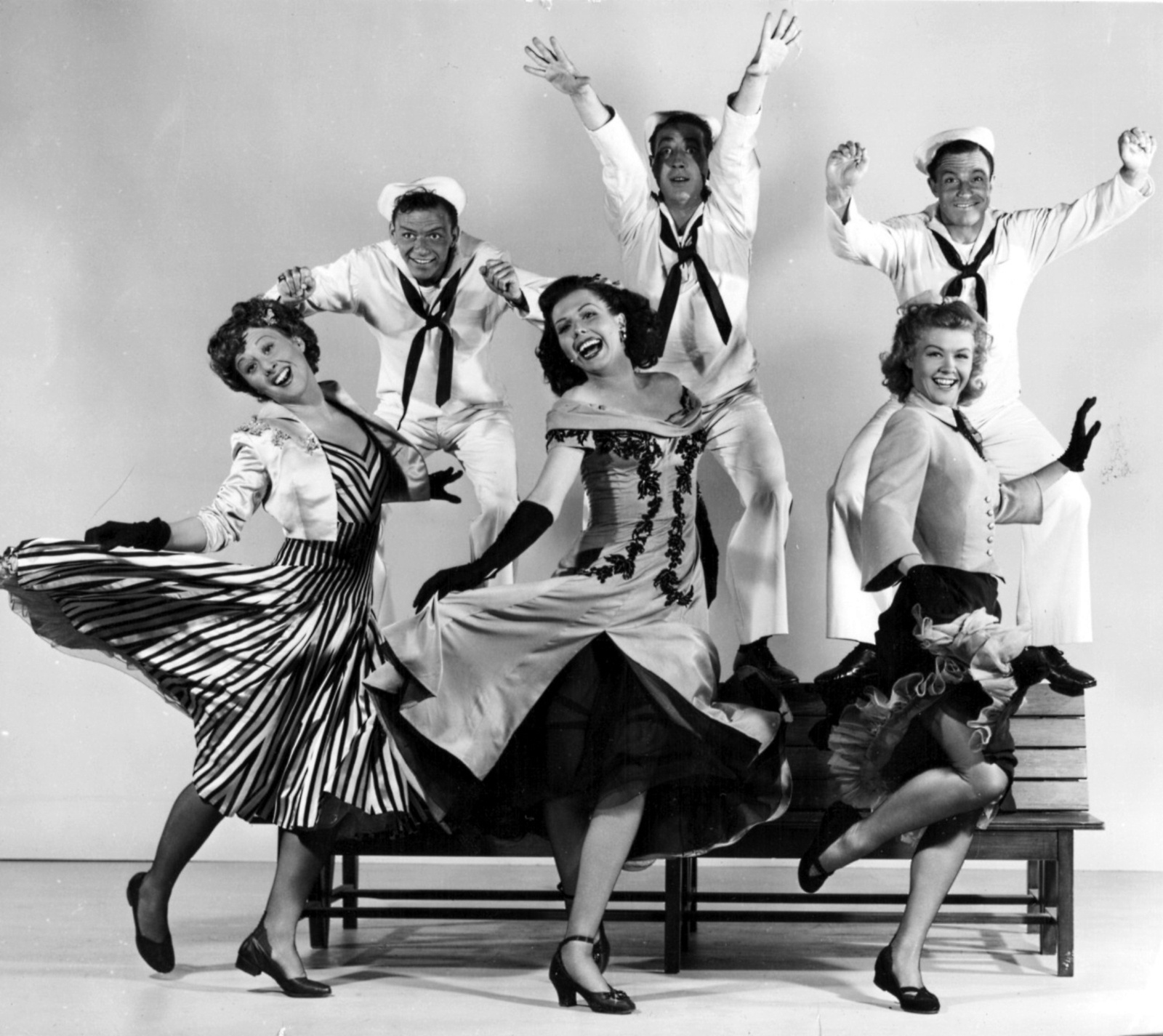
Betty Garrett, star of “On the Town,” dies Sunday

The perky, pretty and talented Betty Garrett died on February 13 at the age of 91.

I was surprised to see that she was only in a hand-full of movies, most of which I had seen.  But even though Miss Garrett was only in six notable classic movies, the roles and her marriage make her unforgettable in Hollywood history.

Garrett was in what is considered one of Hollywood’s best musicals: “On the Town” (1949). Garrett stars along with Ann Miller, Vera-Ellen, Gene Kelly, Jules Munshin and Frank Sinatra in the film about three sailors on leave in New York.  Ann Miller says in a TCM interview that she realized in her “Caveman” dance in the museum, that she had the most impressive group of back-up dancers than any other musical during that time could have.

Garrett plays a plucky, man chasing female cab driver.  Garrett is a great singer and dancer but often was typecasted as the man crazy, love hungry female.

Husband and wife Larry Parks and Betty Garrett in 1955

In both “On the Town” and “Take Me Out to the Ball Game” (1949), Garrett harasses Frank Sinatra (when he was seemingly cute and sweet) for love.  In “Neptune’s Daughter” (1948) she chases Red Skeleton. At least Mickey Rooney is the one after her in “Words and Music” (1948).

Though her film career wasn’t as huge as Bette Davis’, Garrett also had stage and TV success; even often appearing on the 1970s television show “Laverne & Shirley.”

One reason Betty Garrett’s career was brief, was due to her husband’s Communist Party ties from 1941 to 1945, according to her New York Times obituary.  Her husband, Larry Parks-star of “The Jolson Story“- admitted the ties before the House of Un-American Activities in 1955.  The two actors married in 1944 and were married until his death in 1975.

Betty Garrett is one of those actresses who may not have always had the biggest role in a movie-she was fourth billing in “Neptune’s Daughter“- you always remember her from a movie.

She left a mark in Hollywood with her flashing blue eyes, shining curly hair and vivacious singing.

Farewell Ms. Garrett, you will be missed. 

RIP Betty Garrett, you will be missed

Check out the Comet Over Hollywood Facebook page

Y’alls dance, Y’alls dance: RIP Georgia Carroll

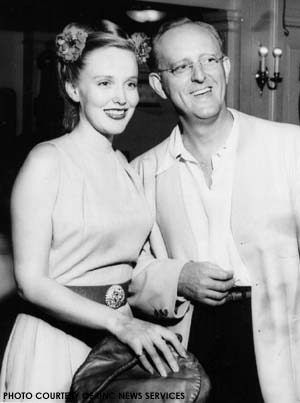
“Gorgeous” Georgia Carroll

Texas breeds cows, politicians and beautiful women.  One of these women was “Gorgeous” Georgia Carroll.

Carroll was born on Nov. 18, 1919 in Blooming Grove, Texas and became a model in the 1930s and 1940s.

Ginny Simms was Kyser’s orginal band singer. The two were romantically involved and Simms left shortly after they broke up. Carroll met future husband and band leader Kay Kyser during World War II, according to the Daily Tar Heel. Carroll enrolled in Kyser’s “Musical Kollege of Knowledge” as the band’s singer and the two later were married.

Carroll and Simms were the opposite end of the piano when it came down to talent and personality. They both brought different things to Kyser’s band.

Georgia Carroll was very beautiful and had an equally golden voice. Carroll was demure, classy and soft. She seems like she was probably polite, quiet and sweet in person. On the other hand, Ginny Simms had a beautiful voice, but she also had a lot of soul. She too was pretty but had a bit harsher appearance than Carroll. I don’t know much about Simms personally, but I do know that she went through men alot, and I’ve also wondered if she was working her way up the ladder. She dated Kyser, sang for him, then left when they broke up. She also had one of her big solo breaks in film after dating Louis B. Mayer. However, dating aside, Simms did have a long and successful marriage until she died in 1994.

Mr. and Mrs. Kyser

Kyser left the big band scene in the early 1950s, and moved his family to Chapel Hill, North Carolina.  Carroll remained in Chapel Hill from 1951 until her death this year at the age of 91.

Kyser was a 1928 UNC graduate- he wrote their fight song and was student body president- and that may be one reason I like him so much. Kyser has a lot of southern charm and humor and went back home to his roots when he retired. Carroll also was a UNC grad, taking 20 years to graduate when she just took one class a semester.  Carroll also helped start a historical preservation society in Chapel Hill in 1972 to save buildings that might be torn down.

On a bit more of a personal note, my grandparents lived in Chapel Hill, North Carolina from 1956 to 1961, while my grandfather was teaching and getting his PhD at UNC.  Though Kyser was a Christian Scientist, Georgia Carroll and the children went to the same Lutheran church my grandparents went to. My mom was in the same Sunday school class as some of the Kyser children, though she was too young to remember, and my grandmother saw Georgia in church frequently. She said she was just as beautiful in person as she was on the screen.

Grandmama even said she would see Kay Kyser in the grocery store on occasion, but she was too nervous to say hello. Such a shame.

Rest in peace, Georgia Carroll. She is so beautiful and is yet another classic singer or star who has left us. Not only do I love her for her talent, but I have always been so intrigued that she lived so nearby.

I really had planned on calling her for an interview for my blog sometime, but never could get up the nerve.

Check out the Comet Over Hollywood Facebook page
Take it Easy Lina: RIP to Lina Romay

Lina Romay with Xavier Cugat in “Two Girls and a Sailor”

About three days ago I found out that the lovely Xavier Cugat rumba singer, Lina Romay, died on December 17.   I was really upset that her death went by me unnoticed, but obviously I wasn’t the only one who didn’t know because the New York Times only posted an obituary on January 1st.

I was planning on writing something about Miss Romay in the near furture. However, I think something was telling me to write about her when I unknowingly watched three Lina Romay movies in one day: “Adventure” (1945),” Love Laughs at Andy Hardy” (1946) and “Embraceable You” (1948).

Lina Romay sang for Xavier Cugat’s band during the 1940s, particuarly during World War II; when South American culture was popular in the United States as I mentioned in another blog post.

Lina Romay in the 1940s

The first time I came across Miss Romay was in high school in “Bathing Beauty” (1941) as she sang “Bim Bam Bum” and “Alma llanera” with Mr. Cugat.  I thought she was pretty and had a nice voice, but dismissed her as another forgettable singer.

Romay popped up in several other movies after that like in “Two Girls and A Sailor” (1944) and “Weekend at the Waldorf” as Cugat’s singer.  In other films she got to flex her acting muscles. In “Honeymoon” (1947) she plays Shirley Temple’s rival and in the film “Embraceable You” (1948), she is cast as the wise-cracking, but caring friend of invalid Geraldine Brooks

Sadly, Miss Romay is drastically underrated and forgotten. Once the war ended, big bands and rumba bands fizzled and so did Miss Romay’s career.  I hate this, because she is probably one of my favorite singers-she performs many of the songs on my favorite CD “Maracas, Marimbas & Mambos: Latin Classics At M-G-M – Motion Picture Soundtrack Anthology.”

Lina Romay retired in the 1950s. Romay had two long and successful marriages.  One to Jay Gould from 1953 until his death in 1987 and a second to writer Robert O’Brien in 1992 until his death in 2005.

Miss Romay, you will be missed.  Your version of “Babalu” will always be my favorite over Dezi Arnez’s.  Rest in peace.

Trivia on Lina Romay:
-Daughter of a Mexican diplomat
-Born in Brooklyn
-Worked as a Spanish-language radio announcer for horse races at Hollywood Park Racetrack in the 1970s and 1980s (according to the NY Times)
-Was in 19 movies and television shows as an actress and seven movies as a singer.
-Be careful while you are looking her up. Apparently an “adult actress” named herself after our Lina Romay in the 1970s.  When I wanted to write Miss Romay for an autography, I could only find the adult star and not the rumba singer.

Check out the Comet Over Hollywood Facebook page and Radio Waves Over Hollywood Facebook page.
My childhood crush: RIP James MacArthur

RIP James MacArthur

Long before I ever sighed for Van Johnson, swooned over Joseph Cotton or dreamed of Douglas Fairbanks Jr., there was James MacArthur.

I was probably five or six years old and my family was watching one of our favorite movies “Swiss Family Robinson” (1960).  Even as a child, I recognized his very attractive looks.  I didn’t really understand when my mom told me that MacArthur was now old when in the movie he looked so young. Did that mean I couldn’t marry him when I grew up?

Right now I am in total shock.  Just an hour ago, I was shopping in TJ Maxx when my mom texted me the bad news: that James MacArthur was dead at 72.  My first childhood crush-and my mother’s childhood crush- was gone!

Admittedly, I haven’t seen many of his films.  My favorites that I have seen are “The Interns” (1962), “Swiss Family Robinson” (1960) and “Spencer’s Mountain” (1963) -though I was jealous of every girl he ended up within the movie.  I will say I tried to watch his first feature film “The Young Stranger” (1957), but was so angered by the stupidity of his parents and other adults in that movie I had to stop. I’ve always wanted to see the Hayley Mills and James MacArthur movie “The Truth About Spring” (1965) but unfortunately, I’ve never been able to find it.

Mother and son, Helen Hayes and James MacArthur

I sometimes forget that James MacArthur is the adopted son of “the first lady of the theater,” Helen Hayes. He was even the god-son of Lillian Gish, talk about one lucky adopted child.

It’s so heartwarming to me to see them in pictures or films together.  In one obituary I read today, he said his favorite episode of  “Hawaii Five-O” was in 1975 when Hayes guest starred as Danno’s Aunt Clara, an old woman on vacation in Hawaii.  In the show Aunt Clara helped the detectives solve the murder (how cute!).

You will be missed, James MacArthur.  I will forever think of you as the young man  in “Swiss Family Robinson.”  Below is my favorite part from the movie. I’ll miss and always have a crush on your, Fritz.

Check out the Comet Over Hollywood Facebook page

Hollywood’s prince: RIP Tony Curtis

Tony Curtis 1925-2010

I remember the first time I saw him as a child he was dressed as a woman.

When I was seven-years-old, I remember thinking he was cute as his tooth twinkled in “The Great Race” (1964).

Though Tony Curtis might not be one of my favorite actors, he is one actor that I remember watching in my early days of discovering classic film as a child. I even remember watching him on the “The Flintstones” as Stoney Curtis-that still gives me a good giggle thinking about it.

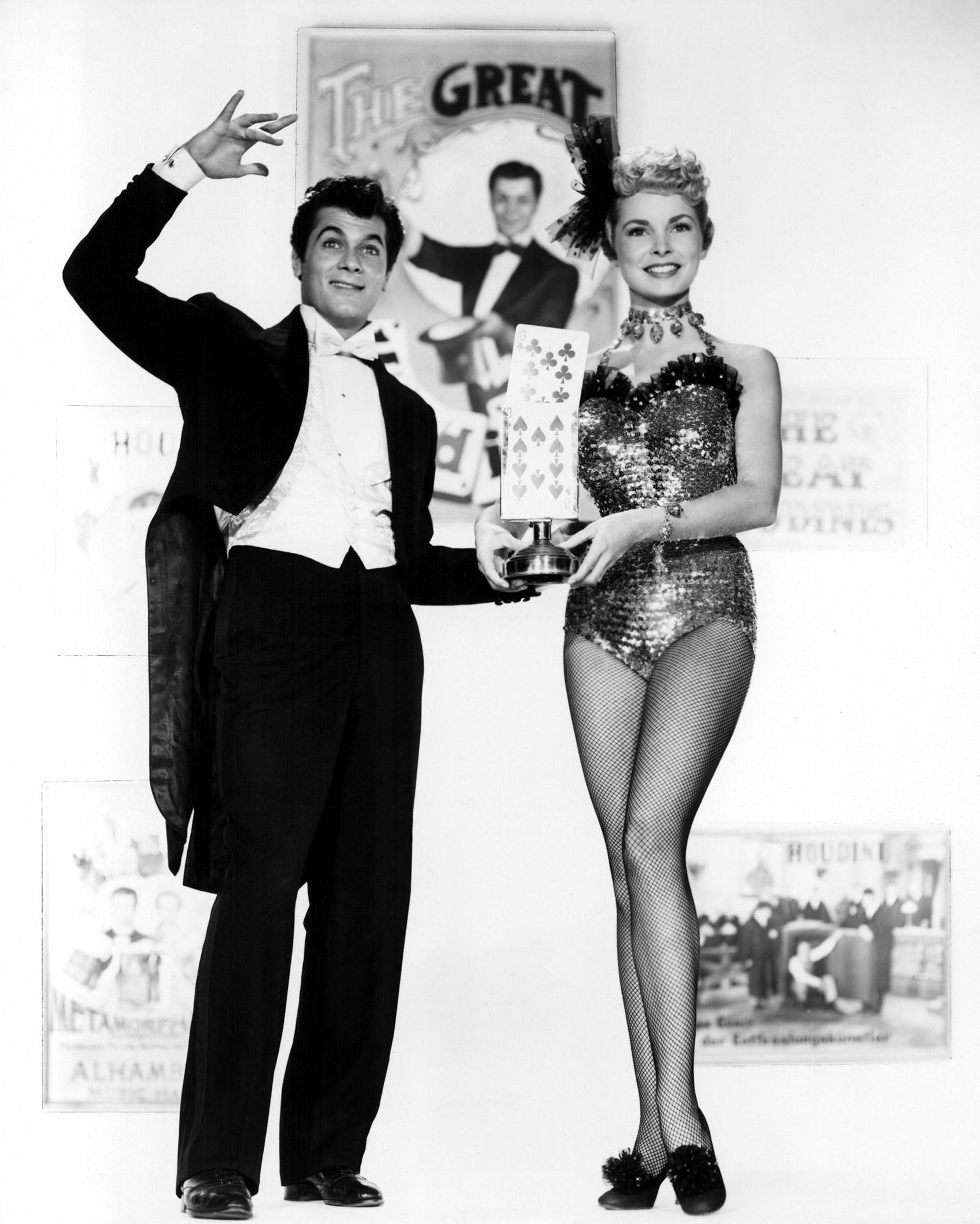
My favorite films of his are “Houdini” (1953), “Operation Petticoat” (1959), “Some Like It Hot” (1959) and “Sex and the Single Girl” (1964). All but one of those is a comedy. I know I’ve heard Tony Curtis say in the “Turner Classic Movies Private Screenings” with Robert Osborne that he was more interested in being a serious actor (like in “The Sweet Smell of Success”), but I really think he did his best work as a comedian.

Janet Leigh and Tony Curtis in “Houdini” (1953)

Janet Leigh and Tony Curtis had a tumultuous marriage that ended in divorce and they didn’t talk after that. His daughter, Jamie Lee Curtis, didn’t have a good relationship with him because she lived with Janet after the divorce and “turned her against him,” according to Curtis in the “Private Screening” interview.

However, though I know Leigh and Curtis ended in divorce, they are one of my favorite Hollywood couples- along with Barbara Stanywck and Robert Taylor, Jennifer Jones and Robert Walker, Dick Powell and June Allyson, etc.  I guess I liked them as a couple because they were both so attractive and cute, and always looked cute and happy in their movies.

I was rather shocked when my mom texted me this morning saying Tony Curtis died. He was one of the last few old Hollywood actors who was active in film festivals and old Hollywood retrospectives. Most recently he was at the Turner Classic Movie Film Festival in Los Angeles in April.

Rest in peace, Mr. Curtis. I will always remember you being hit with pies in “The Great Race” or putting on a great Cary Grant impression in “Some Like it Hot.”  Thank you for helping to keep film history alive.

Check out the Comet Over Hollywood Facebook page and Radio Waves Over Hollywood Facebook page.