“Holiday Affair” (1949) and interview with Gordon Gebert

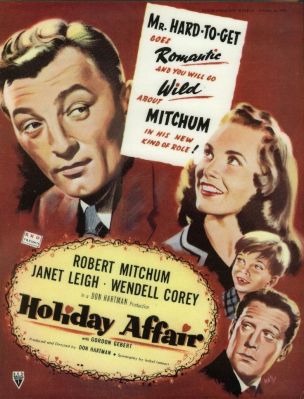
After Robert Mitchum was released from jail for marijuana possession, his studio was looking to clean up his image. The answer was a romantic holiday comedy, “Holiday Affair” (1949).

“At this time Robert Mitchum was operating under the cloud. The head of the studio was eager to clean up his image with this film,” said former child actor Gordon Gebert at a recent screening of the film in Yadkinville, NC.

The film “Holiday Affair” (1949) revolves around war widow Connie, played by Janet Leigh, who lives with her son Timmy, played by Gebert. Connie has dated her boyfriend Carl, played by Wendell Corey, for two years. Carl is secure, reliable and has a steady job, but while Connie likes him, she ducks the discussion of marriage.

Then Connie meets a stranger, Steve, played by Robert Mitchum, who is a store clerk she gets fired. While they never plan on it, the two continuously run into each other, making it hard to forget the other.

Outside of the romantic triangle, the film also focuses on what post-war widows most likely faced: How do you move on from your husband who was killed in war?

Connie hasn’t and tries to honor her husband’s memory every day. She lives a quiet life with her son who she calls the man of the house. Connie tells him frequently that he looks like his father and tries to part his hair in the same way that her husband wore his. She hasn’t allowed herself to fall in love again, because she doesn’t want to be unfaithful to the memory of her first marriage.

Robert Mitchum’s character forces Janet Leigh to face a truth she has been hiding from. Leigh’s character is flustered both by her feelings and by the harsh reality quoted to her by Mitchum.

Continue reading

Watching 1939: Day-Time Wife (1939)

In 2011, I announced I was trying to see every film released in 1939. This new series chronicles films released in 1939 as I watch them. As we start out this blog feature, this section may become more concrete as I search for a common thread that runs throughout each film of the year. Right now, that’s difficult. 

1939 film:  Day-Time Wife (1939)

Release date:  Nov. 24, 1939

Cast: 
Tyrone Power, Linda Darnell, Warren William, Binnie Barnes, Wendy Barrie, Joan Davis, Leonid Kinskey, Joan Valerie, Renie Riano, Marie Blake (uncredited)

Studio:  20th Century Fox

Director:  Gregory Ratoff

Plot:
Jane (Darnell) finds out her husband Ken (Power) is stepping out with his secretary Kitty (Barrie) on their second anniversary. Jane decides to become a secretary herself to find out why husbands go after their secretaries. Her boss is architect Barney Dexter (William), who takes more than a professional interest in her.

Continue reading

Musical Monday: Go West, Young Lady (1941)

It’s no secret that the Hollywood Comet loves musicals.
In 2010, I revealed I had seen 400 movie musicals over the course of eight years. Now that number is over 500. To celebrate and share this musical love, here is my weekly feature about musicals.

This week’s musical:
Go West, Young Lady (1941) – Musical #593

Studio:
Warner Brothers

Director:
Alfred E. Green

Starring:
Penny Singleton, Glenn Ford, Ann Miller, Charles Ruggles, Allen Jenkins, Jed Prouty, Onslow Stevens, Bob Wills, Chief Many Treaties (or Bill Hazlet), Waffles the Dog, The Foursome, The Texas Playboys

Plot:
The western town of Headstone is looking for a new sheriff to get rid of outlaw Killer Pete. Jim Pendergast (Ruggles) think it’s going to be his “nephew,” Bill Pendergast. Bill turns out to be Belinda (Singleton) (with the nickname Bill) and is headed on a stagecoach with the newly appointed sheriff Tex Miller (Ford).

Trivia:
– Edgar Buchanan was originally cast as Jim Pendergast, but couldn’t get out of a film commitment. Charles Ruggles, who was cast in another role, switched roles and Jed Prouty was brought on.
– The only non-Blondie film that Penny Singleton worked on while she was under contract at Columbia.
– The film included many people who worked on the Blondie films: director Frank Strayer, producer Robert Sparks, actor Penny Singleton and writers Richard Flournoy and Karen DeWolf

Allen Jenkins and Ann Miller performing in “Go West, Young Lady”

Highlights:
-Allen Jenkins singing
-Pie falling because of shooting

Notable Songs:
-“Go West, Young Lady” performed by Ann Miller
-“I Wish I could Be a Singing Cowboy” performed by Allen Jenkins
-“Dogie Take Your Time” performed by Penny Singleton

My review:
Go West, Young Lady (1941) is a delightful and charming film. It is classified as a musical, but it is more comedy western with a hint of musical natures in it.

The B-budget film stars Penny Singleton, Glenn Ford and Ann Miller. Today, Ford and Miller are the big names of this film, but in 1941, Singleton was more famous than her co-stars. At this point in time, Singleton was knee-deep performing in “Blondie” movies. Singleton had starred in nine Blondie films by the time “Go West, Young Lady” was released in 1941, and this was the only none-Blondie role she starred in from 1938 to 1946.

While the Blondie films were fun, it was refreshing to see Penny Singleton in a different role. This was still a comedic role, but it gave Singleton the opportunity to sing, dance and act with new co-stars that weren’t Dagwood or Baby Dumpling.

Singleton performs the lilting western tune, “Dogie Take Your Time.” She also performs a funny song and dance in the saloon “Most Gentlemen Don’t Prefer a Lady,” where she dances in her pantaloons.

Glenn Ford and Ann Miller were still finding their way in their careers and hadn’t yet reached the level of stardom we later know them for. However, Miller had been in more high-quality films than either of her co-stars, like “Stage Door” and “You Can’t Take it with You.”

Ann Miller plays the bad girl saloon dancer who has some entertaining musical numbers. She dances and sings the title song, “Go West, Young Lady.” A real treat is a comedic number Miller sings and dances with character actor – Allen Jenkins, yes he does sing! Jenkins doesn’t have the voice of a canary, which makes the song even more funny.

Glenn Ford doesn’t do any singing or dancing but brings the heroics. His chemistry with Singleton is surprisingly sweet and charming.

While “Go West Young Lady” is more a comedy, it has enough songs, dancing and novelty numbers for me to consider it a musical. It’s only 70 minutes but is quite fun and entertaining. I love this film, because it gives a rare glimpse at Penny Singleton not playing Blondi (in the midst of the Blondie series). This musical doesn’t show up often, but when you have the chance, give it a watch.

Penny Singleton and Glenn Ford in “Go West, Young Lady.”

Check out the Comet Over Hollywood Facebook page, follow on Twitter at @HollywoodComet or e-mail at cometoverhollywood@gmail.com

Watching 1939: Judge Hardy and Son (1939)

In 2011, I announced I was trying to see every film released in 1939. This new series chronicles films released in 1939 as I watch them. As we start out this blog feature, this section may become more concrete as I search for a common thread that runs throughout each film of the year. Right now, that’s difficult.

1939 film: Judge Hardy and Son (1939)

Release date: Dec. 22, 1939

Cast: Mickey Rooney, Lewis Stone, Fay Holden, Cecilia Parker, Ann Rutherford, Sara Haden, June Preisser, Maria Ouspenskaya, Henry Hull, Martha O’Driscoll, Leona Maricle, Margaret Early, George P. Breakston, Egon Brecher

Studio: Metro-Goldwyn-Mayer

Director: George B. Seitz

Plot: An older couple (Ouspenskaya, Brecher) come to Judge Hardy (Stone) for help when they are about to be evicted from their home. Judge Hardy enlists the help of his son, Andy (Rooney), to find the couple’s daughter. The Hardys also encounter other troubles: Mrs. Hardy falls ill, Andy is in hock up to his ears and tries to con his way into making money.

Continue reading

Musical Monday: State Fair (1945)

It’s no secret that the Hollywood Comet loves musicals.
In 2010, I revealed I had seen 400 movie musicals over the course of eight years. Now that number is over 500. To celebrate and share this musical love, here is my weekly feature about musicals.

This week’s musical:
State Fair” (1945)– Musical #100

Studio:
20th Century Fox

Director:
Walter Lang

Starring:
Jeanne Crain, Dana Andrews, Dick Haymes, Vivian Blaine, Charles Winninger, Fay Bainter, Donald Meek, Frank McHugh, Jane Nigh, Percy Kilbride, Harry Morgan, William Marshall, Phil Brown

Plot:
The Frake family is excited about heading to the Iowa State Fair, but a pessimist neighbor makes a bet with Abel Frake (Winniger) that something will go badly for the family. The family has a lot to be excited about: the father Abel (Winniger) is entering his prize hog Blueboy and mom Melissa is entering her pickles and minced meat to be judged. Their children Wayne (Haymes) and Margy (Crain) are restless and hope to have fun and meet exciting new people – and they do. Margy meets and falls for reporter Pat (Andrews), and Wayne falls in love with band singer Emily (Blaine). Both have to figure out if this is a vacation romance or the start of a relationship.

Continue reading

Watching 1939: You Can’t Get Away with Murder (1939)

In 2011, I announced I was trying to see every film released in 1939. This new series chronicles films released in 1939 as I watch them. As we start out this blog feature, this section may become more concrete as I search for a common thread that runs throughout each film of the year. Right now, that’s difficult. 

1939 film:  You Can’t Get Away with Murder (1939)

Release date:  March 24, 1939

Cast:  Humphrey Bogart, Gale Page, Billy Halop, Harvey Stephens, John Litel, Henry Travers, Harold Huber, Joe Sawyer, George E. Stone, John Ridgely, Eddie ‘Rochester’ Anderson (uncredited)

Studio:  Warner Bros.

Director:  Lewis Seiler

Plot:
Teen Johnnie Stone (Halop) is raised by his sister Madge (Page). Madge worries about Johnnie who has fallen in with tough characters, like Frank Wilson (Bogart). Madge hopes her upcoming marriage to her boyfriend Fred (Burke) will help Johnnie when the three of them move away for Fred’s job. On the eve of announcing their wedding plans, Johnnie goes on “a job” with Frank, and someone is killed with a gun Johnnie stole from Fred. Fred is accused of murder and sent to jail in Sing Sing, along with Frank and Johnnie who are booked for another crime. Johnnie has to pick between saving Fred’s life or putting his own life in danger by confessing.

Continue reading

Musical Monday: The Sky’s the Limit (1943)

It’s no secret that the Hollywood Comet loves musicals.
In 2010, I revealed I had seen 400 movie musicals over the course of eight years. Now that number is over 500. To celebrate and share this musical love, here is my weekly feature about musicals.

This week’s musical:
The Sky’s The Limit (1943) – Musical #210

Studio:
RKO Radio Pictures

Director:
Edward H. Griffith

Starring:
Fred Astaire, Joan Leslie, Robert Benchley, Robert Ryan, Elizabeth Patterson, Marjorie Gateson, Fred Aldrich, Robert Andersen, Richard Davies, Norma Drury, Dorothy Kelly, Neil Hamilton (uncredited), Peter Lawford (uncredited) Eric Blore (uncredited), Amelita Ward (uncredited)
Himself: Freddie Slack and his Orchestra, Ella Mae Morse

Plot:
Fred Atwell (Astaire) is one of the Flying Tiger pilots during World War II and has been named a hero for all of his successful missions. During his leave back home, he is taken on a personal appearance tour. Tired of the strict schedule, he gets off the train at a stop and decides he’s going to have fun. He meets photographer Joan Manion (Leslie), who he falls for but she believes it just a drifter.

Continue reading

Watching 1939: Torchy Runs for Mayor (1939)

In 2011, I announced I was trying to see every film released in 1939. This new series chronicles films released in 1939 as I watch them. As we start out this blog feature, this section may become more concrete as I search for a common thread that runs throughout each film of the year. Right now, that’s difficult. 

1939 film:  Torchy Runs for Mayor (1939)

Release date:  May 13, 1939

Cast:  Glenda Farrell, Barton MacLane, Tom Kennedy, John Miljan, Frank Shannon, Charles Richman, Joe Downing, John Miljan, Irving Bacon, John Ridgely (uncredited)

Studio:  Warner Bros.

Director:  Ray McCarey

Plot:
Reporter Torchy Blane (Farrell) is writing stories about the corruption of Mayor Saunders (Richman) and how he takes money from crime bosses. To make Torchy stop, the mayor threatens to pull his advertising from her newspaper, which forces Torchy’s editors to stop publishing her stories. Torchy asks papers all over town to publish her stories and is rejected until one small paper accepts. After publishing the article, the editor of the paper is killed, and Torchy’s police officer boyfriend Steve (MacLane) investigates, and Torchy meddles. To get back at Torchy for butting into his case, Steve writes Torchy’s name in as a mayor candidate – which she embraces.

Continue reading

Musical Monday: Young at Heart (1954)

It’s no secret that the Hollywood Comet loves musicals.
In 2010, I revealed I had seen 400 movie musicals over the course of eight years. Now that number is over 500. To celebrate and share this musical love, here is my weekly feature about musicals.

This week’s musical:
Young at Heart (1954) – Musical #26

Studio:
Warner Bros.

Director:
Gordon Douglas

Starring:
Frank Sinatra, Doris Day, Gig Young, Ethel Barrymore, Dorothy Malone, Elisabeth Fraser, Alan Hale Jr., Lonny Chapman

Plot:
The musical family the Tuttles are led by the widower father, Gregory (Keith), his three daughters Laurie (Day), Fran (Malone) and Amy (Fraser), as well as his unmarried sister Aunt Jessie (Barrymore). Their lives start to change as the daughters begin falling in love and getting married. Fran convinces herself that she is in love with and will marry Bob Neary (Hale Jr). Then young composer Alex (Young) comes to board with the Tuttles. Another guest turns the family upside down as well, the moody songwriter Barney Sloan (Sinatra). All of the sisters love Alex, but it’s Laurie that he wants to marry, but will she marry Alex if it hurts her sisters?

Continue reading

Watching 1939: Invisible Stripes (1939)

In 2011, I announced I was trying to see every film released in 1939. This new series chronicles films released in 1939 as I watch them. As we start out this blog feature, this section may become more concrete as I search for a common thread that runs throughout each film of the year. Right now, that’s difficult. 

1939 film: Invisible Stripes

Release date: Dec. 30, 1939

Cast:  George Raft, Jane Bryan, William Holden, Humphrey Bogart, Flora Robson, Paul Kelly, Lee Patrick, Henry O’Neill, Frankie Thomas, Moroni Olsen, Margot Stevenson, Marc Lawrence, Leo Gorcey, Bruce Bennett (uncredited), Frank Faylen (uncredited), William Hopper (uncredited), John Ridgely (uncredited)

Studio:  Warner Bros.

Director:  Lloyd Bacon

Plot:
After he’s paroled from Sing Sing, Cliff Taylor (Raft) finds life is hard as an ex-con. His girl leaves him, and he can’t find work. Even after he finds work, employers get nervous around an ex-con and fire him or police accuse him for crimes. His younger brother Tim (Holden) is disheartened by what he sees with his brother and becomes hard. Because of his hardships, Cliff falls back into crime, which causes problems for the rest of his family.

1939 Notes:
• George Raft was in four films released in 1939
• William Holden’s second credited role released in 1939. He was in three films total
• 1939 gave Margot Stevenson her first full-length films. She was in two films released that year: this one and “Smashing the Money Ring”

Other trivia: 
• Originally supposed to star James Cagney and John Garfield
• Flora Robson plays George Raft’s mother, though she was six years younger than Raft
• One of the last films released in 1939
• The only film that George Raft was directed by Warner Bros. director Llyod Bacon, according to George Raft: The Films by Everett Aaker

My review: Searching for the “1939 feature”:
“Invisible Stripes” is an interesting crime film. It isn’t just “well here is a gangster committing crimes” or the upstanding citizen being brought into a life of crime.

It’s about an ex-con, played by George Raft, sincerely wanting to “go straight” and live a truthful, honest life and make money honestly, but society won’t let him. Employers don’t want to hire him because of his criminal background, or they are suspicious of him after he’s hired. If he is hired, other employees pick fights.

But society also doesn’t want him to commit crimes, which is the only way he can make money. The message is very much “damned if you do, damned if you don’t.”

The film gives a sympathetic look at what people deal with after they are released from a stretch in jail. George Raft plays this character well, and the plot unsurprisingly turns him back towards a life of crime.

But while George Raft is the star of “Invisible Stripes,” William Holden was the standout star of 1939. This is the year that Holden’s career really began and it started out with a bang. Holden was coming off the success of “Golden Boy” (1939), which quickly made him a star. Warner Bros. borrowed Holden from Paramount to play the role of the eager younger brother becomes bitter as he watches the treatment of his brother.

What no mention of Humphrey Bogart? Bogart is in this film, but has a fairly small role and not as much screentime as Raft or newcomer Holden. At this point in his career, Bogart still wasn’t the star that he later became but 1939 slowly boosted him until he found fame.

“Invisible Stripes” isn’t the most memorable film of 1939, or the most memorable Warner Bros. gangster movie, but it’s interesting to see Holden early in his career and Raft and Bogart together.

Check out the Comet Over Hollywood Facebook page, follow on Twitter at @HollywoodComet or e-mail at cometoverhollywood@gmail.com