“A Colorful Life”: Remembering Joan Leslie

Image

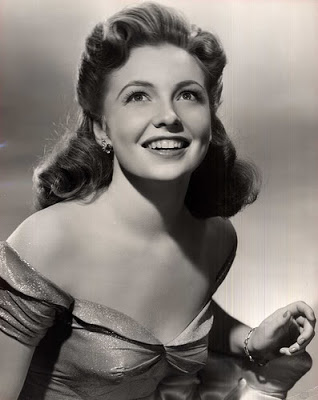
Actress Joan Leslie in the 1940s

Actress Joan Leslie in the 1940s

With her shining smile, bright eyes and fresh face, actress Joan Leslie had an innocent girl-next-door appeal. But during her career at Warner Brothers during the 1940s, Joan Leslie held her own in top films with major actors such as Ida Lupino, Humphrey Bogart and James Cagney.

She was a full-fledged star by age 17. And it all began on the stage when she was nine years old.

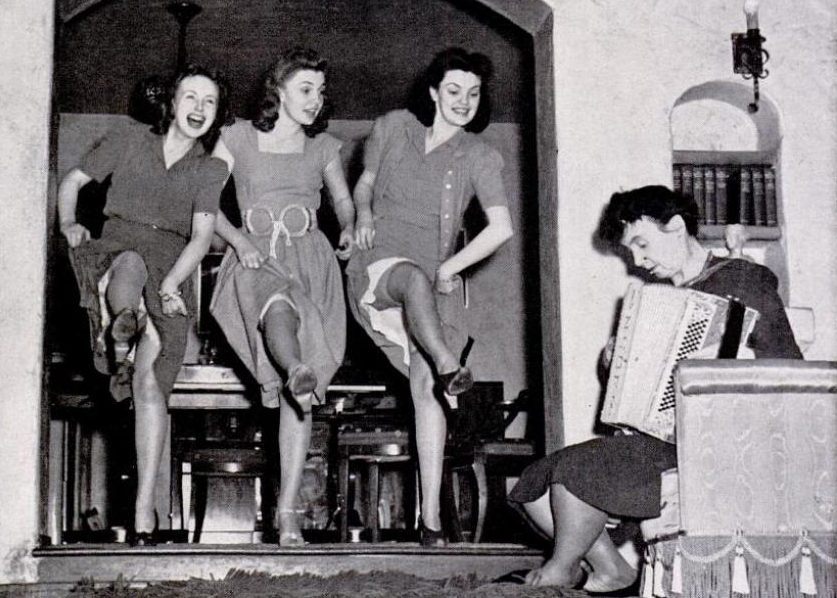
Joan Leslie—then Joan Brodel—was part of a sister act, with her sisters Mary and Betty, known as the Three Brodels. The sisters traveled the United States and Canada; singing, dancing, doing impressions and playing instruments, according to a 1999 interview in the book “Movies Were Always Magical” by Leo Verswijver.

Joan played the accordion and did an impression of actress Greta Garbo.

While performing in New York, an MGM scout saw Joan and signed her to play a small role in the Greta Garbo film “Camille” (1936). In film, Joan, 11, played Robert Taylor’s little sister. She had one line, welcoming him home as he arrived at her first communion.

As she continued to get small, uncredited roles in films such as “Nancy Drew—Reporter” (1938), “Susan And God” (1940) and “Foreign Correspondent” (1940), Joan changed her last name from Brodel to Leslie so she wouldn’t be confused with actress Joan Blondell.

Pictured with her sisters and mother in for a LIFE magazine photo spread.

Pictured with her sisters and mother in for a LIFE magazine photo spread.

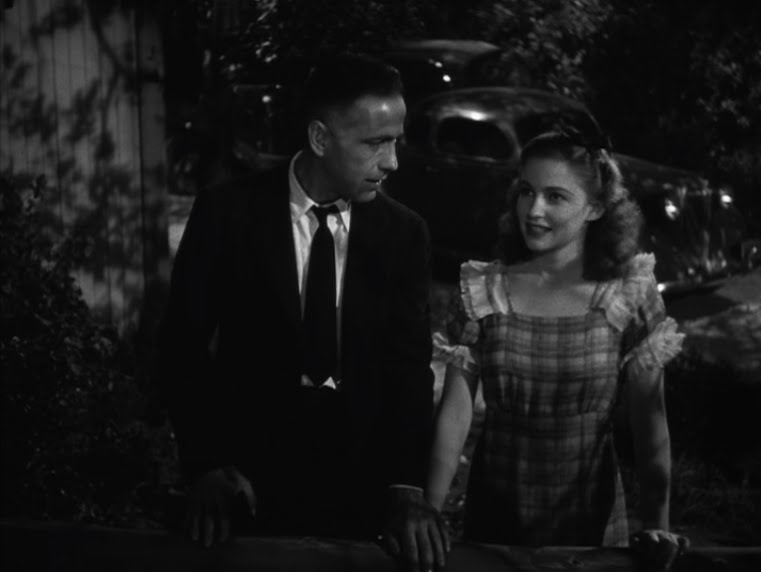
But her big break came at age 15. Joan got the role of Velma, a young girl with a club foot, in the Howard Hawks directed film “High Sierra” (1940) starring Humphrey Bogart and Ida Lupino. In the film, Bogart is a criminal on the run, and when he meets Velma, he wants to help her get an operation for her foot.

At age 15, Joan Leslie with Humphrey Bogart in

At age 15, Joan Leslie with Humphrey Bogart in “High Sierra”

“That was such a good role,” Leslie said in the Verswijver interview. “And I was only 15! I wish I had more such roles when I was older.”

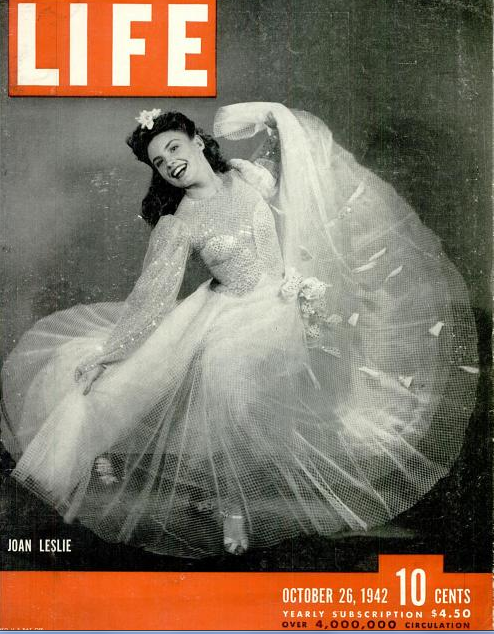
By age 17, Joan Leslie was on the cover of the Oct. 26, 1942, issue of LIFE magazine. “Joan Leslie: girlish and unassuming, at age 17 she shines brightly as a full-fledged movie star able to sing, dance and act,” the magazine headline said.

Joan Leslie on the cover of Life, Oct. 1942.

Joan Leslie on the cover of Life, Oct. 1942.

By this time, Leslie had starred with Bogart a second time in “Thieves Fall Out” (1941). Still in her teens, she played the love interest to top stars such as Gary Cooper in “Sergeant York” (1941) and James Cagney in “Yankee Doodle Dandy” (1942).

“When you talk about working with the best, I’ll always remember Jimmy Cagney. What a creative, dynamic person he was,” she said in the 1999 interview.

Both Cooper and Cagney received Academy Awards for Best Actor for their respective roles.

“I never was nominated but I don’t feel I did anything up to that caliber,” she said.

In most of her roles that followed at Warner Brothers, Joan Leslie exuded a persona that was the young, innocent, sweet girl-next-door.

“I was merely being myself in the 1940s, that’s what it really was,” she said.

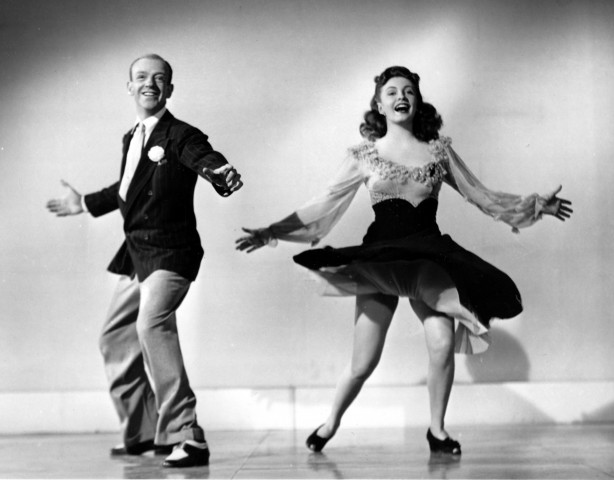
However, Joan Leslie always proved to be versatile. She could go from comedies with Eddie Albert, such as “The Great Mr. Nobody” (1940) to the hard hitting drama “The Hard Way” (1942), playing the younger sister Ida Lupino is pushing to make a star. At age 18, Joan was also the youngest of any of Fred Astaire’s dance partners in the 1943 film, “The Sky’s The Limit.”

Publicity photo of Fred Astaire and Joan Leslie in

Publicity photo of Fred Astaire and Joan Leslie in “Sky’s the Limit.”

However, because she was so much younger than her peers such as Cagney, Olivia de Havilland, Henry Fonda and Bogart, she said she never felt like she was a “chum” to any of these stars, but was also never scared or in awe while working with them.

“People were very nice to me…” she said. “They were getting the quality from me that they wanted: young, innocent and sweet girl next door. It was during the war (World War II) and that’s what they wanted to project on the screen.”

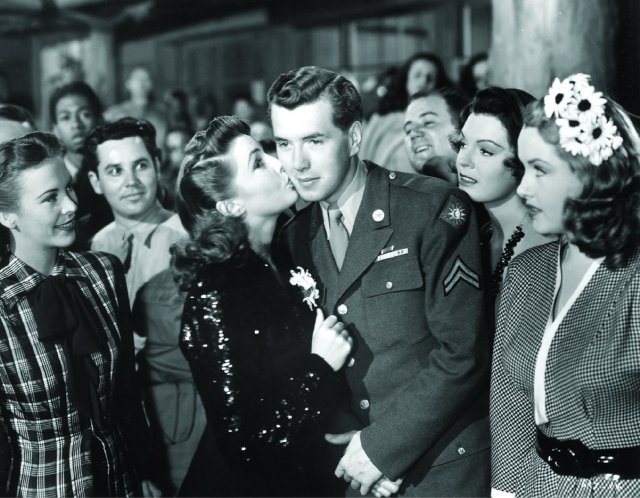
Like many other actresses, Joan Leslie danced at the Hollywood Canteen during World War II with the soldiers. Art imitated life as she starred in the film “Hollywood Canteen” (1944) as herself. In the film a soldier, played by Robert Hutton, wins a date with Joan Leslie and the two end up falling in love.

Joan Leslie and Robert Hutton in the film

Joan Leslie and Robert Hutton in the film “The Hollywood Canteen” (1944)

In 1946, Joan Leslie was voted No. 1 in a Future Star poll, but becoming quality roles were scarce for her. This largely was because she sued Warner Brothers for control of her contract, believing after the age 21 she should be able to pick better parts. Warner lowered her billing in some of her films and blackballed her name with other studios.

“I always liked to play a certain kind of part as a certain kind of person and I don’t find that very much anymore. The business has changed so much,” she said in 1999.

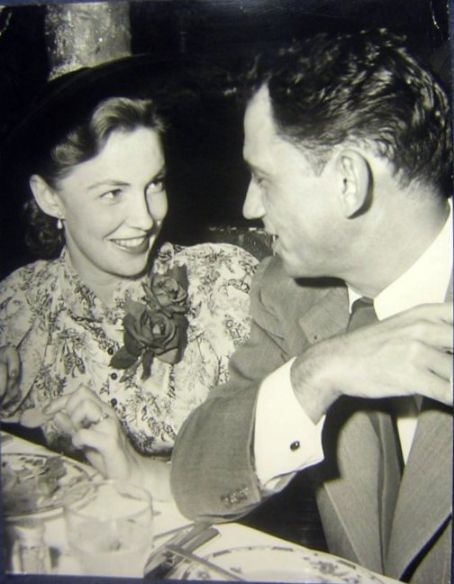
Joan Leslie with her husband William Caldwell, MD.

Joan Leslie with her husband William Caldwell, MD.

However, once Joan Leslie married obstetrician William Caldwell, MD, in 1950, her interest in Hollywood started to fade. When the two had twin girls, Patricia and Ellen, Joan stopped making films and concentrated on her role as a mother.

“When I married, that would be the most important thing in my life,” she said. “When you had a colorful life as an actress, it’s not easy to say that and to mean it as well. My husband respects me for what I have accomplished in my career.”

After her career, she was involved with parish work, the Los Angeles Public Library’s after-school reading program, and the advisory board of the Damon Runyan Cancer Fund, according to her obituary.

Dr. Caldwell passed away in 2000 and Miss Leslie passed away at age 90 on Oct. 12, 2015.

“I had a very colorful life, she said. “There’s nothing quite like it.”

Check out the Comet Over Hollywood Facebook page, follow on Twitter at @HollywoodComet or e-mail at cometoverhollywood@gmail.com

Musical Monday: Rock Around the Clock (1956)

Image

It’s no secret that the Hollywood Comet loves musicals.
In 2010, I revealed I had seen 400 movie musicals over the course of eight years. Now that number is more than 500. To celebrate and share this musical love, here is my weekly feature about musicals.

Rock-Around-Clock-PosterThis week’s musical:
“Rock Around the Clock” (1956) – Musical #528

Studio:
Columbia Pictures

Director:
Fred F. Sears

Starring:
Johnny Johnston, Alix Talton, Lisa Gaye, John Archer, Henry Slate, Robert Banas (uncredited)
Themselves: Bill Haley and the Comets, The Platters, Ernie Freeman Combo, Tony Martinez and His Band, Alan Freed

Plot:
Fictional film about how rock and roll music is discovered. Band manager Steve Hollis (Johnston) observes how a band with a new sound draws teenage dancers when they felt dance bands were dead. The band the kids are dancing to is Bill Haley and the Comets and Hollis sets out to promote them. However, booking manager Corinne Talbot (Talton), who was jilted by Steve, is set to have the band fail.

Trivia:
-This is considered the first major rock and roll musical.
-Queen Elizabeth II requested a print of this film to learn more about rock n’ roll after the movie was released. While on vacation in Scotland at Balmoral Castle,she asked for it to be flown in for a special showing. The film was banned in some British cities before Queen Elizabeth saw it, according to a Sept. 22, 1956, Louella Parson’s article by Louella Parsons. Bill Haley later performed for Queen Elizabeth in 1979.
-The New York Times wrote there were teenage riots when the film was released. In Great Britain and America, teens danced in the aisles, clapped to the music, tore up the seats and shouted they wanted “We want Bill,” according to the book Cliff: An Intimate Portrait of a Living Legend by Stafford Hildred, Tim Ewbank. In Oslo, Norway there were teen riots outside the theater and in Belgium, Germany, teens through tomatoes and eggs at the police station, according to Rebels and Chicks: A History of the Hollywood Teen Movie by Stephen Tropiano
-Haley starred in a sequel to this film called “Don’t Knock Rock” the same year.

Johnny Johnston, Alan Freed and Lisa Gaye in "Rock Around the Clock"

Johnny Johnston, Alan Freed and Lisa Gaye in “Rock Around the Clock”

Notable Songs:
-Rock Around the Clock performed by Bill Haley and the Comets
-Razzle Dazzle performed by Bill Haley and the Comets
-The Great Pretender performed by The Platters
-Only You performed by The Platters
-See You Later, Alligator performed by Bill Haley and the Comets

My review:
If you are a fan of 1950s rock and roll or music history, “Rock Around the Clock” should be added to your must-see list.

The plot is fairly thin but ties in well with the musical performances. It’s also relevant for that time. While rock and roll seems pretty common place now, there was some push back and it was seen as rebellion from teens to adults. The riots and banning of this film when it was released exhibits this idea.

The plot looks at how mainstream band managers and booking managers were reluctant to take a chance on such a radical departure from the dance bands of the 1940s and early 1950s, which were dying out in popularity by this time.

Though qualified as a b-film, “Rock Around the Clock” is also important as film’s first rock and roll musical and was notable enough for Queen Elizabeth to screen the movie to learn what rock and roll is all about.

The lead actors in this film-Johnny Johston, Alix Talton and Lisa Gaye-aren’t anything to write home about but are adequate enough to carry the plot.

But the real stars of the film are the musical performers: Bill Haley and the Comets, The Platters and the Bellhops.

The only musical performances I was not keen on was Tony Martinez and His Band. After listening to Xavier Cugat for years, Tony Martinez sounded like noise.

“Rock Around the Clock” has great music and terrific jive dance numbers; a must see for music lovers.

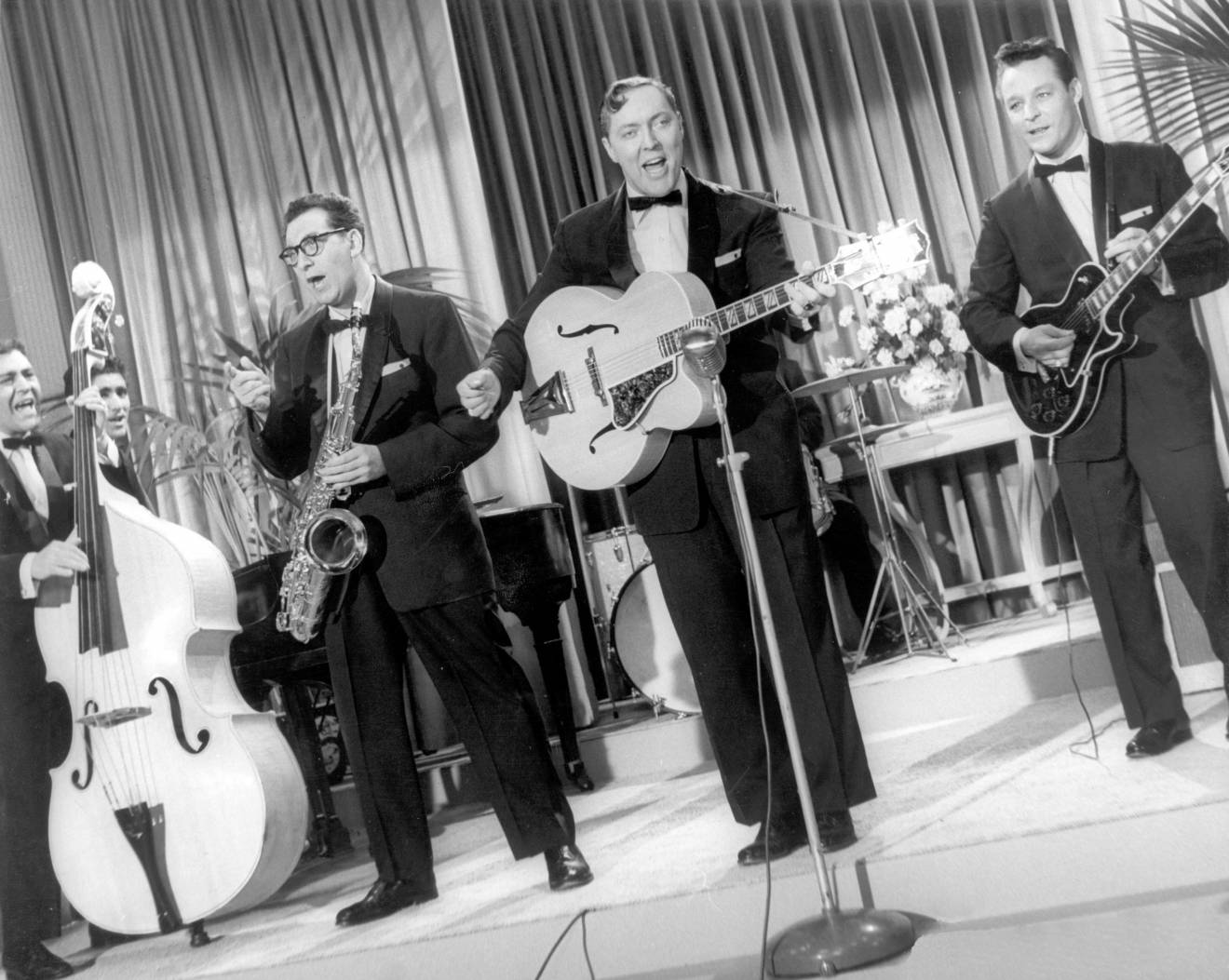
Bill Haley and his Comets in the film "Rock Around the Clock" (1956)

Bill Haley and his Comets in the film “Rock Around the Clock” (1956)

Check out the Comet Over Hollywood Facebook page, follow on Twitter at @HollywoodComet or e-mail at cometoverhollywood@gmail.com

The Rumba King and South American Influence in Film

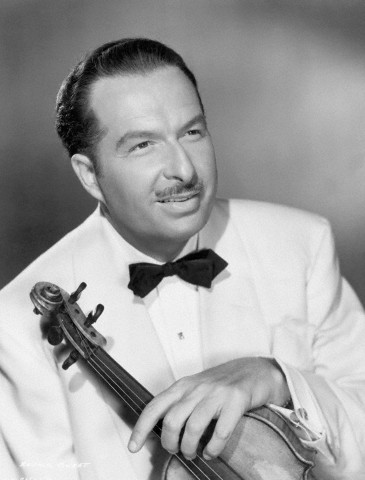
Original caption: Picture shows Xavier Cugat, he became known as the "Rhumba King," and he and his famous band were greatly responsible for the popularity of the "Rhumba," "Samba" and the "Conga." Undated photo circa 1940s-50s. --- Image by © Underwood & Underwood/Corbis

Xavier Cugat

One of my favorite CDs to listen to while my hour long commute is “Maracas, Marimbas & Mambos: Latin Classics At M-G-M.” Along with ballads performed by Colombian singer Carlos Ramierz and toe tapping, show stoppers by Carmen Miranda, one of my favorite 1940s bandleaders multiple times on this album: Xavier Cugat.  From the fun and humorous “Take it Easy” from “Two Girls and A Sailor” (1944) to the bouncing “Walter Winchell Rumba,” Cugat’s songs are jaunty and full of spirit.

What do you think of when you hear “1940s culture”?  Big band music performed by the likes of Glenn Miller or Tommy Dorsey with teens swing dancing and Frank Sinatra crooning? Though big band and swing seem to characterize the popular perception of World War II era United States, one of the biggest fads in the United States in the 1940’s was Latin and Spanish culture.

Throughout the mid-1930s through the early-1950s, Hispanic themed music was popular and Xavier Cugat was the Rumba King.

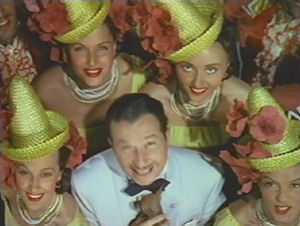
Cugat, nicknamed Cugie, was arguably was the top Hispanic bandleader during this time, popularizing the rumba in the United States. Cugat’s popularity landed him into 17 Hollywood films, including “Luxury Liner” and “Holiday in Mexico” with Jane Powell, and “Thrill of Romance,” “Bathing Beauty” and “On an Island with You” with Esther Williams.

In most of his film appearances, Cugat was accompanied by his female singer, Lina Romay.

Cugat’s trademark was directing his musicians with his violin in one hand while holding a chihuahua in the other. Other times he may sketch a quick drawing while directing.

Xavier Cugat in “Holiday in Mexico” (1948) performing the song “Yo Te Amo Mucho-And That’s That”

Along with Cugat, other hispanic performers would be featured, but each had their own musical style and none overlapped. Carmen Miranda’s numbers were colorful and often comical, characterized by her detailed and elaborate costumes.

Pianist José Iturbi would be featured playing classical pieces, sometimes accompanied by his sister Amparo.

But the Latin fueled music didn’t stop with Cugat, Iturbi and Miranda. In “Easy to Wed” (1946), Esther Williams and Van Johnson sing in Portuguese–coached by Carmen Miranda–“Bonecu de Pixe,” accompanied by “Hit Parade” organist Hazel Smith. Williams said they were trained by Carmen Miranda and she felt ridiculous singing in Portuguese since she was butchering the language, according to her autobiography “The Million Dollar Mermaid.”

To a lesser degree, in most 1940s films, if the stars are in a nightclub, you bet they will be doing a rumba at one point. In “A Date with Judy” (1948)  Carmen Miranda teaches Wallace Beery how to rumba so he can dance with his wife, Selena Royal, for their anniversary. Even Charles Laughton was doing the rumba with Deanna Durbin in “It Started with Eve” (1941).

But this Hispanic influence didn’t stop at the music during this time period: It translated into clothing, film themes and dances.

Fashion

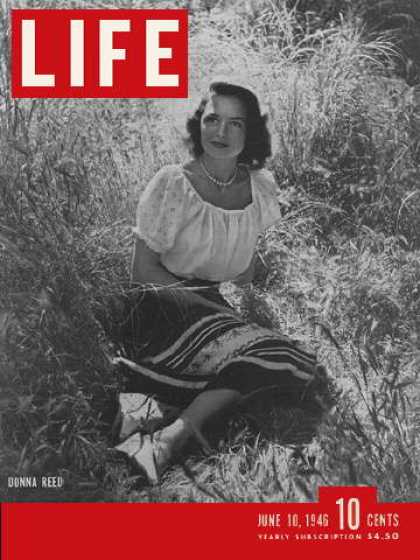
Donna Reed on a June 1946 cover of LIFE in peasant clothes

The Spanish and Latin influence was not just limited to night club entertainment but also rubbed off on fashion.

Popular 1940s summer fashions were influenced by Latin culture with peasant blouses, colorful fiesta skirts and espadrille shoes.

Jane Powell can be seen wearing this style in wore a  in “Luxury Liner” (1948). The July 17, 1944, LIFE magazine cover features a model wearing what was known as the “Peasant Clothes.” She is wearing a lose, capped sleeve blouse, a flared striped skirt and wedged hemp shoes.


Fly Rio, Rio by the sea-o

Movies reflected the Spanish influence interest with fashions, music, location and even film title. Some films in the 1940s were:

•Down Argentine Way (1940)
•Week-End in Havana (1941)
•Holiday In Mexico (1946)
•Thrill in Brazil (1946)

Other movies like “Gilda” (1946) or “Romance on the High Seas” (1948) are located in South America and take part in Carnival.

Why was this Hispanic influence huge in United States pop culture? 

The Good Neighbor Policy.

To state it as simply as possible-During Franklin D. Roosevelt’s presidency starting in 1933, the policy was created with the principle for the United States not to interfere with domestic affairs in Latin America, and the United States acting like “a good neighbor.”

Specifically with stars like Brazilian Carmen Miranda, her job was to star in patriotic films such as “The Gang’s All Here” to bridge the gap between the Americas.

However, the policy declined in 1945 after World War II ended and the Cold War began.

Cugat remained popular throughout the 1950s, but much like big band performers like Harry James or Tommy Dorsey, his popularity faded as the rumbas and dance music were less relevant and rock n’ roll started to emerge. He retired in 1971 after suffering a stroke.

This is part of the Hollywood Hispanic Heritage Blogathon with Aurora’s Gin Joint.

hollywoods-hispanic-heritage-blogathon-1

Check out the Comet Over Hollywood Facebook page for the latest updates. Contact us at cometoverhollywood@gmail.com or @HollywoodComet on Twitter.

Musical Monday: Ten Thousand Bedrooms (1957)

Image

It’s no secret that the Hollywood Comet loves musicals.
In 2010, I revealed I had seen 400 movie musicals over the course of eight years. Now that number is over 500. To celebrate and share this musical love, here is my weekly feature about musicals.

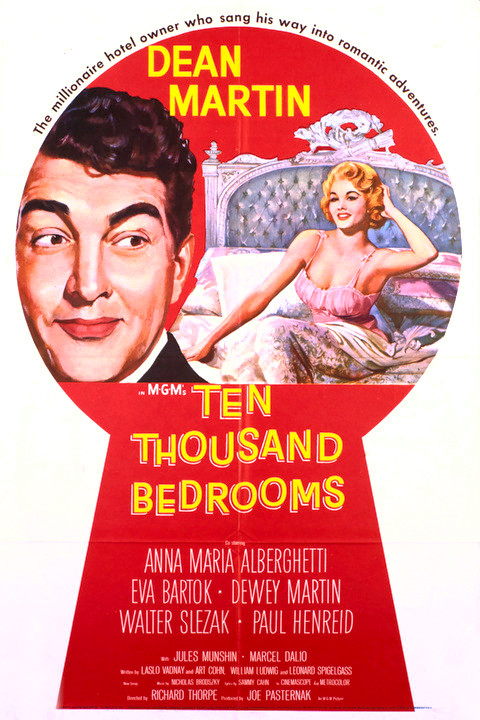
p721_p_v7_aaThis week’s musical:
Ten Thousand Bedrooms (1957) – Musical #520

Studio:
Metro-Goldwyn-Mayer

Director:
Richard Thorpe

Starring:
Dean Martin, Anna Maria Alberghetti, Paul Heinreid, Walter Slezak, Eva Bartok, Dewey Martin, Jules Munshin, Dean Jones

Plot:
Wealthy American Ray Hunter (Martin) owns a successful chain of hotels all over the world. The latest hotel he buys is in Rome where Nina Martelli (Alberghetti) works as a stenographer. Nina the youngest with three older sisters, the oldest-Maria (Bartok) who also is smitten with Ray. When Ray proposes to Nina, her father (Slezak) says there’s no way the youngest can get married be before her older sisters get married first. Ray gets to work on finding husbands for the other girls.

Trivia:
-Filmed on location in Rome, Italy
-The first film made after Dean Martin and Jerry Lewis’s partnership started to dissolve.

Notable Songs:
-Only Trust Your Heart performed by Dean Martin and Anna Marie Alberghetti

My review:
“Ten Thousand Bedrooms” is a cute, colorful musical with a great array of stars.
However, it didn’t fair too well in the box offices, resulting in a $1,196,000 for MGM. This was also a disappointment for Dean Martin. This was his first film after his split with Jerry Lewis. While Lewis’s career continued to with hit after hit, Martin wasn’t having as much luck.

Martin’s songs in the film were all fairly forgettable and seemed “safe” for a singer of his caliber. The worst of his songs is called “Money is a Problem,” a duet with Jules Munshin.

The most disappointing part of “Ten Thousand Bedrooms” for me is that we only here Anna Maria Alberghetti sing one song, and it’s only a few lines of the song.

Alberghetti has a beautiful operatic voice and which is completely wasted by not being utilized in the film.

The added bonus of this film is Paul Henreid. His part is small, but Henreid adds something special to all of his films.

The only other downside is that the film is a tad long at two full hours for as fluffy of a plotline.

For a colorful bit of cute escapism, check out “Ten Thousand Bedrooms,” just don’t expect any show stopping songs from either of the leads.

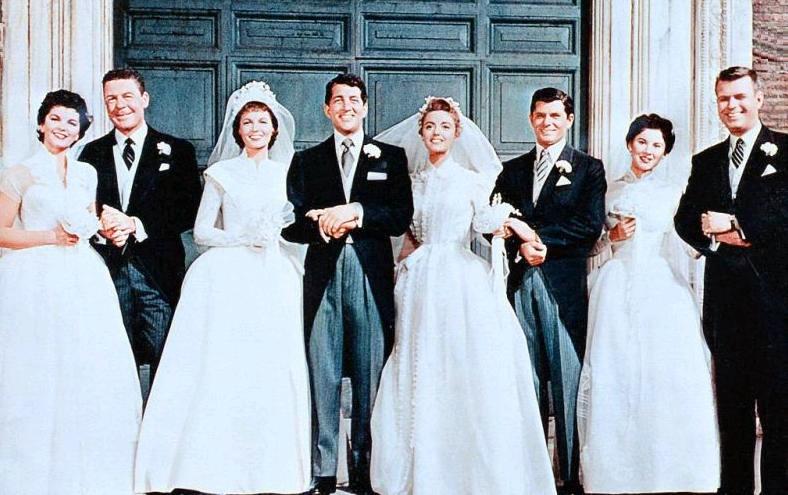
All of the brides in "Ten Thousand Bedrooms"

All of the brides in “Ten Thousand Bedrooms”

Check out the Comet Over Hollywood Facebook page, follow on Twitter at @HollywoodComet or e-mail at cometoverhollywood@gmail.com

Musical Monday: Ding Dong Williams (1946)

It’s no secret that the Hollywood Comet loves musicals.
In 2010, I revealed I had seen 400 movie musicals over the course of eight years. Now that number is over 500. To celebrate and share this musical love, here is my weekly feature about musicals.

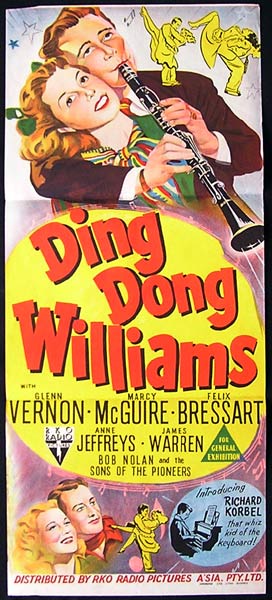
DINGDONGWILLIAMSThis week’s musical:
“Ding Dong Williams” (1946)– Musical #525

Studio:
RKO Radio Pictures

Director:
William Berke

Starring:
Anne Jeffreys, Glen Vernon, Felix Bressart, Marcy McGuire, Tommy Noonan, Cliff Nazarro, James Warren, William B. Davidson, Myrna Dell, Jason Robards, Sr.
As themselves: Bob Nolan, Sons of the Pioneers, Richard Korbel (Introducing 11-year Old Concert Pianist)

Plot:
Hugo Meyerheld (Bressart) is the head of music for a film studio and is told the music he wrote for a film is too antiquated. His adopted daughter Angela (McGuire) has the idea to get jazz clarinet player Ding Dong Williams (Vernon) to write the music. The only problem is that everything he plays is improvised and he doesn’t know how to read or write music.

Trivia:
-Based off short story from Collier’s Magazine, Strictly Ding Dong by Richard English.

-The child piano player Richard Korbel, was supposedly this was the first time in film history that was billed as himself in his first picture, according to a Sept. 27, 1945, article called “Baby Piano Genius Play Self on Screen-a Hollywood First.” This was also Korbel’s only film. Korbel was signed to the picture after receiving high praise after a Carnegie Hall performance.

-Glen Vernon is dubbed by Barney Bigard on the clarinet. Bigard was the clarinet player for Duke Ellington’s band and one of Louis Armstrong’s All-Stars.

Notable Songs:
-Cool Water performed by the Sons of Pioneers
-Candlelight and Wine performed by Anne Jeffreys
-I Saw You First performed by Marcy McGuire

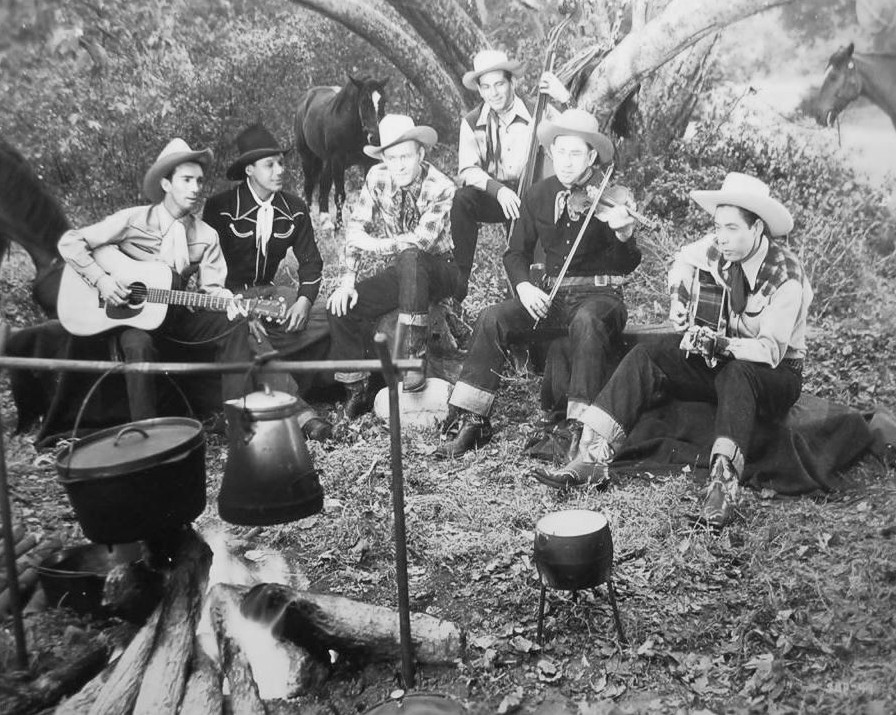
The Sons of the Pioneers performing in "Ding Dong Williams" (1946).

The Sons of the Pioneers performing in “Ding Dong Williams” (1946).

My review:
“Ding Dong Williams” is a simple, pleasant B-musical with the added bonus of only being an hour long.

Set on a Hollywood studio, the film’s plot isn’t much but it’s filled with entertaining songs and jazz music.

The highlight for me was the appearance and performance by the Sons of the Pioneers, known for usually performing with Hollywood cowboy, Roy Rogers.

Though I had never heard of child pianist Richard Korbel prior to this movie, which was his only film, it was interesting to see him perform a few impressive numbers. While his appearance was an interesting novelty, Korbel got quite the media build up for his appearance in this film. He was signed to the film after a successful performance at Carnegie Hall. The magnificent clarinet music in this film was also dubbed by notable clarinet player Barney Bigard of Duke Ellington and Louis Armstrong, which was amazing.

I also always enjoy North Carolina native Anne Jeffreys in her films and the plucky performance of teenage Marcy McGuire.

If you enjoy 1940s jazz music and like films that go by quickly, I suggest the fun, brief and entertaining “Ding Dong Williams.”

Check out the Comet Over Hollywood Facebook page, follow on Twitter at @HollywoodComet or e-mail at cometoverhollywood@gmail.com
Musical Monday: Wabash Avenue (1950)

It’s no secret that the Hollywood Comet loves musicals.
In 2010, I revealed I had seen 400 movie musicals over the course of eight years. Now that number is over 500. To celebrate and share this musical love, here is my weekly feature about musicals.

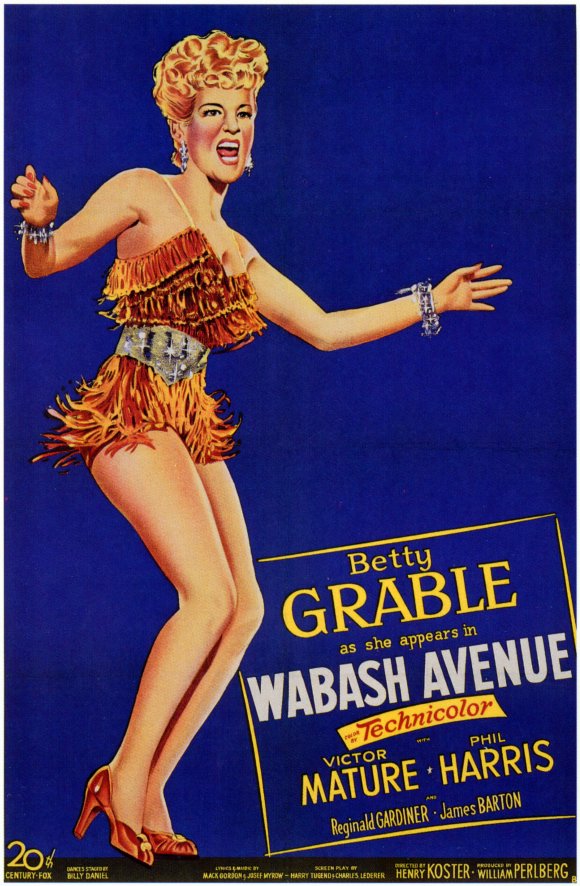
wabash-avenue-movie-poster-1950-1020197109This week’s musical:
“Wabash Avenue” (1950)– Musical #522

Studio:
20th Century Fox

Director:
Henry Koster

Starring:
Betty Grable, Victor Mature, Reginald Gardner, Phil Harris, James Barton, Barry Kelley, Margaret Hamilton

Plot:
In 1892, Ruby Summers (Grable) is the queen of burlesque with her rousing songs, outlandish costumes and shaking of hips. The owner of her dance hall, Mike Stanley (Harris) has cheated Andy Clark (Mature) out of his half ofthe business, and Andy is set to get even. Andy works to ruin Mike’s business and make Ruby into a lady while also making her fall for him.

Trivia:
-Remake of Betty Grable film, “Coney island” (1943), which co-starred George Montgomery and Cesar Romero.
-Josef Myrow and Mack Gordon were nominated for Best Music, Original Song for the song “Wilhelmina”

Notable Songs:
-“I Wish I Could Shimmy Like My Sister Kate” performed by Betty Grable
-“May I Tempt You With a Big Red Rosey Apple” performed by Betty Grable
-“Honey Man” performed by Betty Grable
-“Baby Won’t You Say You Love Me” performed by Betty Grable
-“Wilhelmina” performed by Betty Grable

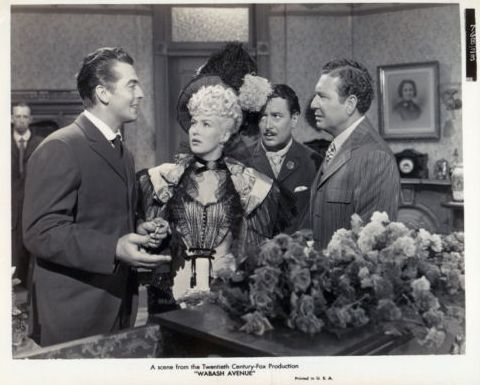
Victor Mature, Betty Grable, Reginald Denny and Phil Harris in

Victor Mature, Betty Grable, Reginald Denny and Phil Harris in “Wabash Avenue.”

My review:
It was rumored that all screenwriters did was take 1943’s “Coney Island,” which also starred Betty Grable, and put a new title page on it to create “Wabash Avenue.”

While I don’t actually think this is the case, “Wabash Avenue” is very similar and nearly is a scene-by-scene remake. I’m not sure why 20th Century Fox decided to remake the same film with the same lead actress, but it’s almost a little off putting.

However, in any film with Betty Grable, it’s difficult not to be drawn to her energetic delivery of a song and dance and “Wabash Avenue” is no exception. In this film, Grable’s Technicolor costumes and songs are fantastic and entertaining.

I of course still enjoyed this film, because I also liked “Coney Island,” but of the two, I prefer “Coney Island” due to the superior male co-stars of Cesar Romero and George Montgomery.

It’s hard to believe that Betty Grable would have anything romantic with Phil Harris-also if you have knowledge of Grable’s friendship with his wife Alice Faye. Though Victor Mature is believable for a grifting cad.

However, “Wabash Avenue” still offers Technicolor fun, regardless of its puzzling similarities to “Coney Island.”

Check out the Comet Over Hollywood Facebook page, follow on Twitter at @HollywoodComet or e-mail at cometoverhollywood@gmail.com
Musical Monday: The Jazz Singer (1952)

It’s no secret that the Hollywood Comet loves musicals.
In 2010, I revealed I had seen 400 movie musicals over the course of eight years. Now that number is over 500. To celebrate and share this musical love, here is my weekly feature about musicals.

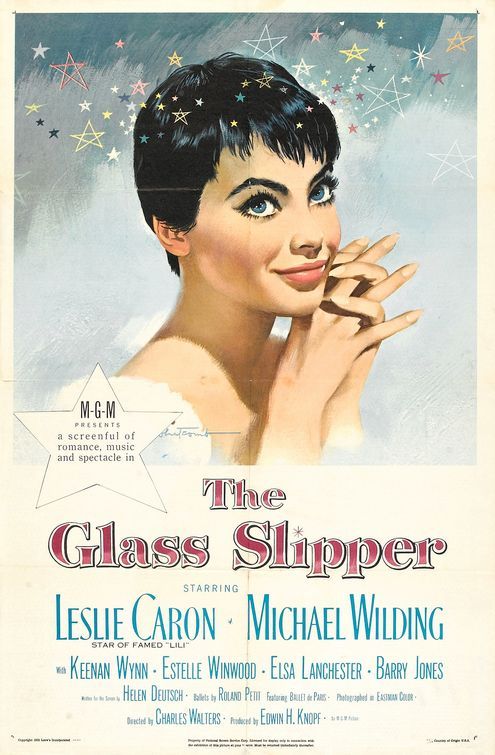
Poster_of_the_movie_The_Jazz_SingerThis week’s musical:
Jazz Singer (1952) – Musical #431

Studio:
Warner Brothers

Director:
Michael Curtiz

Starring:
Danny Thomas, Peggy Lee, Eduard Franz, Mildred Dunnock, Allyn Joslyn, Tom Tully

Plot:
Korean War veteran Jerry Golding (Thomas) returns home from the war. His father (Franz) has dreams of Jerry becoming a Jewish Cantor, but Jerry wants to become a famous jazz singer.

Trivia:
-Remake of the 1927 Al Jolson film The Jazz Singer, but with new songs.
-Doris Day was originally offered Peggy Lee’s role, but Day turned down the role. Just coming from “I’ll See You in My Dreams” with Danny Thomas, she felt it was too soon for them to be recast, according to TCM host Robert Osborne.
-Danny Thomas did not make another film after this movie, according to Osborne.
-Ray Heindorf and Max Steiner were nominated for an Academy Award for Best Music, Scoring of a Musical Picture

Notable Songs:
-What Are New Yorkers Made Of performed by Peggy Lee and Danny Thomas
-This Is a Very Special Day performed by Peggy Lee and Danny Thomas

Danny Thomas and Peggy Lee in

Danny Thomas and Peggy Lee in “The Jazz Singer” remake.

My review:
This lengthy, full sound and Technicolor remake of the 1927 “Jazz Singer” is visually lovely but is a tad dull story wise. In my opinion, the original film is dull but is important because of its influence on sound in music. But this 1952 remake doesn’t really pack any sort of punch and is overly long.

The songs by Sammy Fain, Cole Porter, Richard Rodgers and Lorenz Hart are toe-tapping-worthy, but all seemed like pretty safe songs for well-known, talented singers like Peggy Lee and Danny Thomas.

While Doris Day didn’t take the role, Peggy Lee seems to have been groomed to sound like her. While Lee talked and sang, I could picture Day in the role.

I also love Danny Thomas and adore the film “I’ll See You in my Dreams,” but he never seemed as comfortable in his films as he did in television, where he ultimately his largest success.

While this movie it’s a terrible movie, it’s not one that I would want to watch over and over again mainly due to how long Warner Brothers dragged out the story. I feel many of the early-1950s Warner Brothers color musicals-particularly the biopics- like this one tried too hard and ended up falling flat.

Check out the Comet Over Hollywood Facebook page, follow on Twitter at @HollywoodComet or e-mail at cometoverhollywood@gmail.com
Musical Monday: Way Down South (1939)

It’s no secret that the Hollywood Comet loves musicals.
In 2010, I revealed I had seen 400 movie musicals over the course of eight years. Now that number is over 500. To celebrate and share this musical love, here is my weekly feature about musicals.

way-down-south-posterThis week’s musical:
“Way Down South” (1939)– Musical #518

Studio:
RKO Pictures

Director:
Leslie Goodwins and Bernard Vorhaus

Starring:
Ralph Morgan, Bobby Breen, Clarence Muse, Alan Mowbray, Sally Blane, Edwin Maxwell, Steffi Duna, Matthew ‘Stymie’ Beard, Willie Best

Plot:
When plantation owner Timothy Reid, Sr. (Morgan) dies, his son Timothy, Jr. (Breen) inherits the plantations and all of the slaves. However, lawyer Martin Dill (Maxwell) is the executor of the will and begins selling the property and keeping the money for himself. When Timothy learns Dill plans on selling all of the slaves, who were never sold or beaten during the life of Reid, Timothy enlists help from friendly inn owners to prove Dill is corrupt.

Trivia:
-The film was written by Clarence Muse-who was in the film-and poet, writer and activist Langston Hughes. Several of the songs were also written by Muse and Hughes.
-This film is credited as the first mainstream film written by an African American, according to the book “EVERY STEP A STRUGGLE: Interviews with Seven Who Shaped the African-American Image in Movies” by Frank Manchel.
-Clarence Muse wrote a book called “Way Down South” and producer Sol Lesser wanted to use the title so he bought the book from Muse. The original 1932 book portrayed slaves in a dignified manner.
“He didn’t use any of the stuff on the inside. Then he paid me to do the ensemble, and I wrote the screenplay with Langston Hughes. It came out and we had a ball,” Muse said in an interview published in Manchel’s book.
-Victor Young was nominated for an Academy Award for Best Music, Scoring

Bobby Breen, Alan Mowbray and Sally Blane in

Bobby Breen, Alan Mowbray and Sally Blane in “Way Down South.”

Notable Songs:
-Good Ground written by Muse and Hughes, performed by the Hall Johnson Choir
-Louisiana written by Muse and Hughes, performed by Bobby Breen and Alan Mowbray
-Didn’t My Lord Deliver Daniel? performed by Muse and the Hall Johnson Choir
-Sometimes I Feel Like a Motherless Child performed by Breen and the Hall Johnson Choir

My review:
If you have ever seen little known B-film “Way Down South,” you can say you have seen a film written by celebrated writer and activist Langston Hughes.

Clarence Muse dresses as Bobby Breen's aunt as he tries to help him escape. This is a publicity photo with Muse and Edwin Maxwell.

Clarence Muse dresses as Bobby Breen’s aunt as he tries to help him escape.

Made in the grand year of 1939, this hour long B-musical is nothing to write home about and is most interesting because of it’s screenwriters Hughes and Muse. One of the screenwriters, Clarence Muse, also was one of the leads in the film.

Langston Hughes was criticized for his involvement in this film, however.

Hughes did not defend any racial representations but noted that he tried to highlight morals. He got involved with the film so that he could pay for his mother’s cancer treatments and her funeral, as well as other debts. It also allowed him to buy his first new clothes in three years, according to Which Sin to Bear?: Authenticity and Compromise in Langston Hughes by David Chinitz.

This movie was my first introduction to singing child star Bobby Breen, who acted in films from 1936 to 1942. I wasn’t a huge fan of Breen’s acting or singing, but it was interesting to be introduced to another child actor of the golden era. Though Breen’s singing didn’t grab me, the performances from the Hal Johnson choir are beautiful.

Along with Muse, Alan Mowbray’s role as a New Orleans inn owner was one of the more interesting characters. We also see Loretta Young’s sister, Sally Blane, in a very brief role as Mowbray’s wife.

It’s always interesting to discover forgotten films from Hollywood’s most celebrated year but this one is simply worth seeing due to its two screenwriters.

Check out the Comet Over Hollywood Facebook page, follow on Twitter at @HollywoodComet or e-mail at cometoverhollywood@gmail.com
Behind the Screen at the Museum of the Moving Image

Image

The film and television industry have shaped the way society behaves from the way they dress to the toys they play with.

The Museum of the Moving Image, located in Astoria, NY, celebrates TV and film of the past and present through exhibits that highlight everything down to film makeup and costuming, equipment used behind the scenes and the editing process of screenplays.

Exhibits also show where and how it all began from optical toys from the 1800s to early color television cameras.

In late July, I visited the Museum of Moving Image and enjoyed exploring their Behind the Screen exhibit which included everything from sketches by Orson Welles to a Margaret O’Brien doll. Below are photos from the visit:

All Made Up: 

20150724_145310

Life masks of actors. The front mask is of Dorothy McGuire in “The Enchanted Cottage” (1945) with Anthony Quinn in “Requiem for a Heavyweight” (1962) to the left. (Comet Over Hollywood/Jessica P.)

20150724_145514

A telegram sent by Orson Welles to Maurice Seiderman in reference to make-up–specifically rubber noses–for the film “Compulsion” (1959). Sent in Sept. 1958. (Comet Over Hollywood/Jessica P.)

Sketch made by Orson Welles in August 1958 of how he wanted his makeup to look in "Compulsion" (1959).

Sketch made by Orson Welles in August 1958 of how he wanted his makeup to look in “Compulsion” (1959). (Comet Over Hollywood/Brandon B.)

20150724_145612

Photos of Orson Welles exhibiting the makeup process for “Compulsion” (1959).

Wig worn by Elsa Lanchester in Bride of Frankenstein (1935). (Comet Over Hollywood/Jessica P.)

Wig worn by Elsa Lanchester in Bride of Frankenstein (1935). The white streaks was designed by makeup artist Jack Pierce to suggest her birth by electricity. The wig was made by the Max Factor Company and was reconstructed for the museum of Josephine Turner in 1991 who was the head of the wig-making department at Max Factor from 1935 to 1965. (Comet Over Hollywood/Jessica P.)

Wig worn by Bette Davis in “Jezebel” (1938). (Comet Over Hollywood/Jessica P.)

Wig worn by Elizabeth Taylor in “Cleopatra” (1963). The wig was designed by MGM’s hairstylist Sydney Guilaroff and constructed by Bill Huntley of Wig Creations in London. (Comet Over Hollywood/Jessica P.)

20150724_150258

Script for the Sidney Lumet directed film, “Network” (1976), written by Sidney Chayefsky. The red crayon is Lumet, who would cross out dialogue after it was filmed. (Comet Over Hollywood/Jessica P.)

20150724_150128

Replica of Robin Williams’ makeup for “Miss Doubtfire” (1993). (Comet Over Hollywood/Jessica P.)

20150724_150801

Costume worn by Hedy Lamarr as Delilah in “Samson & Delilah” (1949), directed by Cecil B. DeMille. The gown was designed by Edith Head. (Comet Over Hollywood/Jessica P.)

For the Fans and Consumers: 

IMG_20150724_151102

Various film fan magazines ranging from 1911 to 1980 including: Motion Picture, Photoplay, Picture Play, Motion Picture Classic, Film Fun, Real Screen Fun, Modern Screen, Silver Screen, Screen Romances, Movie Story, Screen and Television Guide, Screenland Plus TV-Land. (Comet Over Hollywood/Brandon B.)

IMG_20150724_151235

Lupe Velez on the cover of a October 1931 issue of Picture Play. (Comet Over Hollywood/ Brandon B.)

IMG_20150724_151206

Bette Davis on the cover of Modern Screen, promoting “The Letter.” (Comet Over Hollywood/Brandon B.)

IMG_20150724_151122

William S. Hart on the cover of a June issue of Motion Picture.


20150724_151123

Shirley Temple and the Dionne Quintuplets on an issue of Modern Screen. (Comet Over Hollywood/Jessica P.)

20150724_151310

Exhibiting how films affected the toy industry with film themed board games, dolls and paint books. (Comet Over Hollywood/Jessica P.)


A Pinnochio doll based off of Walt Disney’s 1940 cartoon. (Comet Over Hollywood/Jessica P.)

20150724_151346

Silent film actor Rudolph Valentino on 1935 “beautebox.” (Comet Over Hollywood/Jessica P.)

20150724_151413

“Our Gang” coloring book. (Comet Over Hollywood/Jessica P.)

Doll of child actress Margaret O’Brien (Comet Over Hollywood/Jessica P.)

Lantern slide, which were used during intermission in modern film houses, which were used between 1916 and 1929. (Comet Over Hollywood/Brandon B.)

Lantern slide, which were used during intermission in modern film houses, which were used between 1916 and 1929. (Comet Over Hollywood/Brandon B.)


IMG_20150724_152614

Film promotion posters and programs. (Comet Over Hollywood/Brandon B.)

Film Cameras: 

IMG_20150724_153529

Edison 35mm Projecting Kinetoscope, Model D, 1912.

IMG_20150724_153600

Pathe 35mm Projector from 1905. (Comet Over Hollywood/Brandon B.)

IMG_20150724_153628

Edison 35mm Projecting Kinetoscope, 1897. This sold for $100 at the time. (Comet Over Hollywood/Brandon B.)

IMG_20150724_154350

Three-strip Technicolor camera, Model EF-2, 1940. (Comet Over Hollywood/Brandon B.)


20150724_154553

Check out the Comet Over Hollywood Facebook page, follow on Twitter at @HollywoodComet or e-mail at cometoverhollywood@gmail.com


“It was my father’s success”: An interview with the real “Gidget”

 Comet Over Hollywood has reviewed the three “Gidget” feature films this summer. To wrap up the series, Comet interviewed Kathy Kohner Zuckerman, the real Gidget whose summer story inspired her screenwriter father to write a book. The conversation was delightful. Ms. Zuckerman was down-to-Earth and it felt like talking and laughing with an old friend. 

(r) Kathy Kohner in 1957 in the photo that was used on the book cover. (L) Kohner Zuckerman pictured in 2014 at Duke's, where she works.

(r) Kathy Kohner in 1957 in the photo that was used on the book cover. (L) Kohner Zuckerman pictured in 2014 at Duke’s, where she works.

It was a different world for Kathy Kohner as she walked on the film set of “Gidget” in 1959.

“It was hard to understand that they were making a movie about me,” said Kathy Kohner Zuckerman, the real “Gidget,” in a phone interview with Comet Over Hollywood on Tuesday, Aug. 25. “They weren’t even filming at Malibu.”

The 1959 “Gidget” film that starred Sandra Dee, James Darren and Cliff Robertson spawned two more feature films, two television shows and several made-for-TV movies. And it all began with a 15-year-old girl telling her father that she wanted to write a story about her summer.

Continue reading →