It’s no secret that the Hollywood Comet loves musicals. In 2010, I revealed I had seen 400 movie musicals over the course of eight years. Now that number is over 500. To celebrate and share this musical love, here is my weekly feature about musicals.
This week’s musical:
At War with the Army (1950) – Musical #581
Studio:
Paramount Pictures
Director:
Hal Walker
Starring:
Jerry Lewis, Dean Martin, Polly Bergen, Mike Kellin, Jimmie Dundee, Tommy Farrell, Danny Dayton, William Mendrek, Angela Greene, Jean Ruth
Plot:
Set on an Army base during World War II, Pfc. Alvin Korwin (Lewis) and 1st Sgt. Vic Puccinelli (Martin) were friends before the war and had a nightclub act. Private Korwin wants to go home to see his newly born baby and Sgt. Puccinelli wants to be transferred overseas. Confusion ensues when a pregnant old girlfriend arrives to visit Sgt. Vic Puccinelli.
It’s no secret that the Hollywood Comet loves musicals. In 2010, I revealed I had seen 400 movie musicals over the course of eight years. Now that number is over 500. To celebrate and share this musical love, here is my weekly feature about musicals.
Starring:
Connie Francis, Jim Hutton, Susan Oliver, Joby Baker, Barbara Nichols, Charles Lane, Jesse White, Chris Noel (uncredited), Madge Blake (uncredited)
Themselves: George Hamilton, Johnny Carson, Yvette Mimieux, Paula Prentiss, Danny Thomas
Plot:
Libby Caruso (Francis) has unsuccessfully tried to make it as a singer. Since she hasn’t made it, she decides to get a job so she can find a husband, get married and have babies. To help get ready in the morning, Libby invents the “Lady Valet” to hang clothes on. She meets Jim Davis (Hutton), who she falls in love with and he sees profit in the Lady Valet. While Jim tries to market the item, Libby mistakes his attention for love.
It’s no secret that the Hollywood Comet loves musicals. In 2010, I revealed I had seen 400 movie musicals over the course of eight years. Now that number is over 500. To celebrate and share this musical love, here is my weekly feature about musicals.
Starring:
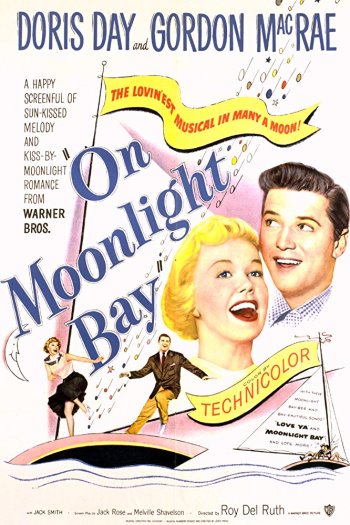
Doris Day, Gordon MacRae, Leon Ames, Rosemary DeCamp, Billy Gray, Mary Wickes, Jack Smith, Ellen Corby
Plot:
Starting in 1916, the film looks at a year in the life of the Winfield family. The films starts when the family moves to a new neighborhood hoping to refine their tomboy daughter Marjorie (Day). Marjorie falls in love with college student William Sherman (MacRae), whose has college ideas have him saying he doesn’t believe in marriage and that banks are parasites. These ideas don’t please her parents (Ames and DeCamp), so Marjorie dates several other young men, but she is preoccupied with thoughts of William. The film is filled with antics of her younger brother (Gray).
It’s no secret that the Hollywood Comet loves musicals. In 2010, I revealed I had seen 400 movie musicals over the course of eight years. Now that number is over 500. To celebrate and share this musical love, here is my weekly feature about musicals.
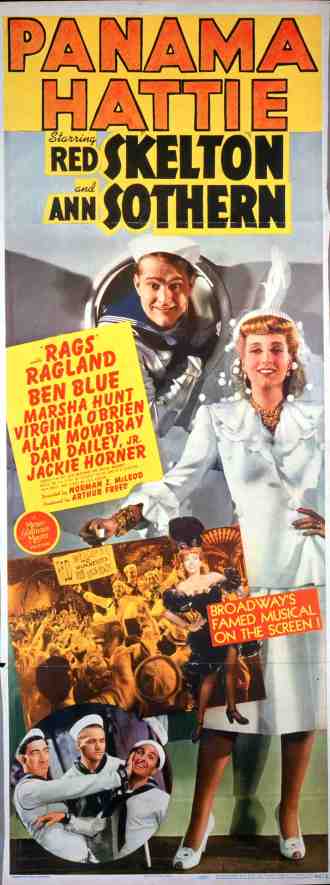
This week’s musical: Panama Hattie (1942) – Musical #114
Studio:
Metro-Goldwyn-Mayer
Director:
Norman Z. McLeod
Starring:
Ann Sothern, Dan Dailey, Red Skelton, Marsha Hunt, Rags Ragland, Ben Blue, Virginia O’Brien, Alan Mowbray, Jackie Horner
Herself: Lena Horne, Berry Brothers
Plot:
Set during World War II, Hattie Maloney, known as Panama Hattie (Sothern), owns a nightclub in Panama where her sailor friends Red, Rags and Rowdy (Skelton, Ragland, Blue) often visit. Hattie is in love with Dick Bulliard (Dailey), who is in the Army and stationed at a nearby base. Hattie is nervous because Dick has been married before and has an 8-year-old daughter Geraldine (Horner) who Hattie will soon meet. Geraldine and Hattie don’t get off on the right foot, as Geraldine laughs at Hattie’s loud clothing. Hattie also has competition when the daughter of the admiral, Leila Tree (Hunt), who has her sights set on Dick. Meanwhile, Red, Rags and Rowdy are always convinced there are spies around and end up uncovering a spy plot.
It’s no secret that the Hollywood Comet loves musicals. In 2010, I revealed I had seen 400 movie musicals over the course of eight years. Now that number is over 500. To celebrate and share this musical love, here is my weekly feature about musicals.
This week’s musical:
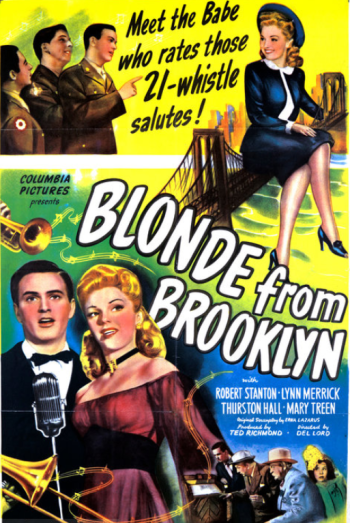
Blonde from Brooklyn (1945) – Musical #575
Studio:
Columbia Pictures
Director:
Del Lord
Starring:
Bob Haymes (billed as Robert Stanton), Lynn Merrick, Thurston Hall, Mary Treen, Gwen Verdon (uncredited), Matt Willis (uncredited), Hugh Beaumont (uncredited)
Plot:
Dixon Harper (Haymes/Stanton) is a soldier returning from World War II. The military lets him know about his G.I. rights, Dixon’s goal is to get back on the stage to perform like he did before the war. Dixon’s routine is to act southern, though he is not southern. He meets jukebox operator and struggling singer, Susan Parker (Merrick). The two team up for a southern act and work with an old southern colonel to be convincing as southerners and Susan masquerades as a southern belle.
Trivia:
-Lead actor Bob Haymes was billed as Robert Stanton in this film. He is the younger brother of Dick Haymes.
Notable Songs:
-“Baby, Save Him for Me” performed by Lynn Merrick
-“Comin’ Around the Corner” performed by Lynn Merrick and Bob Haymes
-“It’s Just a Prayer Away” performed by Bob Haymes
-“Lost, a Wonderful Girl” performed by Bob Haymes
Bob Haymes in “Blonde from Brooklyn”
Mary Treen and Lynn Merrick in Blonde from Brooklyn
My review:
“Blonde from Brooklyn” is one of those entertaining 1940s B-musicals that offers more in the way of music than plot.
Bob Haymes, younger brother of Dick Haymes, is a soldier returning home from World War II and wanting to get his old act off the ground. He meets a jukebox operator (see also Swing Hostess for similar 1940s technology) Lynn Merrick, who he convinces to join him in his act. The act focuses on being southern, though neither one is. They meet a southern colonel, played by Thurston Hall, who helps them create a convincing persona.
Merrick and Haymes both have wonderful singing voices and sing catchy and toe-tapping tunes throughout the film. I wasn’t very familiar with either actor, but found them equally pleasant. Bob Haymes doesn’t look like his older brother Dick, but he has a similar deep, soothing voice.
The only irritating thing about the film is that Bob Haymes, who originally hailed from White Plains, NY, talks with a supposed drawl and throws out some “honey-childs” and “you alls.” He eventually stops once everyone figures out his character isn’t from the south (thank goodness). But as someone who actually lives in the south, that sort of thing really grates on your nerves. Interestingly enough, Haymes retired and passed away in Hilton Head, SC.
Lynn Merrick was lovely and had some lovely costumes.
The best part of “Blonde from Brooklyn” is that it runs only 65 minutes, which is the perfect length for this kind of film. It tells the story adequately with songs sprinkled throughout. The plot isn’t very interesting but the songs are entertaining. If you’re a lover of 1940s tunes, give this one a look (and listen).
It’s no secret that the Hollywood Comet loves musicals. In 2010, I revealed I had seen 400 movie musicals over the course of eight years. Now that number is over 500. To celebrate and share this musical love, here is my weekly feature about musicals.
Starring:
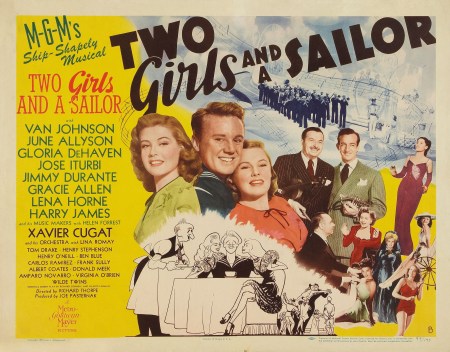
June Allyson, Gloria DeHaven, Van Johnson, Tom Drake, Jimmy Durante, Henry Stephenson, Henry O’Neill, Donald Meek, Frank Jenks, Frank Sully, Karin Booth (uncredited), Ava Gardiner (uncredited), Natalie Draper (uncredited), Gigi Perreau (uncredited), Arthur Walsh (uncredited)
Themselves: Carlos Ramírez, Ben Blue, José Iturbi, Amparo Iturbi, Harry James, Helen Forrest, Xavier Cugat, Lina Romay, Gracie Allen, Lena Horne, Virginia O’Brien, Lyn Wilde, Lee Wilde, Albert Coates
It’s no secret that the Hollywood Comet loves musicals. In 2010, I revealed I had seen 400 movie musicals over the course of eight years. Now that number is over 500. To celebrate and share this musical love, here is my weekly feature about musicals.
This week’s musical:
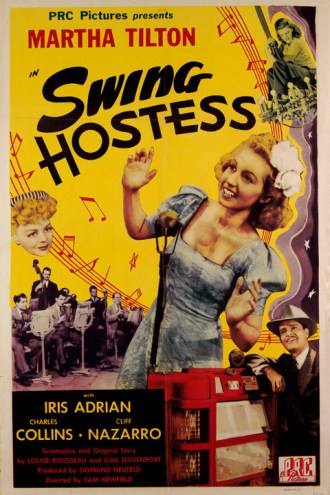
Swing Hostess (1944)– Musical #574
Studio:
Producers Releasing Corporation
Director:
Sam Newfield
Starring:
Martha Tilton, Iris Adrian, Charles Collins, Cliff Nazarro, Harry Holman, Emmett Lynn, Betty Brodel
Plot:
Jive singer Judy Alvin (Tilton) is having a hard time finding a job. She gets a job as a telephone operator for jukeboxes (people pick up a phone and give their song request). Judy cuts a record and it gets confused with acquaintance (and terrible singer) Phoebe Forbes (Brodel) who rides to success on Judy’s voice.
Trivia:
-One of the few films where Martha Tilton acts and isn’t just a specialty singer
-Actress Betty Brodel who is in the film is Joan Leslie’s sister
Highlights:
-Seeing Martha Tilton in a film
Notable Songs:
-“Got An Invitation” performed by Martha Tilton
-“Say It With Love” performed by Martha Tilton
-“Let’s Capture That Moment” performed by Martha Tilton
My review:
As a lover of big band music, Martha Tilton is one of my favorite girl singers of the 1940s. “Swing Hostess” is a small-time B-film but it’s also one of the few opportunities you can see her acting in a film, other than popping in as a specialty singer.
The storyline for “Swing Hostess” isn’t remarkable or new, but it’s fun and cute. It’s also set in my favorite time period: World War II era 1940s. So it’s filled with big band music. While the war isn’t mentioned very much, one of the main characters is drafted into the Army and Martha Tilton sings that he “Got An Invitation” (to be drafted).
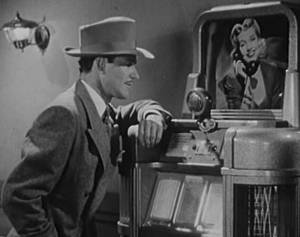
Charles Collins talks to a jukebox hostess
Also the most intriguing part is the jukebox technology. Before watching this film, I didn’t realize that patrons were able to pick up a phone and talk to a hostess on the other end who would put a record on. That is Martha Tilton’s job in this film.
Martha Tilton isn’t an amazing actress, but what she doesn’t have in acting, she makes up for in voice. Also Iris Adrian is there for comedic value.
If you love 1940s films and big band music, check out this film. Bonus points: It’s only 76 minutes!
It’s no secret that the Hollywood Comet loves musicals. In 2010, I revealed I had seen 400 movie musicals over the course of eight years. Now that number is over 500. To celebrate and share this musical love, here is my weekly feature about musicals.
This week’s musical:
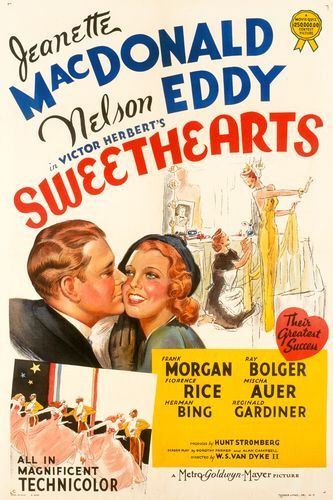
“Sweethearts” (1938)– Musical #292
Studio:
Metro-Goldwyn-Mayer
Director:
W.S. Van Dyke
Starring:
Jeanette MacDonald, Nelson Eddy, Frank Morgan, Ray Bolger, Reginald Gardiner, Florence Rice, Mischa Auer, Herman Bing, George Barbier, Fay Holden, Allyn Joslyn, Lucille Watson, Gene Lockhart, Kathleen Lockhart, Terry Kilburn, Olin Howland, Douglas McPhail, Betty Jaynes, Irving Bacon (uncredited)
Plot:
Husband and wife Broadway stars Gwen Marlowe and Ernest Lane (MacDonald and Eddy) have been happily married for six years and are in their sixth year of performing Victor Herbert’s operetta “Sweethearts.” They are exhausted due to constant singing obligations and decide to go to Hollywood. Their Broadway producer (Morgan) and his staff hatch a plan to drive the couple apart and keep them from going to Hollywood.
It’s no secret that the Hollywood Comet loves musicals. In 2010, I revealed I had seen 400 movie musicals over the course of eight years. Now that number is over 500. To celebrate and share this musical love, here is my weekly feature about musicals.
Starring:
Alice White, John Miljan, Jack Mulhall, Blanche Sweet, Ford Sterling, Virginia Sale, Herman Bing
Plot:
Dixie Dugan (White) is in a failed Broadway show, “Rainbow Girl.” She meets director John Buelow (Miljan) who gives the illusion that he is high powered in Hollywood and convinces her to leave New York to pursue a Hollywood career. Unsurprisingly when Dixie gets to Hollywood, she is now welcomed with open arms. Dixie befriends a “has been” actress Donna Harris (Sweet), who tries to warn her and show her the ropes. Dixie’s boyfriend (Mulhall) who wrote the failed Broadway show is invited to Hollywood to make “Rainbow Girl” into a film. Dixie is cast, but stardom goes to her head.
Trivia:
-The finale reel was filmed in Technicolor but this print no longer survives.
-Belle Mann dubbed Alice White
-Based on Joseph Patrick McEvoy’s 1929 novel, Hollywood Girl
-This film follows Show Girl (1928) where Alice White plays Dixie Dugan. It is followed by “Dixie Dugan” (1943) where Lois Andrews plays the role of Miss Dugan.
-A French version was made (Le masque d’Hollywood (1930)) starring Suzy Vernon, Geymond Vital, Rolla Norman
Highlights:
-Showing how films are made and giving a behind the scenes feel
-Cameo appearances by Al Jolson, Ruby Keeler, Noah Beery, Noah Beery, Jr.; Walter Pidgeon, and Loretta Young
Notable Songs:
-“There’s a Tear for Every Smile in Hollywood” performed by Blanche Sweet
-“I’ve Got My Eye on You” performed by Alice White, dubbed by Belle Mann
-“Hang On to a Rainbow” performed by Alice White, dubbed by Belle Mann
My review:
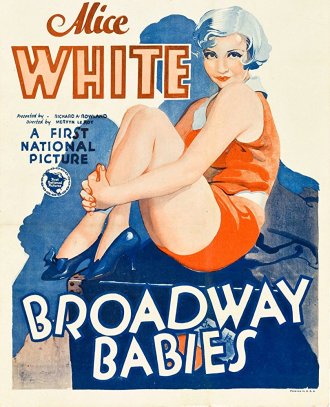
A few weeks ago, I reviewed Alice White’s first talkie, “Broadway Babies,” which I thought was only mediocre. “Show Girl in Hollywood” is perhaps slightly better but still rather bland and clumsy.
I also still don’t feel endeared to Alice White. She’s cute and spunky but she just isn’t a great actor. Probably the best performance in the film comes from Blanche Sweet, who I wasn’t familiar with prior, but her film career began in 1909. Sweet’s character tells Alice White that Hollywood no longer wants you after age 30 and not to take success for granted. Unfortunately, life seems to imitate art here, as Sweet only made one more film in 1930. Sweet retired in 1935 when she got married and would not make another film or TV appearance until 1958, the same year her husband passed away.
Blanche Sweet in “Show Girl in Hollywood”
“Miss Sweet plays her part so well that she puts Miss White in the shade,” wrote New York Times film critic Mordaunt Hall in his May 5, 1930, review.
Rather than the actors and main characters, the setting is the most interesting aspect of this film is the “behind the scenes” feel of Hollywood. It’s one of those Hollywood films about Hollywood, which are usually fun. We see a film being edited, the light crew, the cameras rolling, giving the audience a feeling that they are being let into how Hollywood works. Dixie even ignores the red filming light, walks onto a sound stage, to see a gangster film being shot. Two men are struggling and it looks like one is about to go out a window, then Dixie walks up and appears in the window the man is about to fall out, ruining the shot. This showed audiences how films were made.
We end with a Graumann’s premiere with cameos from actors like Loretta Young and Al Jolson with actress and wife Ruby Keeler all giving glowing remarks about the fictional film, “Rainbow Girl. These cameos are the most exciting part of the film. I hadn’t read ahead about the film so the cameos were a surprise and a treat.
During the premiere, we see the film’s big finale and the camera pans back as if we are watching it on the screen with the rest of the audience. If only the film had ended with that, showing that Dixie Dugan was triumphant, having her own film be the actual film’s ending. But no, Alice White and Jack Mulhall go up on stage (introduced by Walter Pidgeon) to sheepishly tell the audience that it will be a little until the make another film because they are getting married. It’s painful to watch and I just thought “no one in the audience cares and neither do I.”
If you enjoy (what the kids today call) a “meta” film, take a look at this one. The behind-the-scenes film is interesting, but the actual story and lead actors are not.
It’s no secret that the Hollywood Comet loves musicals. In 2010, I revealed I had seen 400 movie musicals over the course of eight years. Now that number is over 500. To celebrate and share this musical love, here is my weekly feature about musicals.
Starring:
Alice White, Marion Byron, Sally Eilers, Charles Delaney, Tom Dugan, Bodil Rosing, Jocelyn Lee, Fred Kohler
Plot:
Chorus girl Dee (White) is in love with stage manager Billy (Delaney), and they are engaged to be married. Dee’s friends Florine (Byron) and Navarre (Eilers) like Billy, but don’t approve of Dee being tied down. Dee moves from the chorus to star of the show when Blossom (Lee) is constantly late for rehearsal. Blossom makes a play for Billy, telling him that she can “get him places” and Dee gets jealous. When bootlegger Perc Gessant (Kohler) steps in and gets Dee a job at a nightclub, Dee and Billy split up, but are still in love.
Trivia:
-Alice White’s first talking film
-Alice White was dubbed by Belle Mann
-The talking film was released on June 30, 1929, and a silent version was released July 28, 1929. The silent version is currently lost.
-Based on the short story “Broadway Musketeers” by Jay Gelzer in Good Housekeeping (Oct 1928).
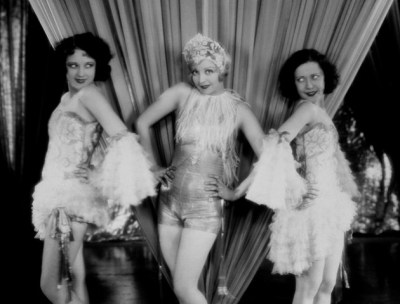
Alice White, Marion Byron, Sally Eilers
Notable Songs:
-“Wishing and Waiting for Love” performed by Alice White, dubbed by Belle Mann
-“Jig, Jig, Jigaloo” performed by Alice White, dubbed by Belle Mann
-“Broadway Baby Dolls” performed by Alice White, dubbed by Belle Mann
My review:
As Hollywood worked to adjust to the dawn of sound, musicals are one aspect that struggled to figure out what worked.
As we have discussed in previous posts, musical numbers were busy, storylines were incoherent and the songs didn’t fit smoothly into the plot.
“Broadway Babies” is a bit better and more watchable than some early musicals (like Tanned Legs), but that may because it’s more of a drama/musical than a straight musical.
This was actress Alice White’s first talking film. White is cute, petite and wears a blond bob, looking like the quintessential flapper. She isn’t the best actress in this film, but that also could be because it was her first talkie (I have only seen White in a handful of other movies so I don’t have much to compare her against). However, the other leads, Marion Byron, Sally Eilers and Charles Delaney, don’t act well either or deliver their lines in a meaningful way, so it could be because everyone was adjusting to a new medium.
Interestingly enough, this film was also shot as a silent film and released in theaters later. I thought that was curious, especially that they released the silent AFTER the talkie. It’s like giving dessert before dinner! The film uses some silent film methods, with title cards explaining what’s about to happen in each scene.
There are some cute dance numbers, but I thought “Gee Alice isn’t much of a singer,” so I was surprised to see White was dubbed by Belle Mann.
While several of the early musicals aren’t very good, I think they are worth seeing. Busby Berkeley is known for “saving” the musical genre in the 1930s, so it’s interesting to see just how far they came from the dawn of sound to only a few years later in 1933.

 This week’s musical:


 ” (1938)– Musical #292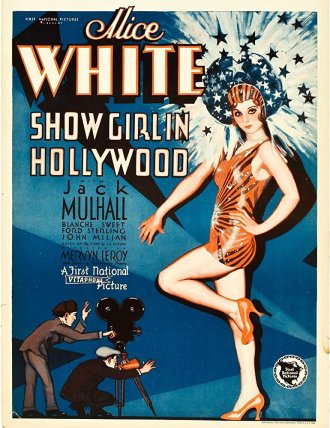
 (1930) – Musical #573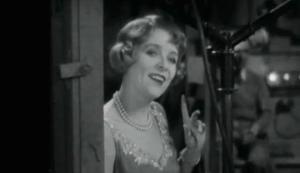
 Comet Over Hollywood