Musical Monday: The Gay Divorcee (1934)

It’s no secret that the Hollywood Comet loves musicals.
In 2010, I revealed I had seen 400 movie musicals over the course of eight years. Now that number is over 500. To celebrate and share this musical love, here is my weekly feature about musicals.
divorceThis week’s musical:
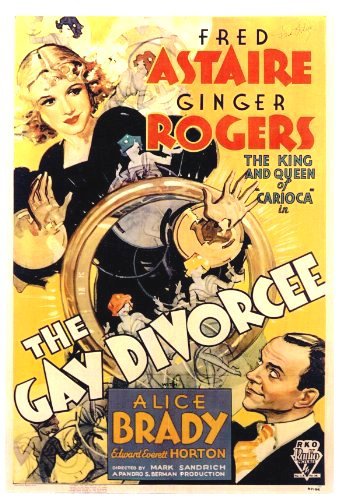
The Gay Divorcee” (1934)– Musical #121

Studio:
RKO Radio Pictures

Director:
Mark Sandrich

Starring:
Ginger Rogers, Fred Astaire, Alice Brady, Edward Everett Horton, Eric Blore, Erik Rhodes, William Austin, Betty Grable, Lillian Miles

Plot:
Mimi (Rogers) is traveling with her Aunt Hortense (Brady) and is looking for a

Trivia:
-This was Fred Astaire and Ginger Rogers’ second film together (out of 10 films). Following their success in “Flying Down to Rio” (1933), RKO teamed them together again.

-“The Continental” lasts 17.5 minutes. This was the longest musical number until Gene Kelly’s ballet in “An American In Paris” (1951).

-The Academy Awards for 1934 were the first to include the category for Best Original Song. Con Conrad and Herb Magidson were the first to receive this award for “The Continental.”

-Based on the 1932 Broadway show “The Gay Divorce,” which starred Fred Astaire and Claire Luce. For the film, the title was changed to “Divorcee.” Fred Astaire’s autobiography “Steps in Time” says the change was to show that the film was about the amorous adventures of a woman.

-Costumes designed by Walter Plunkett

Continue reading

Musical Monday: Two Tickets to Broadway (1951)

It’s no secret that the Hollywood Comet loves musicals.
In 2010, I revealed I had seen 400 movie musicals over the course of eight years. Now that number is over 500. To celebrate and share this musical love, here is my weekly feature about musicals.

broadwayThis week’s musical:
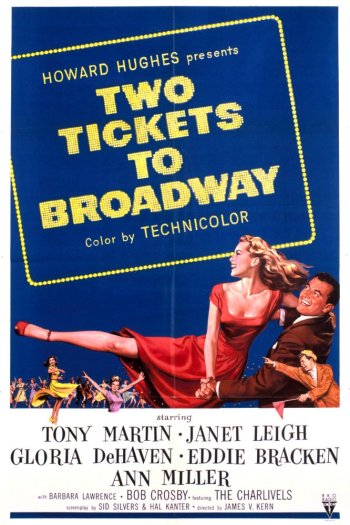
Two Tickets To Broadway (1951) – Musical #130

Studio:
RKO Pictures

Director:
James V. Kern

Starring:
Janet Leigh, Ann Miller, Gloria DeHaven, Barbara Lawrence, Tony Martin, Eddie Bracken, Charles Dale, Joe Smith, Joi Lansing (uncredited), Vera Miles (uncredited)
Themselves: Bob Crosby

Plot:
Nancy Peterson (Leigh) is given a big send off from her hometown, Pelican Falls, as she leaves to get her start on Broadway. On her bus trip to New York, she meets three down-on-their-luck performers: Hannah Holbrook (DeHaven), Joyce Campbell (Miller) and S.F. Rogers (Lawrence). Their agent (and Hannah’s boyfriend), Lew Conway (Bracken) continuously sets them up with dead-end gigs. Nancy also meets (and falls in love with) another down-on-his-luck performer, Dan Carter (Martin). To save face, Lew Conway lies to Dan, Nancy and the three girls; telling them that they have a huge performance spot on Bob Crosby’s TV show. The crew forms an act and starts rehearsing, not knowing that they may not be performing the act anywhere.

Continue reading

Musical Monday: All-American Co-Ed (1941)

It’s no secret that the Hollywood Comet loves musicals.
In 2010, I revealed I had seen 400 movie musicals over the course of eight years. Now that number is over 500. To celebrate and share this musical love, here is my weekly feature about musicals.

All American CoedThis week’s musical:
All-American Co-Ed (1941) – Musical #553

Studio:
Hal Roach Studios

Director:
LeRoy Prinz

Starring:
Frances Langford, Johnny Downs, Marjorie Woodworth, Noah Berry Jr., Esther Dale, Harry Langdon, Kent Rogers, Alan Hale Jr., Lillian Randolph, Margaret Roach (uncredited), Marie Windsor (uncredited), Dudley Dickerson, Claire James (uncredited)
Themselves: The Tanner Sisters- Mickey Tanner, Betty Tanner, Martha Tanner

Plot:
All-girls horticulture college Mar Bryn is failing to attract new students. They hold a contest to bring in beautiful female students. In an effort for publicity, Mar Bryn’s student newspaper makes fun of the Zeta fraternity at Quincton College. Out of revenge, the boys nominate one of their frat brothers to dress up like a girl and enroll.

Continue reading

Musical Monday: Rosalie (1937)

It’s no secret that the Hollywood Comet loves musicals.
In 2010, I revealed I had seen 400 movie musicals over the course of eight years. Now that number is over 500. To celebrate and share this musical love, here is my weekly feature about musicals.

This week’s musical:
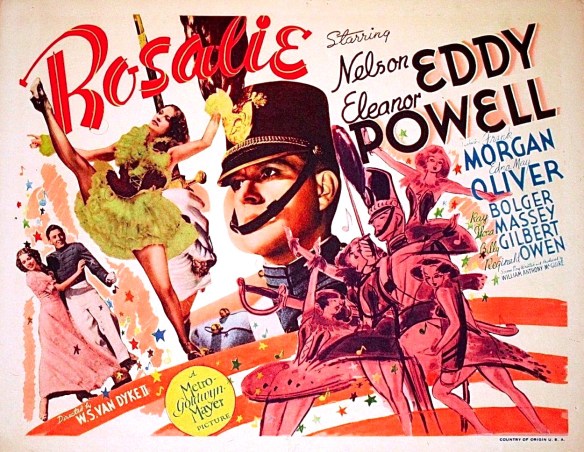
Rosalie” (1937)– Musical #140

rosalie

Studio:
Metro-Goldwyn-Mayer

Director:
W.S. Van Dyke

Starring:
Eleanor Powell, Nelson Eddy, Frank Morgan, Edna May Oliver, Ray Bolger, Ilona Massey, Reginald Owen, Virginia Grey, Billy Gilbert, Jerry Colonna, William Demarest, Tommy Bond, Tom Rutherford

Plot:
Rosalie (Powell) is a student at Vassar and also a princess from the country Romanza. She falls for West Point student Dick Thorpe (Eddy), who will be joining the Army after he graduates. When Rosalie is commanded home, she tells Dick to meet her in Romanza at a spring festival. The only problem is that Rosalie is betrothed to Prince Paul (Rutherford).

Continue reading

Musical Monday: Wintertime (1943)

It’s no secret that the Hollywood Comet loves musicals.
In 2010, I revealed I had seen 400 movie musicals over the course of eight years. Now that number is over 500. To celebrate and share this musical love, here is my weekly feature about musicals.

winterposterThis week’s musical:
Wintertime” (1943) – Musical #560

Studio:
20th Century Fox

Director:
John Brahm

Starring:
Sonja Henie, Cornel Wile, Cesar Romero, Jack Oakie, Carole Landis, S.Z. Cuddles Sakall, Helene Reynolds
Himself: Woody Herman

Plot:
Business partners Skip Hutton (Oakie) and Freddy Austin (Wilde) own a struggling Canadian hotel and are on the brink of foreclosure. When a Norwegian millionaire Hjalmar Ostgaard ( Sakall) and his niece Nora (Henie) stay at the hotel, Uncle Hjalmar is conned into buying the hotel. Nora falls in love with Freddy, but she’s mad that he has to spend most of his time with pretty reporter Marion Daley (Reynolds) so that the hotel can get publicity. Nora also starts performing as an ice skater to earn more money. While Nora is chasing Freddy, singers for Woody Herman’s band Flossie and Brad (Landis, Romero) are having love problems of their own.

Continue reading

Musical Monday: I Love Melvin (1953)

It’s no secret that the Hollywood Comet loves musicals.
In 2010, I revealed I had seen 400 movie musicals over the course of eight years. Now that number is over 500. To celebrate and share this musical love, here is my weekly feature about musicals.

melving7This week’s musical:
I Love Melvin” (1953)– Musical #167

Studio:
Metro-Goldwyn-Mayer

Director:
Don Weis

Starring:
Debbie Reynolds, Donald O’Connor, Una Merkel, Allyn Joslyn, Richard Anderson, Jim Backus, Noreen Corcoran, Les Tremayne, Barbara Ruick, Steve Forrest (uncredited), Robert Fuller (uncredited as acrobatic cheerleader), Ned Glass (uncredited)
Themselves: Robert Taylor

Plot:
Judy Schneider (Reynolds) is a struggling actress with dreams of becoming a Hollywood star. In the mean time, she’s playing a football in a musical number in a Broadway show. Melvin Hoover (O’Connor) is a Look magazine photographer’s assistant. The two bump into each other in Central Park ,and Melvin exaggerates the importance of his job to impress Judy and her family, who want her to marry Harry Flack (Anderson). Melvin’s exaggerations go too far when he promises to put Judy on the cover of Look magazine. All the while, Judy is daydreaming about her fame.

Trivia:
-The “Lady Loves” number was originally supposed to be performed with Debbie Reynolds in a farm setting, according to “That’s Entertainment III” (1994). It was re-shot with Debbie Reynolds dressed as a sophisticated lady.
-Howard Keel was originally supposed to be the star cameo in Reynolds’ dream, rather than Robert Taylor.

Highlights:
-Robert Taylor’s cameo
-The Football Ballet
-Noreen Corcoran’s song and dance with Donald O’Connor
-Dancers in Fred Astaire and Gene Kelly masks and costumes

Notable Songs:
-A Lady Loves performed by Debbie Reynolds
-Saturday Afternoon Before the Game performed by a chorus
-Where Did You Learn To Dance performed by Debbie Reynolds and Donald O’Connor
-We Have Never Met, As Yet performed by Debbie Reynolds and Donald O’Connor
-Life Has Its Funny Little Ups and Downs performed by Noreen Corcoran and Donald O’Connor

My review:
“I Love Melvin” (1953) is an adorable and joyous little movie. It isn’t a big, serious award-winning extravaganza like “Singin’ in the Rain” or “Seven Brides for Seven Brothers,” but it’s a simple story that’s plain fun.

In his April 10, 1953, review, New York Times film critic Bosley Crowther doesn’t call the film bad or good, but “chromium-plated spun-sugar” and that it lacks substance. Crowther isn’t incorrect. “I Love Melvin” is pure escapism and there’s nothing wrong with that.

And while this isn’t a serious film, the cast is excellent. Donald O’Connor and Debbie Reynolds are on-screen together two years after “Singin’ in the Rain” (1951). The two dance and perform with energy and professionalism. They are wonderful to watch and Reynolds and O’Connor have wonderful chemistry.

The outstanding supporting cast is rounded out by Una Merkel, Allyn Joslyn, Richard Anderson, Jim Backus, and Noreen Corcoran. For fans of the TV show “Emergency!,” actor Robert Fuller dances in the football ballet.

Mr. Crowther also wrote, “The music, while undistinguished, is sufficient to get them around and the decor is in the most splendid and expensive Metro style.”

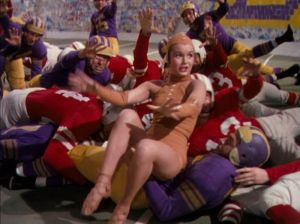
Debbie Reynolds dressed as a football, showing how much she is struggling in her dancing and acting career.

Debbie Reynolds dressed as a football, showing how much she is struggling in her dancing and acting career.

Many of the songs are forgettable but fun. The only real memorable song is “A Lady Loves,” which sometimes gets stuck in my head. The other performances include Noreen Corcoran and Donald O’Connor skating together and Debbie Reynolds is tossed around like a football among dancing football players. The football ballet may be one of the most creative and odd dance numbers I have ever watched. While goofy and bizarre, the football number is meant to be weird to show that Judy is far from fame.

A note to North Carolina football fans: the uniforms, colors and initials of the purple and gold team are similar to East Carolina University in North Carolina. I haven’t been able to find any facts to see if this was intentional.

Along with the football ballet, there are other hilariously goofy scenes as Judy daydreams such as Robert Taylor as her love interest and dancers dressed in Gene Kelly and Fred Astaire costumes.

Debbie Reynolds dreaming that she's in a film with Robert Taylor

Debbie Reynolds dreaming that she’s in a film with Robert Taylor

Debbie Reynolds in a daydream with dancers dressed as Gene Kelly and Fred Astaire

Debbie Reynolds in a daydream with dancers dressed as Gene Kelly and Fred Astaire

While this movie is fun, it is a little sad to watch now. Both child star Noreen Corcoran and actress Debbie Reynolds passed away in 2016. Both are delightful in this movie. This may be one of my favorite Debbie Reynolds films (at least in my top 5).

If you are feeling down, give “I Love Melvin” a watch. The plot is silly and it’s not a serious film, but what does that matter? It’s pure joy.

Donald O'Connor and Debbie Reynolds in "I Love Melvin"

Donald O’Connor and Debbie Reynolds in “I Love Melvin”

Check out the Comet Over Hollywood Facebook page, follow on Twitter at @HollywoodComet or e-mail at cometoverhollywood@gmail.com

Musical Monday: Billy Rose’s Jumbo (1962)

It’s no secret that the Hollywood Comet loves musicals.
In 2010, I revealed I had seen 400 movie musicals over the course of eight years. Now that number is over 500. To celebrate and share this musical love, here is my weekly feature about musicals.

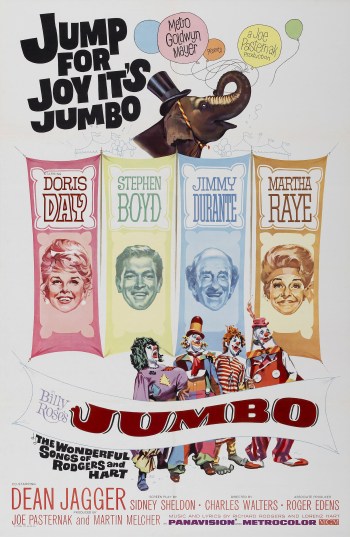
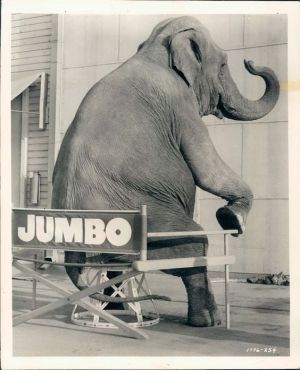
jumboThis week’s musical:
Billy Rose’s Jumbo” (1935)– Musical #23

Studio:
Metro-Goldwyn-Mayer

Director:
Charles Walters

Starring:
Doris Day, Stephen Boyd, Martha Raye, Jimmy Durante, Dean Jagger, John Astin (uncredited)

Plot:
Set in the early 1900s, the Wonder Circus is run by Pop Wonder (Durante) and his daughter Kitty (Day) with their main attraction Jumbo the Elephant. The circus is floundering financially and unpaid performers are quitting left and right to join other shows. Kitty hires a drifter Sam (Boyd) who does odd jobs and various performances. Kitty falls for Sam, but does Sam have the circus’s best interest in mind?

Awards and Nominations:

  • George Stoll was nominated for an Academy Award for Best Music, Scoring of Music, Adaptation or Treatment

Trivia:

  • Though she sang the title track for some of her films, this was Doris Day’s last musical film.
  • The film is based on a Billy Rose produced show, which opened on Broadway on Nov. 16, 1935, at the Hippodrome.
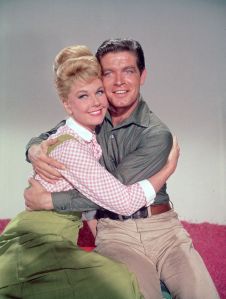
  • Day and Boyd in "Jumbo"

    Day and Boyd in “Jumbo”

    The film rights were bought by MGM in 1943 to co-star Judy Garland, Mickey Rooney, Wallace Beery and Frank Morgan, according to the book “Charles Walters: The Director Who Made Hollywood Dance” by Brent Phillips.

  • Though the four leads had doubles for the circus routines, they all went to circus school so the actor’s shots and would blend with the stunt doubles, according to Charles Walters: The Director Who Made Hollywood Dance by Brent Phillips.
  • Jimmy Durante starred in both the 1935 Broadway show and the 1962 film. Aside from a cameo in “It’s a Mad, Mad, Mad, Mad World,” this was Durante’s last major role in a feature film.
  • Director Charles Walters originally wanted Richard Burton as the male lead, according to Phillips’ book.
  • Choreographed by Busby Berkeley. This was Berkeley’s last film. Director Charles Walters hired Berkeley because he felt he was the only one who could effectively stage the large circus numbers in the manner they were performed on Broadway, according to Charles Walters: The Director Who Made Hollywood Dance by Brent Phillips.
  • Music written by Richard Rodgers and Lorenz Hart
  • Stephen Boyd is dubbed by James Joyce

Highlights:

  • Doris Day’s costuming
  • Circus acts
  • Jumbo the elephant
  • Martha Raye dressed as a lion during the “Circus On Parade” number

Notable Songs:

  • “Over and Over Again” performed by Doris Day
  • “This Can’t Be Love” performed by Doris Day
  • “Circus On Parade” performed by Jimmy Durante, Martha Raye, Doris Day
  • “The Most Beautiful Girl in the World” performed by Stephen Boyd, dubbed by James Joyce, and reprised by Jimmy Durante
  • “My Romance” performed by Doris Day
  • “Why Can’t I?” performed by Doris Day and Martha Raye

My review:
I will watch any film that includes:
1. Doris Day
2. Circus themes
And “Jumbo” has both of those features that would pull me into the film. The first time I saw this movie in 2003 at the dawn of my Doris Day love, I don’t remember particularly loving this movie. Revisiting it more than 10 years later, I enjoyed it for the most part but it does have its flaws.

Shot in gorgeous in Metrocolor, the movie is visually pleasing with circus costumes, big tops and Doris’s long blond (wig) hair. The Richard Rogers and Lorenz Hart written music also helps. “This Can’t Be Love,” “My Romance” and “Over and Over Again” are lovely and enjoyable songs.

“Jumbo” starts off as incredibly enjoyable. The ending leaves me a little deflated, not because it’s sad, but because the last eight minutes is a ridiculous long rendition of “Saw Dust, Spangles and Dreams.” This is complete with the lead cast (including Stephen Boyd) doing a clown act and Boyd is even a lion tamer.

Jimmy Durante is, as always, humorous and adorable. And because he always seems so sweet, your heart breaks with him at the thought of potentially losing his circus and beloved elephant Jumbo. I also love that Durante was in the original 1935 Broadway show, as well as this film.

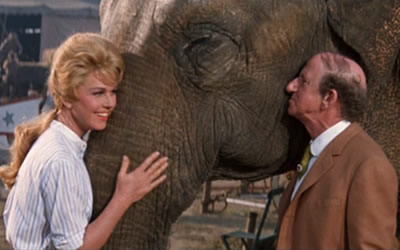
Doris Day, Syd the Elephant and Jimmy Durante

Doris Day, Syd the Elephant and Jimmy Durante

In some films, Martha Raye’s prescience can be a bit much for me, but I enjoy her role in this movie. She’s funny and she and Doris Day perform a lovely duet. I’m not positive how they got along offset, but they make a charming set of female friends in this movie.

As for our star: With all of her films, Doris Day shines in this movie. Though it’s obviously a wig, her long turn-of-the-century hairstyle looks nice on her and her costumes are colorful. She makes an energetic, joyful and fun circus performer. The only issue is I can’t help but feel that this movie would have been more effective 10 years earlier when Day was under contract with Warner Brother’s.

While “Jumbo” is fun, I just feel that it’s a 1952 movie musical trying to fit in 1962. By 1962, movie musicals were starting to decline. They were also taking a more serious tone, such as “West Side Story” (1961), which looked at racism and gang violence. “Jumbo” producer Joe Pasternak produced many of MGM’s Technicolor extravaganzas in the 1940s and 1950s, such as “Thrill of Romance” (1944) starring Esther Williams, “Anchors Away” (1945) starring Frank Sinatra and Gene Kelly, and “In the Good Old Summertime” (1949) starring Judy Garland. Even he knew that “Jumbo” didn’t fit in anymore.

“We were getting older while the audiences were getting younger. Doris Day wasn’t a kid,” Pasternak said.

The film rights to the 1935 Broadway play were purchased by MGM in 1943, to co-star Judy Garland, Mickey Rooney, Wallace Beery and Frank Morgan. Later in 1947, it was set to star Garland or Kathryn Grayson with Frank Sinatra. And again, in 1952, Debbie Reynolds, Red Skelton, and Donald O’Connor were to be in the film, according to the book “Charles Walters: The Director Who Made Hollywood Dance” by Brent Phillips.

I can picture this film with any of the above listed in the time frame they were originally considered. Doris Day, Durante and Raye would have been even better in this film in 1952. Maybe Gordon MacRea could have played the leading man.

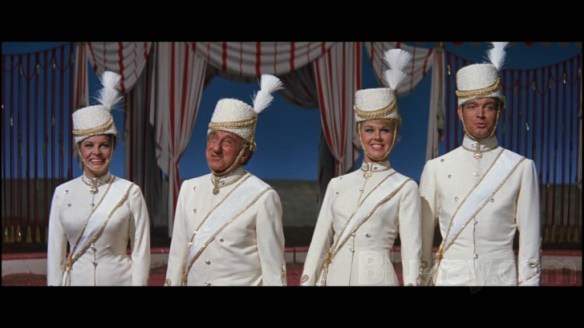
Raye, Durante, Day, Boyd in "Jumbo"

Raye, Durante, Day, Boyd in “Jumbo”

Another flaw was casting actor Stephen Boyd as the leading man. I love Stephen Boyd (and I had a major crush on him after first seeing this film) and I think he’s a great actor. However, Boyd doesn’t fit in a musical. This just doesn’t seem his style and he ended up being dubbed.

Director Charles Walters said Boyd worked hard on the film but wasn’t right for the film. Walters did say Boyd had a good sense of humor on set, which I was happy to hear. However, instead of Boyd, Walters wanted Richard Burton instead, which would not have been better than Boyd.

jumboThe only lead star in this film that didn’t receive enough screen time was the film’s namesake: Jumbo, played by Syd the elephant. For a film named after the elephant’s character, Syd probably only was on screen for 15 minutes of the 126 film.

For a movie about Jumbo, you see very little of the elephant, but his scenes are enjoyable. You get to see Jumbo do a few acts and play the tuba. I love elephants, so I particularly enjoyed his scenes.

Though “Billy Rose’s Jumbo” should have been released in theaters at least five years earlier to be relevant to audiences, it still is a fairly enjoyable film.

Check out the Comet Over Hollywood Facebook page, follow on Twitter at @HollywoodComet or e-mail at cometoverhollywood@gmail.com


Musical Monday: Tonight and Every Night (1945)

It’s no secret that the Hollywood Comet loves musicals.
In 2010, I revealed I had seen 400 movie musicals over the course of eight years. Now that number is over 500. To celebrate and share this musical love, here is my weekly feature about musicals.

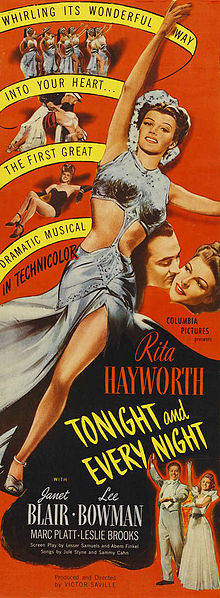
tonightThis week’s musical:
Tonight and Every Night” (1945)– Musical #181

Studio:
Columbia

Director:
Victor Saville

Starring:
Rita Hayworth, Janet Blair, Lee Bowman, Marc Platt, Leslie Brooks, Florence Bates, Professor Lamberti, Shelly Winters (uncredited)

Plot:
Told as a retrospective story to a LIFE magazine reporter, a theater in London never closed or missed a performance during the German blitz in London throughout World War II. The stars of the show were Rosalind Bruce (Hayworth), Judy Kane (Blair) and Tommy Lawson (Platt) are the stars of the show. Rosalind is an American and ends up falling in love with British flyer Paul Lundy (Bowman).

Trivia:
-Loosely based on the Windmill Theatre in London, which never closed during World War II and the German blitz
-Rita Hayworth took time off after filming “Tonight and Every Night” to have her baby, daughter Rebecca, who she had with Orson Welles, according to a “Movie of the Week” feature in the Feb. 12, 1945, issue of LIFE magazine.
-Originally was set to be a drama with Ida Lupino and Merle Oberon. After Hayworth’s success in “Cover Girl,” Columbia cast Hayworth in the film instead and made it into a musical, according to Turner Classic Movie Host Ben Mankiewicz.
-Because Rita Hayworth was pregnant during the filming, costume designer Jean Louis had to find creative ways to hide her pregnancy.
-Based on the play “Heart of a City.”
-Choreographed by Jack Cole, who dances during the number “What Does an English Girl Think of a Yank?”
-Rita Hayworth was dubbed by Martha Mears

Highlights:
-Rita Hayworth’s “You Excite Me” number, choreographed by Jack Cole
-Marc Platt’s dancing, particularly when he is auditioning

Notable Songs:
-“Tonight and Every Night” performed by Janet Blair, the cast and Rita Hayworth, dubbed by Martha Mears
-“You Excite Me” performed by Rita Hayworth, dubbed by Martha Mears
-“The Boy I Left Behind” performed by Janet Blair, Rita Hayworth, dubbed by Martha Mears
-“What Does an English Girl Think of a Yank?” performed by Rita Hayworth, dubbed by Martha Mears (mainly notable for the dancing.)
-“Anywhere” performed by Janet Blair

My review: (with vague SPOILERS)
“Tonight and Every Night” is my favorite Rita Hayworth film. This is a fairly forgotten and underrated musical, which is a shame. “Tonight and Every Night” explodes with gorgeous Technicolor and has a few fantastic dance numbers choreographed by Jack Cole.

This isn’t your average fluffy musical. I think what I like best about this lively film is that it’s set during World War II and mixes musical comedy with a serious theme: the German blitz on England during World War II. The storyline focuses on a theater in London vowing never to close or end a performance during the Blitz. This plot makes the film interesting and gives it weight. In the film, the actors even decide to make a dormitory out of the theater, sleeping in dressing rooms and making a little canteen. Rita Hayworth’s romance with Lee Bowman is more of a subplot to this than the main focus. (SLIGHT SPOILER) “Tonight and Every Night” also takes very sad and serious turn at the end that leaves me in tears every time. Turner Classic Movies host Ben Mankiewicz said 1945 audiences were unprepared and shocked by an ending that wasn’t happy. Most musicals from the dawn of sound to the 1950s didn’t leave the audience sad. Out of the pre-1959 musicals I have seen, this is the only one that leaves me sad.

Mankiewicz also said that this film originally wasn’t intended to be a musical and was going to star Ida Lupino and Merle Oberon. While I can picture how this film would have played out, I am happy that it ended up being a musical — even if Rita Hayworth was dubbed.

While singing may not have been a strong suit of Hayworth’s, her dancing is superb. I often find that Hayworth’s dancing skills are overlooked, as she’s often remembered for film noirs like “The Lady from Shanghai” or “Gilda.” However, I would list her in the top 10 best dancers in Hollywood of the classic era. Her best dance numbers in this film are “You Excite Me” and “What Does an English Girl Think of a Yank?”

Another fantastic dancer in this film is Marc Platt. Not a well-known name, Platt was also one of the brothers in “Seven Brides for Seven Brothers” and danced in “Oklahoma.” This seems to be one of the few films that he had a speaking role in. Most notably in this film, Platt auditions for Florence Bates dancing to classical, opera, boogie-woogie and a Hitler speech.

Also in the film is Janet Blair who is beautiful to look at and has a lovely singing voice. She and Rita Hayworth compliment each other well on-screen.

“Tonight and Every Night” will maybe make you laugh and smile, and maybe even cry, but it’s a fast-moving Technicolor marvel that you shouldn’t miss.

Check out the Comet Over Hollywood Facebook page, follow on Twitter at @HollywoodComet or e-mail at cometoverhollywood@gmail.com

Musical Monday: Down To Their Last Yacht (1934)

It’s no secret that the Hollywood Comet loves musicals.
In 2010, I revealed I had seen 400 movie musicals over the course of eight years. Now that number is over 500. To celebrate and share this musical love, here is my weekly feature about musicals.

yacht2This week’s musical:
Down to Their Last Yacht (1934) – Musical #556

Studio:
RKO Radio Pictures

Director:
Paul Sloane

Starring:
Mary Boland, Polly Moran, Ned Sparks, Sidney Fox, Sidney Blackmer, Sterling Holloway, Marjorie Gateson, Irene Franklin, Ramsay Hill, Lynne Carver (uncredited)

Plot:
When the wealthy New York Colt-Stratton’s (Fox, Hill Gateson) lose everything in the 1929 crash, they become part of the working class. All they have left is their yacht. Nella Fitzgerald (Moran) approaches the family with the idea to rent out the yacht for a cruise for the nouveau riche. One of the passengers, gambler Barry Forbes (Blackmer), falls in love with Lucy Colt-Stratton (Fox) during the voyage. During the sea trip, the boat shipwrecks on South Sea Island of Malakamokolu. The island is ruled by Queen Malakamokalu (Boland), who made herself the ruler of the island. She makes all the passengers labor around the island. She also gives them an ultimatum: Either Barry marries her or she kills them all.

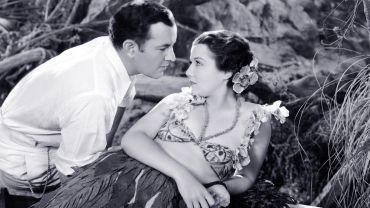
Sidney Blackmer and Sidney Fox in "Down to Their Last Yacht"

Sidney Blackmer and Sidney Fox in “Down to Their Last Yacht”

Trivia:
-Producer Lou Brock’s last film for RKO.
-Scored by Max Steiner

Highlights:
-Ned Sparks humor

Notable Songs:
-“Tiny Little Finger on Your Hand” performed by Sidney Blackmer
-“There’s Nothing Else to Do in Ma-La-Ka-Mo-Ka-Lu” performed by the chorus
-“South Sea Bolero” performed by the chorus

My review:
“Down to Their Last Yacht” is an odd little comedy mixed with music. It’s a little scatterbrained, but pretty funny and has some pre-code humor. The film begins and you think it is going to follow the three Down Colt-Strattons more, but they have a fairly minor role, except for Lucy, played by Sidney-Fox. The names you recognize are in the supporting cast (Polly Moran, Mary Bolland, Ned Sparks), but unfortunately, the straight-faced Ned Sparks is wasted in this film. He’s hardly in it.
The film was going a fairly predictable path until the boat shipwrecks. That was pretty unexpected and the plot takes a completely different turn. I’ll admit I was a little disappointed by this. The plot went completely zany, when I hoped the film was going to focus more on the social-registry family who now has to work for a living.
This is one of those movies that is comedy first and musical second, but it has enough songs to qualify as a musical. The songs aren’t memorable but they’re catchy.
“Down to Their Last Yacht” isn’t well-known as a musical, pre-code or comedy, but it’s enjoyable. It’s a quirky little hour long film filled with nonsense that you should catch.

Polly Moran in "Down to Their Last Yacht"

Polly Moran in “Down to Their Last Yacht”

Check out the Comet Over Hollywood Facebook page, follow on Twitter at @HollywoodComet or e-mail at cometoverhollywood@gmail.com

Musical Monday: Ziegfeld Girl (1941)

It’s no secret that the Hollywood Comet loves musicals.
In 2010, I revealed I had seen 400 movie musicals over the course of eight years. Now that number is over 500. To celebrate and share this musical love, here is my weekly feature about musicals.

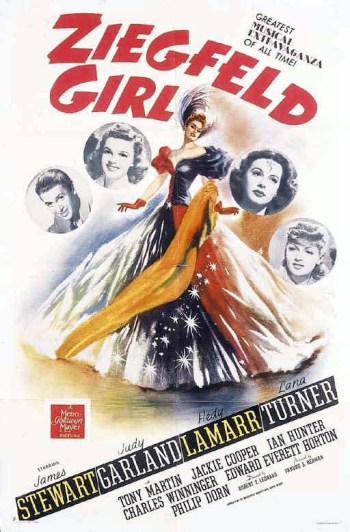
ziegfeld2This week’s musical:
Ziegfeld Girl” (1941) Musical #126

Studio:
Metro-Goldwyn-Mayer

Director:
Robert Z. Leonard, Busby Berkeley

Starring:
Lana Turner, Judy Garland, Hedy Lamarr, James Stewart, Jackie Cooper, Charles Winninger, Tony Martin, Ian Hunter, Eve Arden, Philip Dorn, Al Shean, Edward Everett Horton, Dan Daily, Fay Holden, Felix Bressart, Rose Hobart, Leslie Brooks (uncredited), Georgia Carroll (uncredited), Joyce Compton (uncredited), Patricia Dane (uncredited), Myrna Dell (uncredited), Jean Wallace (uncredited)

Plot:
Three girls are selected to be in the latest Broadway production of Florenz Ziegfeld:
• Sheila (Turner), a Brooklyn native who is discovered while working on an elevator in a department store
• Susie (Garland), a performer in an act on vaudeville with her father. The only problem is Mr. Ziegfeld only wants Susie and not her dad (Winninger)
• Sandra (Lamarr), who is discovered while she is with her violinist husband (Dorn), who is auditioning for the orchestra.
The film follows the girls as they rise to fame and the trials they face on their way up: alcohol, wooing men who try to take them away from husbands and boyfriends and getting accustomed to more money. They all learn that fame has a great price.

Trivia:
-Florenz Ziegfeld was a famous Broadway producer who died in 1932. He was known for his lavish sets and elaborate costumes that “glorified the American girl.” Ziegfeld is a God-like figure in this film: he is discussed but never seen.

-“Ziegfeld Girl” is one of three films MGM dedicated to Florenz Ziegfeld. This film is a follow up to “The Great Ziegfeld” (1936), a biopic of Ziegfeld starring William Powell as the impresario. “Ziegfeld Girl” is a sequel which shows the life of the Ziegfeld Girls. The third film was “Ziegfeld Follies” (1946), which just showed multiple Ziegfeld-like acts.

-Hedy Lamarr requested to be in this film as a change of pace from her other dramatic roles, according to historian John Fricke.

-Two of the actors in the film were in original Florenz Ziegfeld produced films: Charles Winneger, who was in the original stage production of Show Boat, and Al Shean, who was part of the act Gallagher and Shean. Winninger and Shean recreate one of the Gallagher and Shean numbers in the film.
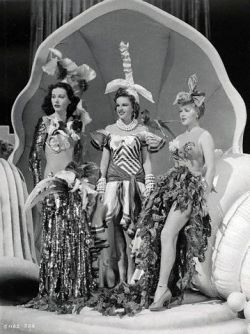
ziegfeld5

Hedy Lamarr, Judy Garland and Lana Turner in costume for the “Minnie from Trinidad” number

-The production of this film was originally announced in 1938 and was to star Eleanor Powell, Joan Crawford, Margaret Sullivan and Virginia Bruce (who was in The Great Ziegfeld). It was several years before the script was developed and the film was recast with newer talent, according to film historian John Fricke.

-James Stewart’s last film before joining the military to fight in World War II. His next film was “It’s a Wonderful Life” in 1946.

-The finale of “Ziegfeld Girl” edits in multiple numbers from “The Great Ziegfeld.” Judy Garland’s character is dressed in a costume which recreates the “Pretty Girl” number from the 1936 film, on top of the large tower.

-Busby Berkely choreographed the numbers in the film.

-The original finale was going to be “We Must Have Music” with Judy Garland, but it was deleted.

-Judy Garland felt a little inferior to her co-stars. A frequent story she shared was: When Lana Turner came onset, the technicians would whistle. When Hedy would pass through, they would sigh. When Judy came on set they would tell her hello, according to “Beautiful: The Life of Hedy Lamarr” by Stephen Michael Shearer.

-“Ziegfeld Girl” was the game changer in Lana Turner’s career, and it led to more serious, dramatic and adult roles. The role was even expanded for Turner during filming.

-Lana Turner was originally supposed to die at the end of the film, according to TCM film historian Robert Osborne. Her death had negative reactions from preview audiences and is now cut to be left ambiguous.

-Model and later wife of Kay Kyser, Georgia Carroll, said in 2008 that Hedy Lamarr was shy and private during the filming. Hedy Lamarr and Judy Garland were friends and Lamarr and Lana Turner were cordial, according to “Beautiful: The life of Hedy Lamarr” by Stephen Michael Shearer.
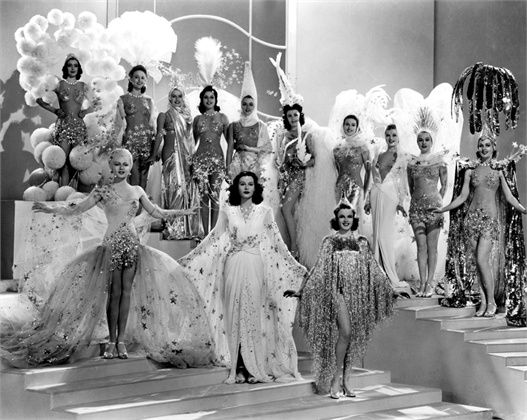
Publicity still of the costumes from the "You've Stepped Out of a Dream" number

Publicity still of the costumes from the “You’ve Stepped Out of a Dream” number

Highlights:
-Elaborate costumes by Adrian
-Eve Arden’s sassy character

Notable Songs:
-“You Stepped Out of a Dream” performed by Tony Martin
-“Minnie from Trinidad” performed by Judy Garland
-“You Never Looked So Beautiful” performed by the chorus, borrowed by the 1936 film
-“I’m Always Chasing Rainbows” performed by Judy Garland
-“Laugh? I Thought I’d Split My Sides” performed by Judy Garland and Charles Winninger
-“Caribbean Love Song” performed by Tony Martin
-“Mr. Gallagher and Mr. Shean” performed by Charles Winninger and Al Shean

My review:
In the grand scheme of film history, “Ziegfeld Girl” (1941) may not be very important. It is notable because it gave Lana Turner’s career the boost it needed, landing her in more sophisticated and adult roles. But when it comes to Metro-Goldwyn-Mayer movie musicals, this one isn’t even listed in the top 10.

But I love it. “Ziegfeld Girl” may be overly long (with a run time of 2 hours and 12 minutes) and the plot may be rather fluffy, but I think it’s a great example of the lavish luxury that was a Metro-Goldwyn-Mayer film.
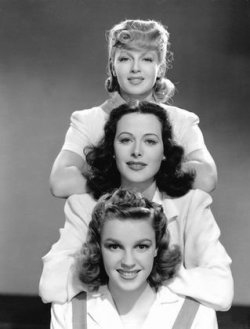
Publicity still of Lana Turner, Hedy Lamarr and Judy Garland

Publicity still of Lana Turner, Hedy Lamarr and Judy Garland

With the Adrian gowns and themes of fame and newly found wealth, “Ziegfeld Girl” oozes glamour, sophistication and the jewel-encrusted style many people dream about. For some reason, for me, this film holds the definition of MGM glamour more than other well-known MGM films like “Singin’ in the Rain” (1952), “The Women” (1939) or “Grand Hotel” (1932).

I think one major reason for this is the “You Stepped Out of a Dream” number where Tony Martin sings as women in elaborate (yet eccentric) costumes walk up and down stairs like goddesses.

After it’s release, Hedda Hopper said that the film is so beautiful that it “makes you ill that it’s not in color.” I can’t say I agree though. While Technicolor would have made “Ziegfeld Girl” even more glorious, I somehow think that black-and-white suits it and glitters more than color would. Color would have almost been too distracting.

The cast of this film is also bursting at the seams. Not only are the leading ladies three of MGM’s most well-known and top stars, the character actors seemingly just keep coming out of the woodwork through the film.

The only thing I don’t love about this film is the finale. Pasting together “Great Ziegfeld” (1936) feels off, though you could look at it as tying it back to the original film and making “Ziegfeld Girl” a true sequel. But that’s a bit of a stretch. It really comes off as lazy, and costume and dance styles had changed so much in five years that it doesn’t fit. However, the originally planned “We Must Have Music” finale is also weak (it’s included on the DVD special features). They would have been better off ending with “Minnie from Trinidad.”

I do also enjoy that two original Ziegfeld players- Charles Winninger and Al Shean- are included in the film.

I first saw “Ziegfeld Girl” in 2004 or 2005 and I fell in love with it and I still really love this movie. I loved it so much that “ziegfeldgirl1941” was part of my e-mail address at the time. I even tried to convince my mom to play “You Stepped Out of a Dream” when I walked downstairs to my prom date (she refused so this didn’t happen).

If the glamour of this film was a soap or a perfume, I would buy it and wear it. But since it’s not, I did the next best thing. I created Hedy Lamarr’s “Stepped out of a Dream” costume designed by Adrian for this Halloween. I bought the sleeveless white dress but made the rest of the costume- sewing on sleeves, cutting out and gluing silver stars and sequins, using 12 glue sticks to attach the wire with stars on a board on my back (Adrian also used a board on Hedy’s back.) If this 20-hour project doesn’t describe my love for “Ziegfeld Girl,” I’m not sure what does.
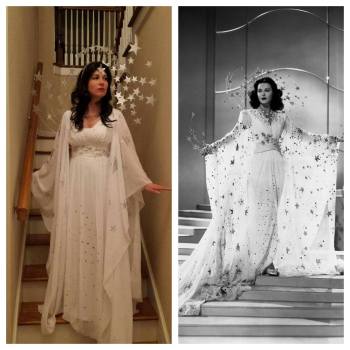
My version of Hedy Lamarr's "Dream" costume

My version of Hedy Lamarr’s “Dream” costume

If you love MGM glamour and musicals, I would give this one a watch. I’ll give you fair warning that it’s a bit dramatic in parts, like when Lana Turner’s luck starts to change, but it’s such a fabulous look at MGM in it’s prime.

Check out the Comet Over Hollywood Facebook page, follow on Twitter at @HollywoodComet or e-mail at cometoverhollywood@gmail.com