Evolution of a classic film fanatic

It started with a girl named Maria and a boy named Tony who thought something was coming. That’s what I usually tell people when they ask how I became a classic movie fan: it happened on a fateful March evening in 2003 when I saw “West Side Story” (1961). I became obsessed, end of story.

But my “West Side Story” obsession (which is a whole other blog post) isn’t even close to where my classic film education began. Let’s travel back in time to 1988, the year I was born. Or maybe 1991, I would have been a bit more coherent to films at age three.

My parents introduced my two older sisters and me to classic film at an early age. Some of these movies were Disney movies like “Lady and the Tramp” or “Swiss Family Robinson” or family friendly movies like “White Christmas” and “Yankee Doodle Dandy.”
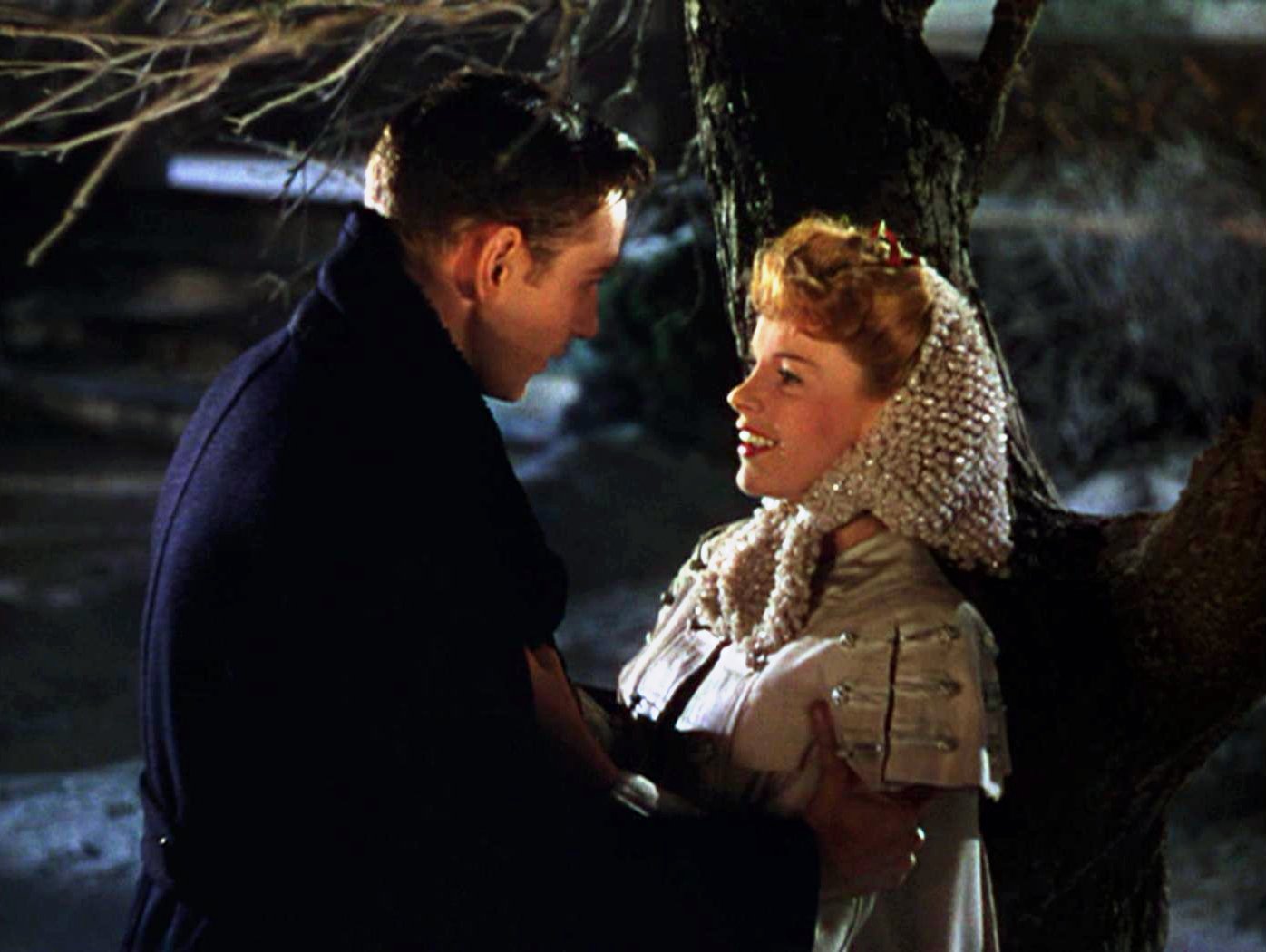
Tom Drake and Judy Garland in “Meet Me in St. Louis” (1944)

I  distinctly remember watching “Meet Me in St Louis” when I was five or six and thinking that Judy Garland looked pretty or laughing at Julie Newmar’s name “Dorcas” in “Seven Brides for Seven Brothers.”

Basically classics have always been in my life, but as a child I never realized that they were old and thought all of these wonderful movies were brand new.

My real interest in movies started when I was in third grade and I saw the cartoon version of “Anastasia” on a rainy November day in 1997. No this isn’t a classic movie, but it started a long line of movie obsessions to come.  I mean, I even thought I was somehow the lost princess Anastasia Romanov. I was hooked.

Fast-forward to middle school. I became interested in shows on TVLand, The Monkees and 1960s pop culture. I was interested in anything old, and naturally gravitated towards movies, which is probably where it all began.

But the real gateway drug to the classic film addiction was “West Side Story” (1961). On an evening in March 2003, my dad said, “You like musicals and old movies; you should see ‘West Side Story.’” He later said he created a monster and wasn’t joking at all.
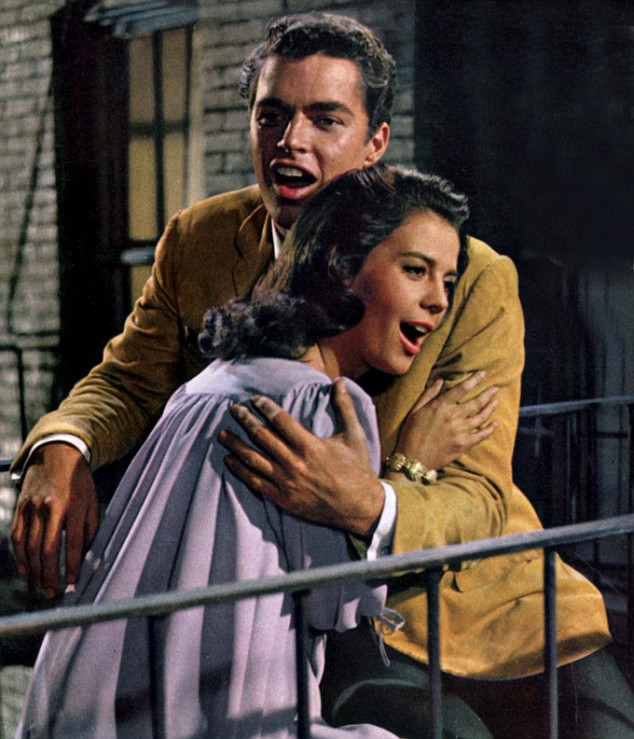
Richard Beymer and Natalie Wood in “West Side Story” (1961), the film I was obssessed with for two years.

From “West Side Story,” I snowballed into a musical love and I went out of my way to tape them off the television. I started a new musical list that is  still growing at 390 titles.

I then found actors I liked, like Doris Day and Jane Powell, and wanted to see their movies and the interest just grew and grew and grew. Now, I’m not obsessed with one particular actor or movie, it’s more that I’m crazy about the whole classic film shebang.

As a rule I only watch movies from the beginning of film to the mid-1960s. Pre-code movies are great because their vulgarity is done in a tongue-and-check way that sometimes can go by unnoticed if you aren’t paying attention. Once you get into the 1960s and beyond, the plots run thin in an attempt to be artistic, nudity isn’t rare and morals go out the window. Also actors from the Golden Era were fading away and the studio system was crumbling.

I guess if I had to make an analogue with how it all started, “West Side Story” would have been that first beer that led me into old movie alcoholism. It didn’t matter what I watched as long as it fulfilled my movie viewing needs. I think my viewing is a bit more mature than that now. Sure I still watch a few clunkers, or watch a stinker movie for the sake of fulfilling a classic actor list (like “Night of the Demon” for Dana Andrews) but it is just all part of the experience.

What kind of movie fan am I now?

•I make monthly lists from Now Playing to tape; usually 30 to 40 movies a month. We use A LOT of VHS tapes.

•I only buy books, paper dolls, posters or anything of that nature that is movie related. I often search Ebay for classic film memorabilia, and as much as I would enjoy Lana Turner’s evening bag from “Imitation of Life”, as a 21-year-old college student, that really isn’t in my budget.

•I don’t have any real obsession now. I have my favorite movies, actors and actresses but no one that I hyperventilate over when I think about them. I guess the only movie that would come close to that is “Since You Went Away” or the actor Van Johnson.

•I want to meet Robert Osborne one day. He is my hero and I think we would
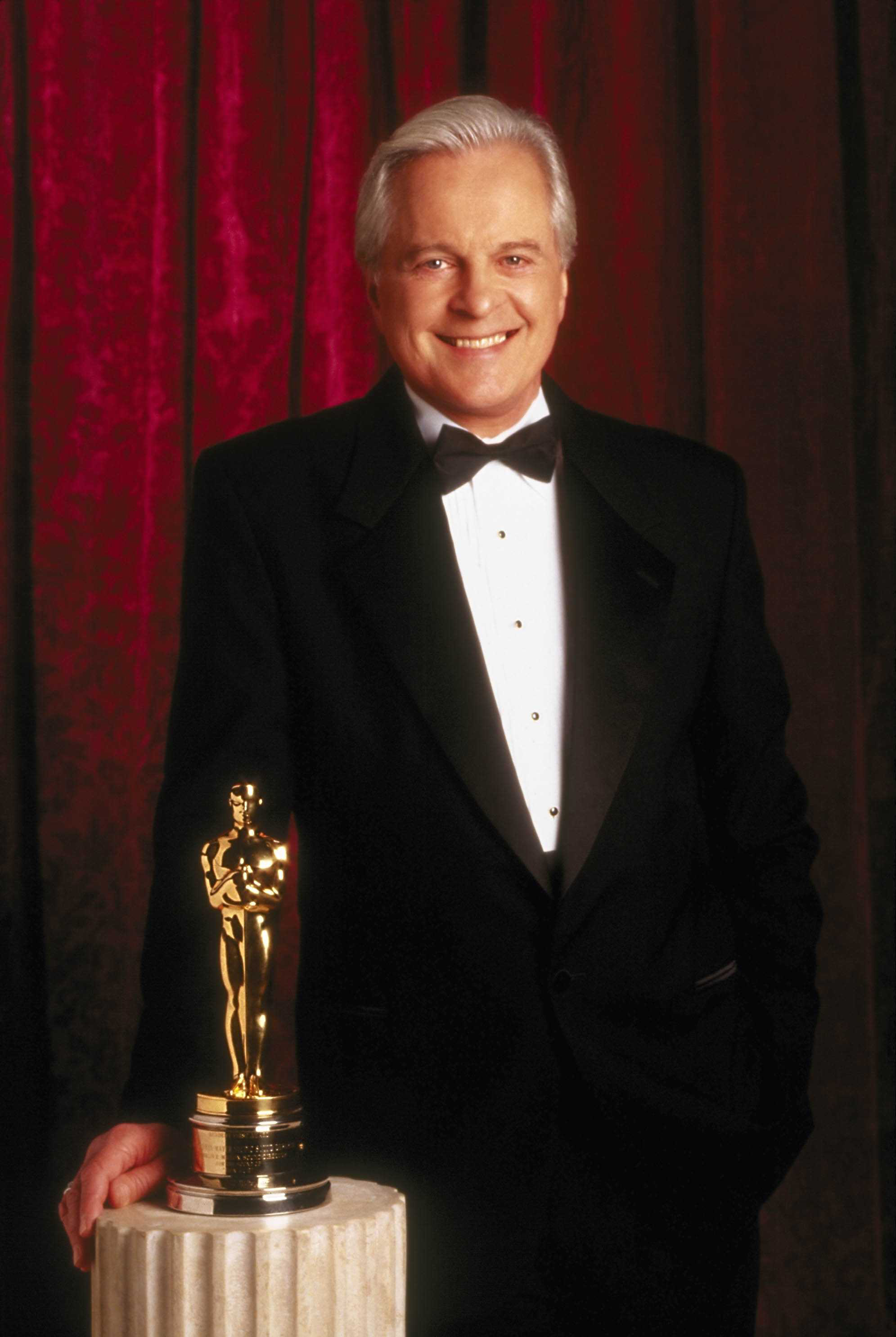
Robert Osborne: My hero

be best friends. Robert, if you just happen to be reading this, let’s meet in Atlanta and have lunch, okay? I’m just in South Carolina so it’s not that far.

•I’ve come to realize that the Hollywood I dreamed about in middle school and early high school is non-existent now. I used to dream about going to Hollywood and thinking it would be like it was during the Golden Era: clean, historically preserved and bowing down to Hollywood greats like Joan Crawford. My family took a family vacation there in 2006 and I’ve realized there is nothing for me there. Hollywood is not interested in preserving history, and even though the Hollywood Bowl was cool, it’s not like Kathryn Grayson will be singing a concert there ever again.

Check out the Comet Over Hollywood Facebook page for the latest updates.
I’m ready for my close up: Photography in films

Photography and moving pictures walk hand-in-hand, especially when shooting in black and white. Many people prefer color and dismiss black and white as cheap. However, some don’t realize the skill it takes to shoot black and white: making sure you have perfect lighting or having the shadows just right are just a few things to consider.

For being so closely related, it’s surprising that there aren’t many classic films about photography. I was only able to find an handful:

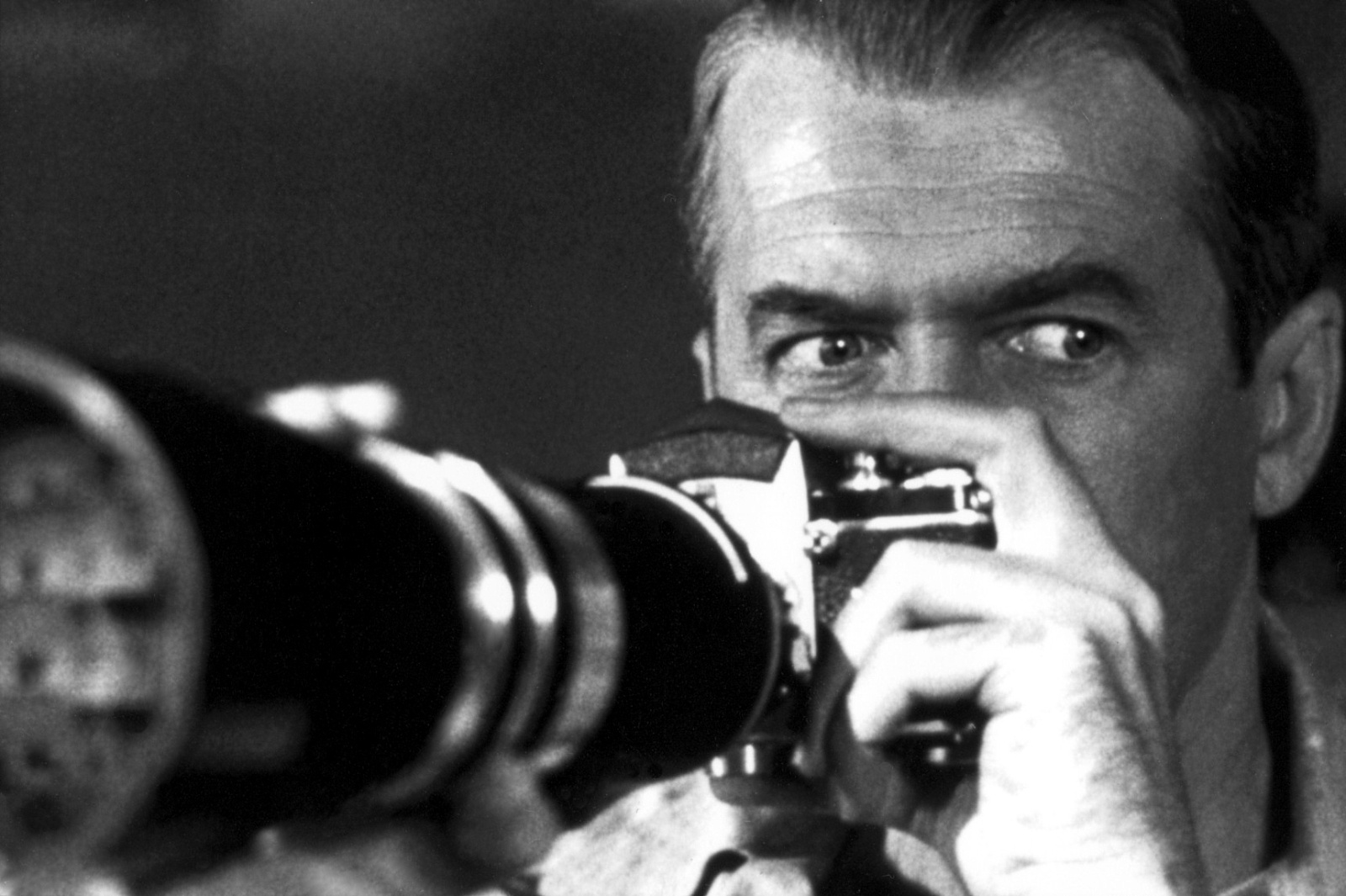
James Stewart in “Rear Window” spying on his neighbor

1. Rear Window (1954): James Stewart plays L.B. “Jeff” Jeffries, a free lance photographer who is laid up with a broken leg that was a result of a dangerous assignment. I’m not sure if this movie paints photographers in the best light. Jeff is in love with high society Grace Kelly but doubts that she could go on assignments with him even though she says she could. Jeff is also a bit of a peeping Tom, spying on his neighbors with his telephoto lens.
However, his peeping Tom-ery isn’t all bad since he uses it to solve a murder that he partially witnesses in an apartment across the way. Jeff cleverly mixes his career and survival techniques as he thwarts the murderer by blinding him with flash bulbs.

2. Roman Holiday (1953): The movie is more about  journalism than a photography, but the photographer certainly plays a large part in the film. Journalist, Joe Bradley (Gregory Peck), is trying to get an exclusive story on a visiting princess (Audrey Hepburn) who just happens to be staying in his apartment.
Eddie Albert plays Peck’s photographer friend who tags along to get the photos for the story. This movie seems to depicts photographers as deceitful playboys. When Peck calls Albert about the story, Albert is photographing and kissing a woman in his apartment. When he is getting pictures of the princess, he doesn’t openly take pictures of her but uses sneaky little spy cameras. A real photographer wouldn’t be so afraid…
Actually, from a journalism student’s point-of-view, it doesn’t paint the newspaper business in a good light either. It has the “anything for a story” undertones and Peck goes to unethical measures to get a story. Even though he doesn’t publish it, if he was doing that in today’s journalism world he would probably face a law suit.

Audrey Hepburn and Fred Astaire in “Funny Face.” Their characters were modeled after Richard Avedon and Dovima.

3. Funny Face (1957):

This movie is simply about fashion photography. It has many interesting and pretty scenes with fashion, dresses and dancing. The thing I like about the movie is that Fred Astaire’s character, Dick Avery, and Audrey Hepburn’s character is supposed to be like the relationship between one of my favorite photographers, Richard Avedon and his muse, Dovima.
Fashion photography is fun and pretty to look at, but the photographer I can’t imagine it being very exciting. From a journalist/writer view point, it would be like writing the same story over and over again. For example, how does Danielle Steel get any excitement out of writing when all of her books basically have the same plot?


4. Weddings and Babies (1958): This is an independent film about a photographer (John Myhers) who is trying to save money in order to get married to his girlfriend, Viveca Lindfors.
I think this movie gives the most realistic depiction of a photographer. He feels unfulfilled because he is only taking pictures of just weddings and babies and wants to do something with a purpose. I’ve heard several photographers say that, others take the wedding route because it’s easier and pays well, but the ones with a drive don’t care so much about the money.
My philosophy of photography is that it should inform just like a newspaper article. You can write a story about how the Yanomamo are losing their indigenous life style, but a picture can better show how it is devastating them. Photography should be about truth, not about how to show in the best light.


5. Blowup (1966): This movie is a mod 1960s, English film. If that doesn’t mean anything to you, it means that it’s rather odd, has little plot and a few naked women thrown in for good measure. However, in comparison to the photographer in “Rear Window” who is a photojournalist and travels the world, the photographer, played by David Hemmings, is a successful commercial fashion photographer. He is also bored with life…go figure, wouldn’t you if you were just photographing fashion?
Anyways, the movie is about his career as a photographer, but it is rather long and drawn out. He thinks he might have photographed a murder, but we never really find out and the murder is never solved. It is a treat though to see the beautiful Russian model, Verushka, at the beginning of the film.

Those movies are the only real pre-1970s movies that used photography as a basis of the plot. I was disappointed and surprised that there are so few movies that have main characters playing photographers, since photojournalism was a big field in the 1940s and 1950s due to publications like LIFE that revolved around photography. I just can’t believe that there are so many movies about stewardesses, nurses and architects but so few about photographers.

Here are a few films that the main characters are photographers, but it is not a main point in the plot:

-One More Tomorrow (1946): Anne Sheridan plays a photographer who falls in love with high society Dennis Morgan. The fact that she is a female photographer means she is lower class and could never fit in Morgan’s social circle.

If a Man Answers (1962): Sandra Dee marries photographer Bobby Darin. She plans on keeping her new husband using a dog training book, because she worries about him photographing other women.

Wait Until Dark (1967): Audrey Hepburn plays a blind woman terrorized by men trying to get a heroine filled doll. Her husband in the movie is a photographer.

Check out the Comet Over Hollywood Facebook page for the latest updates.

Different look, same great product

“Comet Over Hollywood” has received a slight make-over. Not that I don’t love Cyd Charisse in “Party Girl,” I just felt that we needed to put on our bathing suits with Constance Bennett and dive in to summer movie fun blogging!

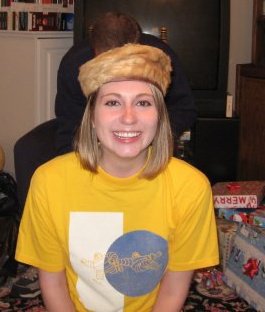
My mink hat on Christmas Day 2009

Cheesiness aside, Constance Bennett is an actress I really admire and try to follow. For years she was known as one of the best dressed women in Hollywood. Why was Bennett such a fashion icon? Because she wore what she liked and didn’t follow fads.

I admit she is the reason I buy a lot of the vintage clothes I own and wear. Within the past year I’ve bought: a mink hat, turban, orange 1960s cape/poncho or 1940s yellow strapless formal.

Therefore, I dedicate this blog to my fashion inspiration, Constance Bennett.

Here is a video that shows Bennett’s glamour and fashion:

Confessions of a VHS User

222 classic movies on VHS tapes

Recently my mother told me that we had an estimated 222 movies taped off of Turner Classic Movies. Why you ask?

Every month I flip through the “Turner Classic Movie Now Playing Guide” and make a list of 20 to 50 movies to tape.

Our family owns a DVR but we use VHS tapes, because they hold more, are reusable and usually give us higher quality.

I tape so many movies so I can fulfill the many lists I have made to organize my old movie obsessions.

Here is a very brief summary of the lists I have so far:
-Movie Musical list: I have currently seen 374 musicals. I started this list back in 2004 when I was in 9th grade.  This includes any movie musical I have seen, new or old; anything from a Kay Kyser musical to “Chicago.”
-Silent Movie list: This currently only has 40 movies. I only started really getting interested in silent films in late 2008 and just started the list in March 2010.
-Screen teams: This is a list of famous screen teams such as Errol Flynn and Olivia De Havilland, Myrna Loy and William Powell, Annette Funicello and Frankie Avalon.  I try to see all of the movies the screen teams were in together.
-Movies Series: Similarly to the Screen Teams list, I am trying to see all the movies in certain film series such as Andy Hardy, Dr. Kildaire and Maisie.
-Actresses Lists: I have 47 actresses that I am trying to see all of their movies. A few of these are Jean Arthur, Bette Davis and Kay Francis. So far I’ve only seen all of Judy Garland’s movies.
-Actors Lists: Similar to the actress list, except with 19 actors. Lists include Van Johnson, Dana Andrews and George Brent.

Recently, I have started a rather ambitious list. It is all of the movies from 1939- a total of 514 movies and I have only seen 84.

“The Rains Came”: 20th Century Fox’s contribution to the 1939 royalty

The year of 1939 is important not just for “The Wizard of Oz” and “Gone with the Wind,” but it also birthed other well known movies such as “Ninotchka,” “Goodbye, Mr. Chips,” “Stagecoach” and “The Grapes of Wrath.”

It’s amazing to look at all of the films that came out during what is known as “Hollywood’s Greatest Year,” and I was inspired to try to see all of them.

Turner Classic Movies showed a documentary in the summer of 2009 called “1939: Hollywood’s Greatest Year.” The documentary said the reason this year was profitable was the United States was slowly getting out of the depression and the film companies were able to fund bigger projects.

However, this glory only lasted one year.  Two years later World War II hit, actors were drafted and America and Hollywood put their efforts toward the war on the home front and overseas. Once the war was over, the tone of America and movies changed from light and happy 1930s films to darker and angsty melodramas, according to the documentary.

In a way, this is why I want to make the list. I feel like when people hear 1939, they think of “Gone with the Wind” or “Wizard of Oz,” but there were so many other special movies that year. I want to see if the other films that you don’t hear about have that same magic. Who knows, once I finish watching all 514 movies maybe I’ll try my hand at writing a book.

Making the list took maybe three days, however I know that the watching process will take much longer. I’m worried about being able to track some of the movies and making it through low budget crime movies.

Wish me luck!

Check out the Comet Over Hollywood Facebook page for the latest updates.

Serenade me, Mr. Powell

Ginger Rogers was the Star of the Month for March on Turner Classic Movies. Ginger Rogers is a triple threat. She can sing, act and dance. She even won an Oscar for her 1941 performance in “Kitty Foyle.”

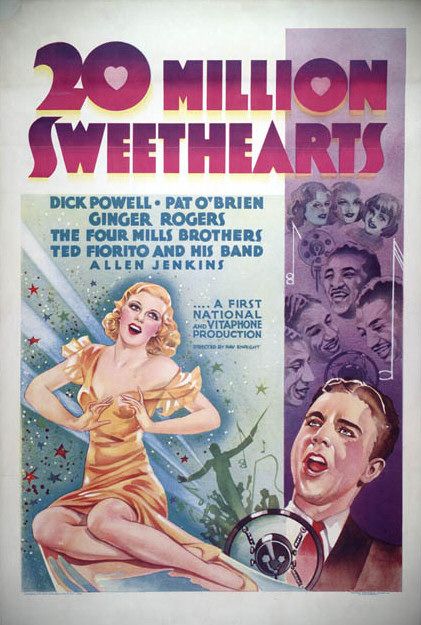
I taped several of her films that I haven’t seen (I’m trying to see all of her movies). One of these movies that I taped was “20 Million Sweethearts” (1934). The movie features Ginger Rogers and Dick Powell with a supporting cast of Allen Jenkins and Pat O’Brien.

Ginger Rogers is best known for the 10 films that she made with Fred Astaire. The screen team is recognized for their singing and dancing, but Astaire is generally the only one who gets to sing. Rogers only had the chance to sing solo in two of their 10 films together. These rare times occurred when Astaire refused to sing a song that was originally written for him. An example of this is “The Yam” in “Carefree” (1938).

The treat about the movie “Twenty-Million Sweethearts” is we actually heard Ginger sing several songs. I find it ironic that Ginger Rogers had the chance to sing more in a movie with Dick Powell than she does in her movies with Fred Astaire.

Dick Powell was one of the top “crooners” in the 1930s. His smooth voice could make women melt like butter. Fred Astaire was known more for his dancing. I’m sure women wouldn’t mind if he sang to them, but I have a feeling they would rather it be in their ear as he whisked them around on a dance floor.

Here is a comparison of the two men’s singing qualities:

Dick Powell and Ginger Rogers in “Twenty Million Sweethearts.” (1934)

Fred Astaire singing “The Way You Look Tonight” to Ginger Rogers in “Swing Time” (1936)

I personally would rather have Powell sing to me over Astaire. Who do you prefer?

Check out the Comet Over Hollywood Facebook page for the latest updates.
Star Collector


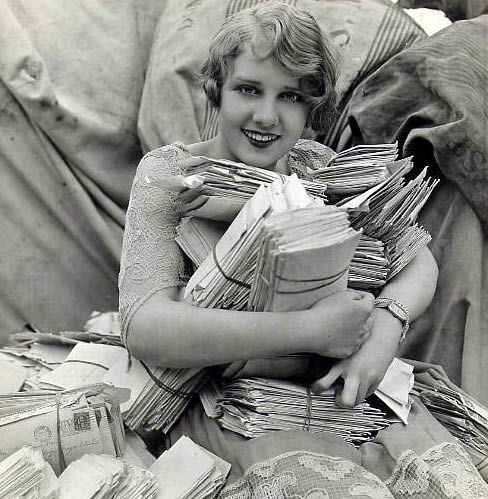
Anita Page in the 1920’s. At one point she had more fan mail than Greta Garbo.

Not only am I old-fashioned in my movie tastes, but I am also pretty passe as a movie fan.

I write fan mail.

You may be thinking, “Who does that anymore?” A surprising amount do continue to write to stars like Debbie Reynolds, Tony Curtis and Elizabeth Taylor. No one writes the stars of today, though, like Angelina Jolie, Orlando Bloom or Jennifer Aniston. Why is this? Because they won’t answer…that is if you can even find an address to write to.

I get my fan mail addresses from an autograph database called StarTiger.com. On the website you can search virtually any movie star, singer or sports player. Each star has their own profile page. On this page there is a list of addresses that you can contact them.

Continue reading

Let’s talk about a little pet peeve of mine…

Andy Hardy (Mickey Rooney) surrounded by Polly Benedict (Ann Rutherford), Betsy Booth (Judy Garland) and Cynthia Potter (Lana Turner).

How I define a classic movie fan and my pet peeve of the old movie ‘posers’ . I know I am a little fanatical and old movies are my life, but if you are going to claim to like old movies you have to know your stuff.

Another thing that drives me crazy is what consumers and manufacturers consider when it comes to classic movie merchandise (not including books, there is an abundance of wonderful film books). Everywhere you go, you see mugs, purses, T-shirts, magnets, etc with four people on them 1.) Marilyn Monroe 2.) Audrey Hepburn 3.) James Dean 4.) John Wayne. Then I go to Los Angeles with high hopes of Doris Day and Esther Williams merchandise, but I was quickly dismayed. In Hollywood, the movie mecca of the world, they still carried the same crap that they sell in Greenville, South Carolina. (Don’t get me wrong, I like Dean, Wayne and Hepburn but I want some variety.)

Continue reading

Bedtime for Bonzo is not the only movie Ronald Reagan made

This is another post I wrote early in my blogging career on blogger. It is a little better than the Susan Slade one, but yet again just a plot summary. Hopefully you can see the improvements of the blog from then to now.

It has once again been another long absence from my blog. I didn’t mean for it to be this way; I actually have several movies in mind to blog about, but I end up watching more movies instead of blogging. Movie watching is what I do, as lazy it may be-but sometimes I do exercise while watching movies!

Today’s blog is the Ronald Reagan/Joan Leslie movie “This Is the Army” (1943).

Now I can already hear some of you groaning, “Ronaaald Reeeeaaaggan. Uggggggh.” Well I don’t know much about how he was politically, but I do know that he was a top notch actor for Warner Brothers back in the 1930’s and 1940’s.

Those politicians and late night talk show hosts just look like uneducated film boobs when they talk about Ronald Reagan’s sub-par career, because they obviously know nothing about classic film or Warner Brothers in the late 1930’s and early 1940’s. Ronald Reagan was actually the star of the month for March on Turner Classic Movies-which is nothing to sneeze at. Usually it is someone like Spencer Tracey, Sean Connery or Bette Davis.

Continue reading

Teen sex, mountain climbing accidents and babies on fire=Susan Slade

This was one of my first blog posts from the Blogger version of my blog. I wrote it in 2009. I am aware it is very long, not very good and basically a play by play of this very silly movie. I put it up because I’m deleting the blogger “Comet Over Hollywood” and wanted my earlier posts archived.

I have been meaning to write in my blog for about…2 weeks now. I watched several movies over spring break and I don’t plan on talking about every single one of them, but I do think a few are worth mentioning.

The first one is: Susan Slade (1961)

Susan Slade is one of those deliciously trashy movies that came out in the late 1950’s and early 1960’s (i.e Peyton Place, A Summer Placee, Imitation of Life, All the Fine Young Cannibals, etc). Some of them are pretty bad and there are serious moments where you will find yourself collapsing on the sofa in laughter. But each of those movies that has something about them that I just love: scandal and romance. It was originally a book, but I’m assuming it was one of those dime store trashy novels looking at the plot.

The movie begins with the narration of Susan’s father,Roger Slade played by Lloyd Nolan. He made his fortune out in the desert of Chile from an oil drilling company he started, and if it wasn’t oil it was some sort of natural resource. After living away from civilization for about 10 years, Roger is retiring and the Slade family is moving back to America, California to be specific.

While the family has been away, Susan Slade, played by the squinty eyed and baby voiced Connie Stevens, has turned into a beautiful young lady, of course. She doesn’t look any older than 16 years-old, but I’m assuming we are supposed to believe that she is in her 20’s. On the boat over to America, Mr. and Mrs. Slade express concern about Susan’s shyness and are worried that their daughter is socially awkward.

But lo’ and behold! Susan meets a man! But she is so attracted to him that she runs away every time he tries to talk to her.

The man she meets, Conn Williams played by Grant Williams, seems like a complete sleaze but Leah Slade, played by Dorothy McGuire, is in favor of the young and seemingly successful young man. With ole mom’s consent Susan goes forth to get her man.

All of a sudden, socially awkward Susan Slade, is flirting with Conn and acting coy like we all forgot that she was supposed to be socially awkward. For someone who has been out in the desert for 10 years, she obviously didn’t go without practice.

Continue reading