Serenade me, Mr. Powell

Ginger Rogers was the Star of the Month for March on Turner Classic Movies. Ginger Rogers is a triple threat. She can sing, act and dance. She even won an Oscar for her 1941 performance in “Kitty Foyle.”

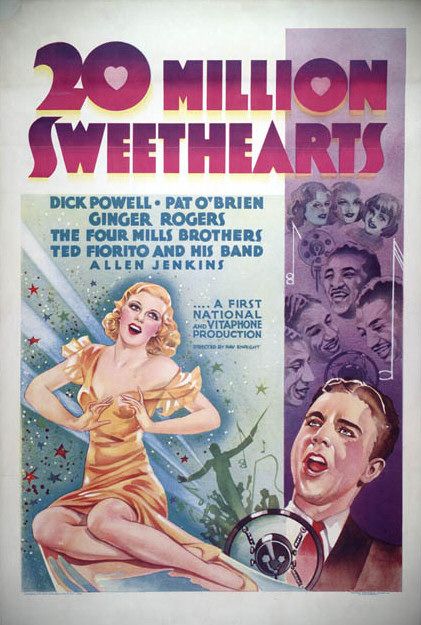
I taped several of her films that I haven’t seen (I’m trying to see all of her movies). One of these movies that I taped was “20 Million Sweethearts” (1934). The movie features Ginger Rogers and Dick Powell with a supporting cast of Allen Jenkins and Pat O’Brien.

Ginger Rogers is best known for the 10 films that she made with Fred Astaire. The screen team is recognized for their singing and dancing, but Astaire is generally the only one who gets to sing. Rogers only had the chance to sing solo in two of their 10 films together. These rare times occurred when Astaire refused to sing a song that was originally written for him. An example of this is “The Yam” in “Carefree” (1938).

The treat about the movie “Twenty-Million Sweethearts” is we actually heard Ginger sing several songs. I find it ironic that Ginger Rogers had the chance to sing more in a movie with Dick Powell than she does in her movies with Fred Astaire.

Dick Powell was one of the top “crooners” in the 1930s. His smooth voice could make women melt like butter. Fred Astaire was known more for his dancing. I’m sure women wouldn’t mind if he sang to them, but I have a feeling they would rather it be in their ear as he whisked them around on a dance floor.

Here is a comparison of the two men’s singing qualities:

Dick Powell and Ginger Rogers in “Twenty Million Sweethearts.” (1934)

Fred Astaire singing “The Way You Look Tonight” to Ginger Rogers in “Swing Time” (1936)

I personally would rather have Powell sing to me over Astaire. Who do you prefer?

Check out the Comet Over Hollywood Facebook page for the latest updates.

The Mystery of the Murdered Movie

I love Nancy Drew.

I have played and solved 21 of the HerInteractive PC games and read most of the original yellow bound novels. I even own a Nancy Drew cookbook, a “Nancy Drew’s Guide to Life” book and a large Nancy Drew cut out.

Nancy Drew has played a pivotal role for the past 80 years in literature for young girls, as well as in pop culture.

Everyone knows who she is and is fairly respected as a literary character. However, why is there not a flattering movie adaptation depicting everyone’s this important literary character and symbol for American women?

Eight years after the first Nancy Drew novel, “The Secret of the Old Clock,” was published in 1930, the first Nancy Drew film adaptation was released.

Nancy Drew, Reporter,” the first film adaptation of the series, was released in 1938, three more movies were released all in 1939. These movies included “Nancy Drew  Troubleshooter,” “Nancy Drew Detective ” and “Nancy Drew and the Hidden Staircase).”

Film series were not rare in the 1930’s and 1940’s. In fact many studios made a great deal of money off of series such as “Andy Hardy,” “Dr. Kildaire,” “Maisie” and “Boston Blackie just to name a few of many.

I imagine that is what Warner Brothers was trying to do with Nancy Drew. But none of the films followed or resembled any of the Nancy Drew books, except for snippets of “Nancy Drew and the Hidden Staircase” which I think is modeling itself after the book “The Hidden Staircase.”

In novels Miss Drew is level-headed, fearless and intelligent. She doesn’t goof off and there isn’t much time for romance in her life. Yes there is her boyfriend, Ned Nickerson, but I can count on one hand the amount of times they kissed or flirted in the novels. She was also very talented and fashionable. She could tap dance the Morris code while wearing a freshly pressed tailored suit.

Also in the novels, Ned was concerned about Nancy but never hindered her sleuthing. Carson Drew, Nancy’s father, was a distinguished lawyer. He teased his daughter for her appetite for mysteries and trusted her good sense.

However, the characters in the 1930s Nancy Drew series didn’t resemble Carolyn Keene’s intelligent teens.

Nancy Drew, played by Bonita Granville, was bumbling, scatter-brained and frightened for most of the films. She set out to solve a mystery but would run home before finding any actual clues.

Bonita Granville as Nancy Drew and Frankie Thomas as Ted Nickerson

Ned Nickerson, played by Frankie Thomas, was named TED in the movies for some reason. He was maybe the most tolerable character in the movies, but I wouldn’t run to him to protect me.

John Litel was a very irritating Carson Drew. He forbid Nancy from sleuthing and worried about her constantly. Even Hannah Gruen, the housekeeper, ran away in terror when someone broke into their home. Hannah in the books would have knocked them on their ear.

John Litel as Carson Drew in “Nancy Drew…Reporter” (1938)

The films involve very little mystery solving and an over abundance of silly slap-stick. I’m not asking for a whole detailed novel to be played out in the 68 minute films, but Warner Brothers could have at least been accurate with their character depictions.

Bonita Granville, who was 16 when she played Nancy Drew, was in top-notch films such as “These Three”(1936), which she received her only Oscar nomination, and “Now, Voyager” (1941), giving excellent performances in both but clearly Nancy Drew was not the role for her.

I made a list of who, with some tweaks to the script, could have been the perfect Nancy Drew casting in the 1930s or 1940s.

Nancy Drew: Deanna Durbin (19 at this time) would be my first pick. She sometimes plays silly characters, but also plays serious roles beautifully. Nancy Drew was also supposed to be very attractive. Miss Granville wasn’t ugly, but Deanna Durbin is decidedly prettier. I’m sure they would have to fit in a song or two for Deanna. She would have been old enough by this time, because “First Love,” the film that she received her first on-screen kiss came out the same year as the series.

Carson Drew: John Litel is generally a character actor with small roles. I’m not sure why they chose him to play the distinguished lawyer, Carson Drew. I can’t think of anyone else who could play this role more perfectly than Walter Pidgeon. Mr. Pidgeon is the definition of distinguished and sophistication. With his fatherly and friendly acting style, along with his pipe, I can picture him now giving Nancy advice.

Ned Nickerson: I would either say a teen-aged Jackie Cooper (17 at the time) or Robert Stack (20 at this time). Both boys were attractive and would have seemed more protective of Nancy Drew than Frankie Thomas. Stack was also in the 1939 film “First Love” with Miss Durbin and would have been of a suitable age.

Check out the Comet Over Hollywood Facebook page for the latest updates.

Star Collector


Anita Page in the 1920’s. At one point she had more fan mail than Greta Garbo.

Not only am I old-fashioned in my movie tastes, but I am also pretty passe as a movie fan.

I write fan mail.

You may be thinking, “Who does that anymore?” A surprising amount do continue to write to stars like Debbie Reynolds, Tony Curtis and Elizabeth Taylor. No one writes the stars of today, though, like Angelina Jolie, Orlando Bloom or Jennifer Aniston. Why is this? Because they won’t answer…that is if you can even find an address to write to.

I get my fan mail addresses from an autograph database called StarTiger.com. On the website you can search virtually any movie star, singer or sports player. Each star has their own profile page. On this page there is a list of addresses that you can contact them.

Continue reading

Elephants and overbearing housekeepers

Have you ever seen a movie that is so similar to another one, yet you know it isn’t a remake?

I’m not saying something like Disturbia (2007) and Rear Window (1954) which are so similar it might as well be a remake and there was a court case over the fact that the screenwriter of Distrubia copied Rear Window.

Two movies I feel are very similar are Alfred Hitchcock’s Rebecca (1940)and Elephant Walk (1954).

Both have very similar plots. The odd thing is that both of these films were movies adapted from books. Elephant Walk was written by Robert Standish in 1948 and Rebecca was written by Daphne Du Maurier ten years prior in 1938.

Let’s briefly over view the plots before we proceed with the comparison.

Rebecca (1940): A young woman (Joan Fontaine) meets a rich widower (Laurence Oliver) and has a whirlwind romance. They fall in love and marry after not knowing each other for very long. Shortly after moving into her new home, the young bride finds that she is not in control of her own household. Mrs. Danvers (Judith Anderson) the house keeper underminds everything the 2nd Mrs. DeWinter tries to do and constantly reminds her that she is not as good as the deceased wife, Rebecca.

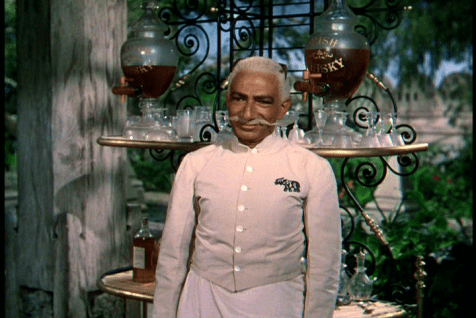
Elephant Walk (1954): Rich plantation owner John Wiley (Peter Finch) from Ceylon comes to England specifically to find a bride who ends up being Ruth Wiley (Elizabeth Taylor). She marries him after only knowing him a brief time and finds plantation life in Africa difficult. Not only is life in Africa strenuous, but also the fact that the head man servant, Appuhamy (Abraham Sofaer), won’t let Ruth run her home. It makes things difficult because everyone idolizes John’s father, the late Mr. Wiley, and talks about him as if he is still alive.

If you don’t see the similarities through the plot summaries, then this will help:

1.) Both movies have a creepy housekeeper that won’t let the heroine run her home. It doesn’t make things any better when their husbands are cold and don’t stand up for them at all.

In both films, the servants worship someone who is dead and continue to act as if they are alive. In Rebecca it is Mrs. Danvers constantly reminiscing about old times with Rebecca of when she would get ready for parties and brush her hair as Rebecca told her about her evening. In Elephant Walk it’s Appuhamy still serving his late master and acting as if he is alive and giving orders.

Judith Anderson as Mrs. Danvers in Rebecca

Appuhamy played by Abraham Sofaer in Elephant Walk

Continue reading

Let’s talk about a little pet peeve of mine…

Andy Hardy (Mickey Rooney) surrounded by Polly Benedict (Ann Rutherford), Betsy Booth (Judy Garland) and Cynthia Potter (Lana Turner).

How I define a classic movie fan and my pet peeve of the old movie ‘posers’ . I know I am a little fanatical and old movies are my life, but if you are going to claim to like old movies you have to know your stuff.

Another thing that drives me crazy is what consumers and manufacturers consider when it comes to classic movie merchandise (not including books, there is an abundance of wonderful film books). Everywhere you go, you see mugs, purses, T-shirts, magnets, etc with four people on them 1.) Marilyn Monroe 2.) Audrey Hepburn 3.) James Dean 4.) John Wayne. Then I go to Los Angeles with high hopes of Doris Day and Esther Williams merchandise, but I was quickly dismayed. In Hollywood, the movie mecca of the world, they still carried the same crap that they sell in Greenville, South Carolina. (Don’t get me wrong, I like Dean, Wayne and Hepburn but I want some variety.)

Continue reading

Bedtime for Bonzo is not the only movie Ronald Reagan made

This is another post I wrote early in my blogging career on blogger. It is a little better than the Susan Slade one, but yet again just a plot summary. Hopefully you can see the improvements of the blog from then to now.

It has once again been another long absence from my blog. I didn’t mean for it to be this way; I actually have several movies in mind to blog about, but I end up watching more movies instead of blogging. Movie watching is what I do, as lazy it may be-but sometimes I do exercise while watching movies!

Today’s blog is the Ronald Reagan/Joan Leslie movie “This Is the Army” (1943).

Now I can already hear some of you groaning, “Ronaaald Reeeeaaaggan. Uggggggh.” Well I don’t know much about how he was politically, but I do know that he was a top notch actor for Warner Brothers back in the 1930’s and 1940’s.

Those politicians and late night talk show hosts just look like uneducated film boobs when they talk about Ronald Reagan’s sub-par career, because they obviously know nothing about classic film or Warner Brothers in the late 1930’s and early 1940’s. Ronald Reagan was actually the star of the month for March on Turner Classic Movies-which is nothing to sneeze at. Usually it is someone like Spencer Tracey, Sean Connery or Bette Davis.

Continue reading

Teen sex, mountain climbing accidents and babies on fire=Susan Slade

This was one of my first blog posts from the Blogger version of my blog. I wrote it in 2009. I am aware it is very long, not very good and basically a play by play of this very silly movie. I put it up because I’m deleting the blogger “Comet Over Hollywood” and wanted my earlier posts archived.

I have been meaning to write in my blog for about…2 weeks now. I watched several movies over spring break and I don’t plan on talking about every single one of them, but I do think a few are worth mentioning.

The first one is: Susan Slade (1961)

Susan Slade is one of those deliciously trashy movies that came out in the late 1950’s and early 1960’s (i.e Peyton Place, A Summer Placee, Imitation of Life, All the Fine Young Cannibals, etc). Some of them are pretty bad and there are serious moments where you will find yourself collapsing on the sofa in laughter. But each of those movies that has something about them that I just love: scandal and romance. It was originally a book, but I’m assuming it was one of those dime store trashy novels looking at the plot.

The movie begins with the narration of Susan’s father,Roger Slade played by Lloyd Nolan. He made his fortune out in the desert of Chile from an oil drilling company he started, and if it wasn’t oil it was some sort of natural resource. After living away from civilization for about 10 years, Roger is retiring and the Slade family is moving back to America, California to be specific.

While the family has been away, Susan Slade, played by the squinty eyed and baby voiced Connie Stevens, has turned into a beautiful young lady, of course. She doesn’t look any older than 16 years-old, but I’m assuming we are supposed to believe that she is in her 20’s. On the boat over to America, Mr. and Mrs. Slade express concern about Susan’s shyness and are worried that their daughter is socially awkward.

But lo’ and behold! Susan meets a man! But she is so attracted to him that she runs away every time he tries to talk to her.

The man she meets, Conn Williams played by Grant Williams, seems like a complete sleaze but Leah Slade, played by Dorothy McGuire, is in favor of the young and seemingly successful young man. With ole mom’s consent Susan goes forth to get her man.

All of a sudden, socially awkward Susan Slade, is flirting with Conn and acting coy like we all forgot that she was supposed to be socially awkward. For someone who has been out in the desert for 10 years, she obviously didn’t go without practice.

Continue reading