It’s no secret that the Hollywood Comet loves musicals. In 2010, I revealed I had seen 400 movie musicals over the course of eight years. Now that number is over 500. To celebrate and share this musical love, here is my weekly feature about musicals.
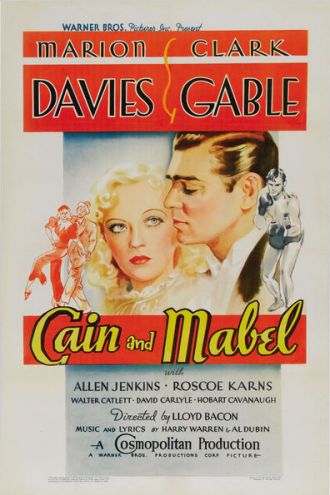
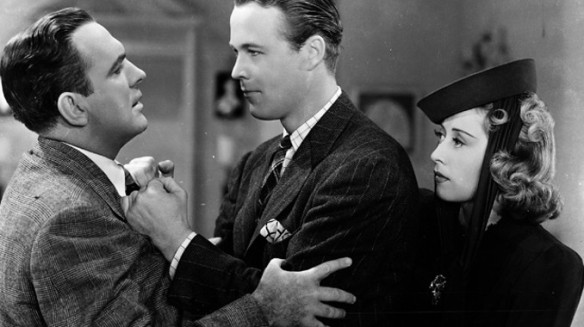
This week’s musical: Cain and Mabel (1936) – Musical #459
Studio:
Warner Brothers
Director:
Lloyd Bacon
Starring:
Marion Davies, Clark Gable, Allen Jenkins, Roscoe Karns, Ruth Donnelly, Walter Catlett, Hobart Cavanaugh, Pert Kelton, Robert Paige, E.E. Clive, Sammy White, Marie Provost (uncredited)
Plot:
After Mabel O’Dare (Davies) loses her job as a waitress, she ends up working her way up to be a musical star. Larry Cain (Gable) is a prizefighter, who is kept awake all night before a fight due to Mabel’s tap dance practice in a hotel suite above him. Mabel’s press agent (Karns) creates a romance between Mabel and Larry, unbeknownst to them, for publicity.
In 2011, I announced I was trying to see every film released in 1939. This new series chronicles films released in 1939 as I watch them. As we start out this blog feature, this section may become more concrete as I search for a common thread that runs throughout each film of the year. Right now, that’s difficult.
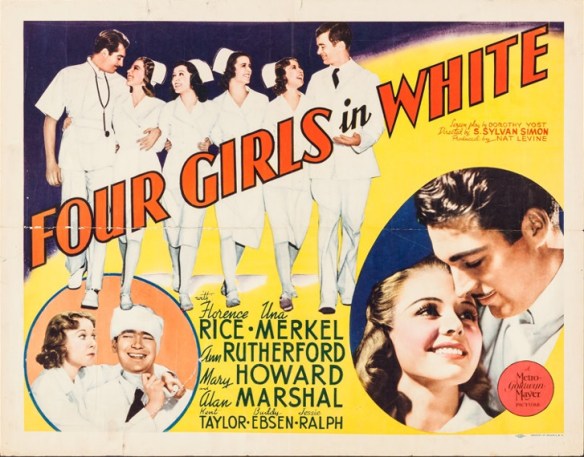
1939 Film: Four Girls in White
Release date: January 27, 1939
Cast: Florence Rice, Ann Rutherford, Una Merkel, Mary Howard, Alan Marshal, Kent Taylor, Buddy Ebsen, Jessie Ralph, Sara Haden, Phillip Terry, Tom Neal, Joy Anderson (uncredited)
Studio:
Metro-Goldwyn-Mayer
Director:
S. Sylvan Simon
Plot:
Four nurses (Rice, Rutherford, Merkel, Howard) are student nurses trying to make it through their three years at a hospital until graduation. Norma (Rice) is looking for a rich husband, Mary (Howard) pines way for her young daughter, Patricia (Rutherford) is sweet and diligent, and Gertie (Merkel) looks forward to her next meal. The girls face the stresses of becoming a nurse and making mistakes. Norma falls in love with a doctor (Marshal) but is frustrated that he always gets called into work.
1939 notes:
• Ann Rutherford was in seven films released in 1939. This one was released first.
• Phillip Terry was in 12 feature films in 1939. This is one of four films that was credited. The rest were uncredited.
Mary Howard, Florence Rice, Ann Rutherford and Una Merkel in “Four Girls in White” (1939)
My review: Searching for the “1939 feature”:
I love nurse films and this one is no exception. The 1930s were filled with nurse films, but many of the Pre-Code era featured sassy, fast-talking nurses who have at least one scene in their skivvies and rolling up or down their stockings. An example of this would be Night Nurse (1931), where Barbara Stanwyck ends up as a private nurse to children of an alcoholic mom.
Others were very dramatic accounts, like Prison Nurse (1938) or The Nurse from Brooklyn (1938).
While there have been many films focusing on the nursing field throughout the 1930s, I feel that “Four Girls in White” (1939) provides something a little different.
I felt that “Four Girls in White” showed girls working to become nurses in a hospital with the same tone and feeling that the Dr. Kildare film series (which began in 1937) showed about young doctors coming into the medical field.
Each nurse is independent and eager for a career in the medical field. Now, some of these nurses had different agendas other than just helping sick people. One, in particular, was looking to marry a rich husband, but we see each of them studying and working hard to learn (and also messing up). Much of their learning is shown through montages that give a feel for the four nurses’ personalities.
These low-budget Metro-Goldwyn-Mayer films of the late 1930s and early 1940s all have a brisk brightness that is especially pleasing. There are some overly dramatic moments (a few disasters strike and all nurses are needed) but it really is a fun film.
Is it a great film? Probably not, but it has a fresh and hopeful feeling that is found in MGM films of this time.
It’s no secret that the Hollywood Comet loves musicals. In 2010, I revealed I had seen 400 movie musicals over the course of eight years. Now that number is over 500. To celebrate and share this musical love, here is my weekly feature about musicals.
Starring:
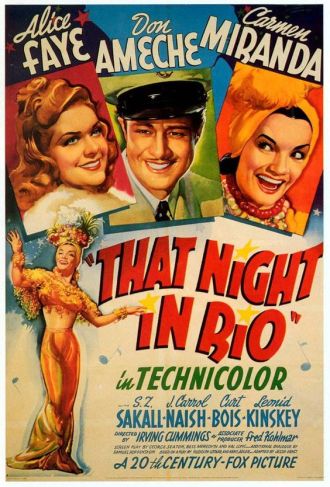
Alice Faye, Don Ameche, Carmen Miranda, S.Z. Sakall, Leonid Kinskey, Curt Bois, J. Carrol Naish, Maria Montez, Fortunio Bonanova
As themselves: Flores Brothers Trio
Plot:
Nightclub performer Larry Martin (Ameche) looks similar to the Baron Duarte (Ameche) and has an act where he poses as him. When Baron Duarte falls into financial issues and has to travel to Buenos Aires, his business partners have Larry step in to impersonate the Baron while he’s gone. Larry agrees, only if the Baron’s wife (Faye) isn’t informed that he is a stand-in.
In 2011, I announced I was trying to see every film released in 1939. This new series chronicles films released in 1939 as I watch them. As we start out this blog feature, this section may become more concrete as I search for a common thread that runs throughout each film of the year. Right now, that’s difficult.
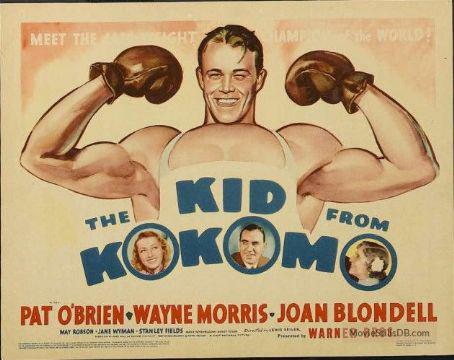
1939 film: The Kid from Kokomo
Release date: May 19, 1939
Cast: Wayne Morris, Joan Blondell, Pat O’Brien, Jane Wyman, May Robson, Sidney Toler, Maxie Rosenbloom, Stanley Fields, Ward Bond,
Studio: Warner Brothers
Director: Lewis Seiler
Plot:
Fight promoter Billy Murphy (Pat O’Brien) is rarely on the straight and narrow with his fighters. One day he finds Homer Baston (Wayne Morris) on a farm, with a punch so strong that it sends men flying. Why did Homer punch them? Because they said Mother’s Day was a racket. Homer is loyal to a mother that he never knew and hopes one day she will return. Murphy recruits Homer to become a fighter, but Homer is reluctant to leave home in case his mother returns. To con him into fighting, Murphy creates a publicity hunt for Homer’s mother. Just as Homer is about to walk out, Murphy finds Maggie (May Robson), a drunken woman with a criminal past. He convinces Maggie to tell Homer that she is his mother to keep him from fighting. While Homer succeeds with his career, Maggie spends all of his money and bets it on horses.
Homer also meets and falls in love with Marian (Jane Wyman), who comes from a wealthy family and her father (Sidney Toler) is a judge…who recognizes Maggie.
1939 Notes:
• By 1939, Wayne Morris was one of the main contract players at Warner Brothers. He made eight films in both 1937 and 1938, but only two in 1939.
• This was one of six screenplays by Dalton Trumbo filmed in 1939.
Other trivia:
• Adapted from the story “Broadway Cavalier.”
Pat O’Brien, Wayne Morris and Joan Blondell
My review: Searching for the “1939 feature”:
This is an entertaining B-movie. I love Wayne Morris as the sweet, naïve farm boy (my heart melted to butter when I saw him carrying a lamb). But May Robson steals the show here as the criminal posing as a mother, who ends up carrying for this sweet guy. May Robson was 80 years old when this film was released, so really she could have been a grandmother to 25-year-old Wayne Morris!
The May 20, 1939, New York Times review by Frank Nugent said “line between comedy and sheer bad taste has rarely been more clearly overstepped than in the Strand’s “The Kid From Kokomo”…which I felt was a bit dramatic. The film is an innocent comedy that perhaps uses a guy’s love for his mother to get him into boxing.
“The Kid from Kokomo” is not a unique film for any of the leads and far from the only film they made in 1939. The only actor in less than three films was Wayne Morris, who only released two films in 1939:
• May Robson: 7
• Jane Wyman: 5
• Pat O’Brien: 5
• Joan Blondell: 5
Though it was released in 1939, “The Kid from Kokomo” has the same brisk feel of most Warner Brothers comedies from 1936 to 1940. The year of release doesn’t make it much different. In fact, Wayne Morris’s role is very similar to his character in the comedy “Kid Galahad” (1937), another film that features Morris plucked from his daily life and groomed to be a boxer.
Once World War II began, this type of fast-paced, con-artist comedy seems to stop being used as a basic plotline theme.
It’s no secret that the Hollywood Comet loves musicals. In 2010, I revealed I had seen 400 movie musicals over the course of eight years. Now that number is over 500. To celebrate and share this musical love, here is my weekly feature about musicals.
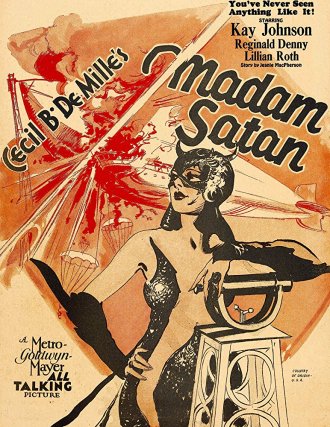
This week’s musical: Madam Satan (1930) – Musical #579
Studio:
Metro-Goldwyn-Mayer
Director:
Cecil B. DeMille
Starring:
Kay Johnson, Reginald Denny, Lillian Roth, Roland Young, Ann Sothern (uncredited), June Knight (uncredited),
Themselves: Abe Lyman and his Band
Plot:
Angela Brooks (Johnson) discovers her husband Bob (Denny) is cheating on her with Trixie (Roth). His friend Jimmy Wade (Young) tries to cover for him, but Angela isn’t fooled. To try to win her husband back, Angela goes to a wild masquerade ball on a zeppelin thrown by Jimmy. She disguises herself as the sexy Madam Satan to lure her husband back to her and make him believe that she is not cold, as he believes.
In 2011, I announced I was trying to see every film released in 1939. This new series chronicles films released in 1939 as I watch them. As we start out this blog feature, this section may become more concrete as I search for a common thread that runs throughout each film of the year. Right now, that’s difficult.
Release date: Oct. 14, 1939
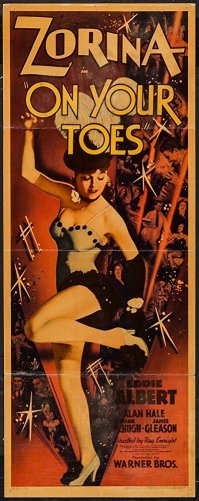
Cast: Vera Zorina, Eddie Albert, Alan Hale, James Gleason, Queenie Smith, Frank McHugh, Leonid Kinskey, Gloria Dickson, Donald O’Connor, Erik Rhodes, Berton Churchill, William Hopper (uncredited), Carla Laemmle (uncredited),
Studio:
Warner Brothers
Director:
Ray Enright
Plot:
Beginning in the 1920s, the Dancing Dolans (Gleason, Smith, O’Connor) is one of the top vaudeville performances. However, Mrs. Dolan wants her son Phil Jr. (O’Connor to Albert) to be educated and be a composer. The Dancing Dolans continue performing, but their acts are no longer well-received and vaudeville is dying. Phil Jr. meets Russian composer Ivan Boultonoff (Kinskey), and Phil composes “The Slaughter on Tenth Avenue” for the Russian Ballet. Phil reconnects with Vera (Zorina), a ballerina he knew from vaudeville, and she lobbies for the head of the ballet company (Hale) to use the music.
1939 notes:
• This was only Eddie Albert’s second feature film; the first was Brother Rat in 1938. While not one of Warner Brother’s top leading men (like Ronald Reagan, Humphrey Bogart, Dennis Morgan or Jack Carson), Albert was a steady comedic star for Warner. Eddie Albert was a lead character in “Brother Rat,” but “On Your Toes” was his first true leading role where the plot and camera mainly followed him.
• Vera Zorina is recreating her role from the 1936 stage production of “On Your Toes”
• This was also the second American feature film for ballet dancer Vera Zorina, who appeared in a total of eight films.
• While Donald O’Connor is only a child in this film, this was his 13th film as a child star.
Other Trivia:
• James Wong Howe was the cinematographer for “On Your Toes.” Sol Polito photographed the “Slaughter on Tenth Avenue” ballet.
• Donald O’Connor plays young Eddie Albert
• Originally planned as a Fred Astaire vehicle, but Astaire turned down the film.
My review: Searching for the “1939 feature”:
So far I have watched 179 films from the year 1939. None of them have been bad, but none of them
While “On Your Toes” has three ballet numbers and some vaudeville dances at the beginning, I wouldn’t consider it a musical. There is very little singing and the focus is much more composing music and dance.
Outside of the ballet dancing, the comedy featuring Eddie Albert, James Gleason, and Alan Hale, is not very different from what you would experience in another 1930s or early-1940s Warner Brothers film.
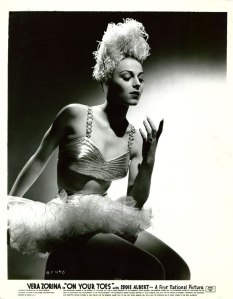
Vera Zorina in costume for the Princess Zenobia number in “On Your Toes” (1939)
The ballet numbers in it are gorgeously photographed by Howe and Polito. First, Vera Zorina dances beautifully in the Princess Zenobia ballet (photographed by Howe) as the audience is able to see a serious ballet performance. When Eddie Albert enters the Princess Zenobia number, the ballet scene turns away from serious dance to comedy. Albert’s character doesn’t know the dance and makes a ridicule of everyone else, but the papers think the comedy was intentional, giving the dance a good review.
“The Slaughter on Tenth Avenue” ballet is the climax of the film. This wonderful ballet scene is 13 minutes, mixing ballet and some vaudeville tap dancing.
“On Your Toes” is your standard 1930s Warner Brothers comedy. However, it’s unique in the fact that the audience is able to see a serious ballerina who danced for (and was married to) the great George Balanchine, co-founder of the New York City Ballet. Zorina was the prima ballerina in several performances for the Colonel de Basil’s Ballets Russes de Monte Carlo from 1934 to 1936.
With all the musicals I have watched, I can not recollect any other film before Michael Powell’s “The Red Shoes” (1948) that photographs a ballet performance to its full potential. For instance, in early sound films like “Broadway Melody of 1929,” you can see sloppy ballet dancing (I’m thinking specifically of the “Wedding of the Painted Doll” number).
I enjoyed “On Your Toes,” as it is a funny and entertaining film with some of Warner Brothers top comedians. It was a good mix of comedy and art with the ballet.
It’s no secret that the Hollywood Comet loves musicals. In 2010, I revealed I had seen 400 movie musicals over the course of eight years. Now that number is over 500. To celebrate and share this musical love, here is my weekly feature about musicals.
This week’s musical:
At War with the Army (1950) – Musical #581
Studio:
Paramount Pictures
Director:
Hal Walker
Starring:
Jerry Lewis, Dean Martin, Polly Bergen, Mike Kellin, Jimmie Dundee, Tommy Farrell, Danny Dayton, William Mendrek, Angela Greene, Jean Ruth
Plot:
Set on an Army base during World War II, Pfc. Alvin Korwin (Lewis) and 1st Sgt. Vic Puccinelli (Martin) were friends before the war and had a nightclub act. Private Korwin wants to go home to see his newly born baby and Sgt. Puccinelli wants to be transferred overseas. Confusion ensues when a pregnant old girlfriend arrives to visit Sgt. Vic Puccinelli.
But in 2011, I decided I wanted to see beyond more than just the big-budget box office successes of the year and dig deeper to see what made this year tick. Were all the movies special or was it just a handful?
This included watching all the B and C movies – The 68-minute movies that star people like character actor Henry O’Neill as a lead character.
So seven years ago I set out to see every film made in 1939, a count that came roughly to 515.
To date after all this time, I’ve still managed to only watch 173 movies made in 1939. So to help propel myself further, I am beginning a weekly Comet Over Hollywood series focused on the films of 1939.
Every Thursday, I will review a film made during 1939. This could range from the top tier films to those B movies shown in a double feature.
It’s no secret that the Hollywood Comet loves musicals. In 2010, I revealed I had seen 400 movie musicals over the course of eight years. Now that number is over 500. To celebrate and share this musical love, here is my weekly feature about musicals.
This week’s musical:
Spinout (1966) – Musical #580
Studio:
Metro-Goldwyn-Mayer
Director:
Norman Taurog
Starring:
Elvis Presley, Shelley Fabares, Diane McBain, Deborah Walley, Dodie Marshall, Jack Mullaney, Warren Berlinger, Jimmy Hawkins, Carl Betz, Cecil Kellaway, Una Merkel
Plot:
Mike McCoy (Presley) is a carefree musician living a nomadic life with his band (Walley, Mullaney, Hawkins). Cynthia Foxhugh (Fabares) is a spoiled rich girl with her sights set on Mike. She uses her rich father (Betz) to try and get Mike. Her father also wants him to race his car. Cynthia isn’t the only one after Mike: Diana St. Clair is researching him for her book “The Perfect American Male,” and decides she needs to marry Mike. And tomboy band member Les (Walley) also likes Mike.
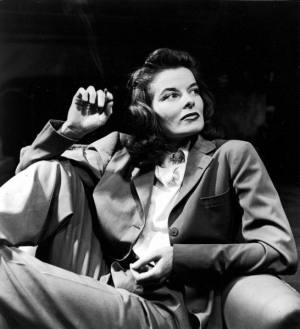
Katharine Hepburn photographed by Alfred Eisenstaedt for LIFE magazine in 1938.
When it comes to classic film actresses, Katharine Hepburn placed herself far from the crowd of studio starlets.
Her characters were strong, she didn’t attend Hollywood events, and she didn’t present herself in a soft, feminine manner.
“Kate wasn’t someone you could mold easily, that you could control,” said director Dorothy Arzner, who directed Hepburn in Christopher Strong (1933).
And when you think of Katharine Hepburn, you think of her clothing—particularly her pants, something so innocuous now but an article of clothing “polite” women of the 1930s and 1940s weren’t seen wearing in public.
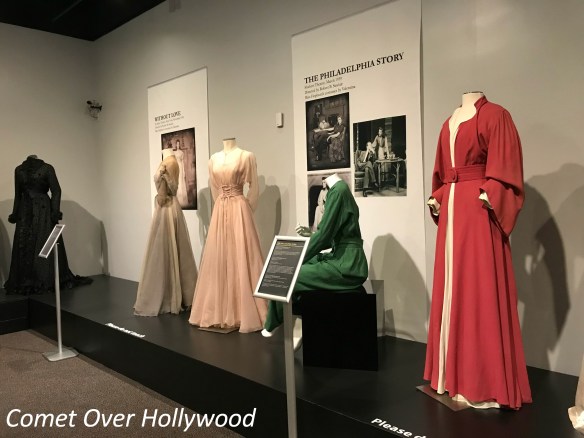
These pants and other items of Katharine Hepburn’s costumes and clothing are on display in the Upcountry History Museum in Greenville, SC, as part of the “Katharine Hepburn: Dressed for Stage and Screen” exhibit, running through January 14. The costumes are on loan to the Upcountry History Museum from the Kent State University Museum. The Hepburn Estate donated Miss Hepburn’s collection to Kent State University Museum.
Costumes from the play version of “The Philadelphia Story” at the Upcountry History Museum.
“It was Miss Hepburn’s wish that her personal collection of her performance clothes be given to an educational institution. Her other personal effects were sold in a Sotheby’s Auction for charity,” said Jean L. Druesedow, director of the Kent State University Museum in an e-mail interview. “Her executors discovered the Kent State University Museum through friends of friends and Gladys Toulis, the first director of the Kent State Fashion School.”