Musical Monday: Oh, You Beautiful Doll (1949)

It’s no secret that the Hollywood Comet loves musicals.
In 2010, I revealed I had seen 400 movie musicals over the course of eight years. Now that number is over 600. To celebrate and share this musical love, here is my weekly feature about musicals.

This week’s musical:
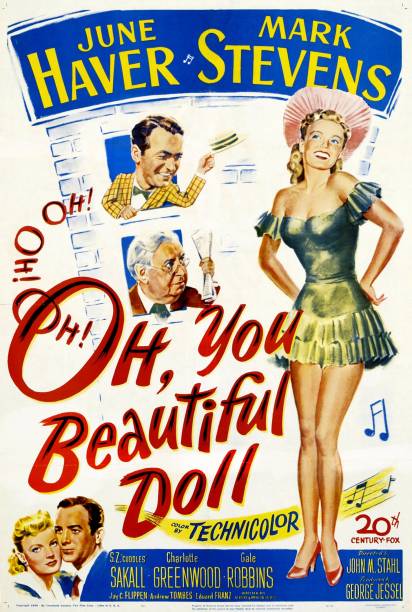
Oh, You Beautiful Doll (1949) – Musical #798

Studio:
20th Century Fox

Director:
John M. Stahl

Starring:
Mark Stevens, June Haver, S.Z. Sakall, Charlotte Greenwood, Gale Robbins, Jay C. Flippen, Andrew Tombes, Eduad Franz, Robert Gist (uncredited), Ray Walker (uncredited), Victor Sen Yung (uncredited)

Plot:
A biographical film about composer Alfred Breitenbach (Sakall), who became known as Fred Fisher for his Tin Pan Alley songs. In the film, Alfred has ambitions of composing great music, such as an opera. However, he and his family — wife Anna (Greenwood) and daughter Doris (Fisher) — are very poor. Song plugger Larry Kelly (Stevens) meets Alfred by accident and hears some of his music. Larry jazzes up portions of Alfred’s opera and writes lyrics to it, making Alfred’s music a success with mainstream music, where he is credited as Fred Fisher. Alfred struggles with being known and becoming famous off music he doesn’t like, though he and his family are living more comfortably. Outside of this, Larry and Doris are also falling in love.

Continue reading

Musical Monday: Boarding House Blues (1948)

It’s no secret that the Hollywood Comet loves musicals.
In 2010, I revealed I had seen 400 movie musicals over the course of eight years. Now that number is over 600. To celebrate and share this musical love, here is my weekly feature about musicals.

boarding house bluesThis week’s musical:
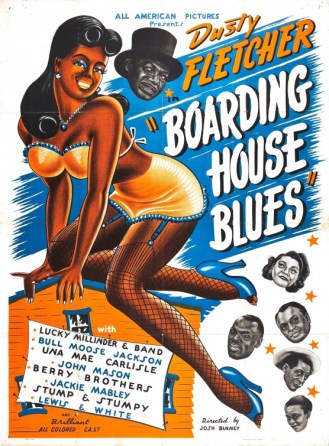
Boarding House Blues (1948) – Musical #767

Studio:
All-American Pictures

Director:
Josh Binney

Starring:
Mom Mabley (billed as Jackie Mabley), Dusty Fletcher, Marcellus Wilson, Marie Cooke, Augustus Smith, Johnny Lee, Emory Richardson, Harold Cromer, Sidney Easton, Freddie Robinson, John “Spider Bruce” Mason, John Riano
Specialty Acts: Lucky Millinder and His Band, Una Mae Carlisle, Bull Moose Jackson, Berry Brothers, Lewis and White, Anistine Allen, Paul Breckenridge, Stump and Stumpy (James Cross and Eddie Hartman), Lee Norman Trio, Henry “Crip” Heard

Plot:
Mom (Mabley) runs a boarding house of entertainers in Harlem, and shares with her tenants that they are broke and the land lord is going to kick them. To help raise money for rent, the boarders put on a show.

Continue reading

Musical Monday: Sun Valley Serenade (1941)

It’s no secret that the Hollywood Comet loves musicals.
In 2010, I revealed I had seen 400 movie musicals over the course of eight years. Now that number is over 500. To celebrate and share this musical love, here is my weekly feature about musicals.

sun valleyThis week’s musical:
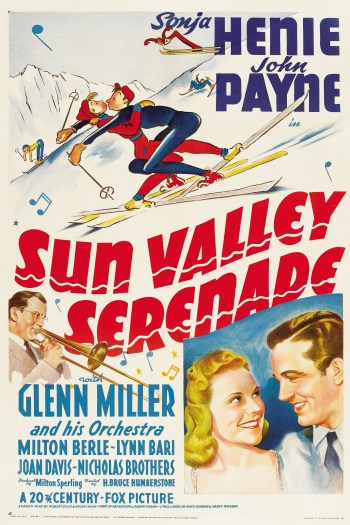
Sun Valley Serenade –Musical #539

Studio:
20th Century Fox

Director:
Bruce Humberstone

Starring:
Sonja Henie, John Payne, Glenn Miller, Milton Berle, Lynn Barrie, Joan Davis, Ann Doran (uncredited)
Themselves in Specialty Performance: Tex Beneke, Ray Anthony, Angela Blue, The Nicholas Brothers, Dorothy Dandridge

Plot:
A down on their luck band lands a Christmas Eve gig in Sun Valley, Idaho, after they hook up with temper mental singer Vivian Dawn (Bari). To help with publicity for the band, their publicist Nifty Allen (Berle) set up for pianist Ted Scott (Payne) to adopt a European war orphan. While Ted and bandleader Phil Corey (Miller) have prepared for a baby orphan, their adoptee is fully grown Norwegian Karen (Henie). When the band leaves for Sun Valley, Karen sneaks along, threatening a budding romance between Ted and Vivian.

Continue reading

Musical Monday: Silver Skates (1943)

It’s no secret that the Hollywood Comet loves musicals.
In 2010, I revealed I had seen 400 movie musicals over the course of eight years. Now that number is over 500. To celebrate and share this musical love, here is my weekly feature about musicals.

Belita7This week’s musical:
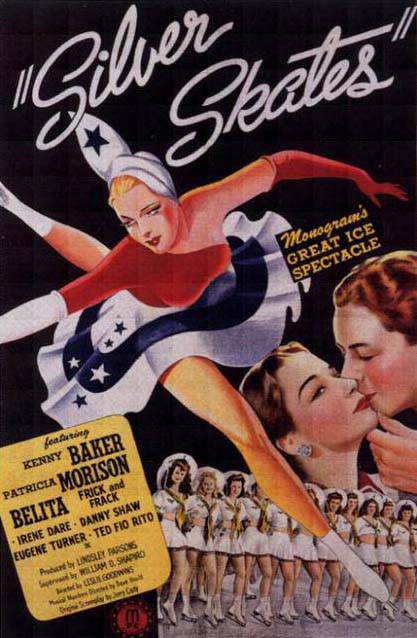
Silver Skates” (1943)– Musical #518

Studio:
Monogram Pictures

Director:
Leslie Goodwins

Starring:
Belita, Kenny Baker, Patricia Morison, Joyce Compton, Frank Fraylen, Irene Dare, Danny Shaw
Specialty performances: Skating team Frick and Frack-Werner Groebli and Hans Mauch, Eugene Turner, Ted Fio Rito Orchestra

Plot:
Claire Thomas (Morison) owns an ice show that is financially on the rocks. The only thing keeping the show afloat is ice skater Belita (as herself). However, Belita is leaving the show to get married. Show member Eddie (Fraylen) starts a rumor that Belita is in love with the show’s singer Danny (Baker) so she will stay. However, Danny is engaged to Claire. Along the way, Claire meets a war orphan, Katrina (Dare), who joins the skating show and Claire would like to adopt. The only issue is, she needs to be married to adopt Katrina.

Continue reading

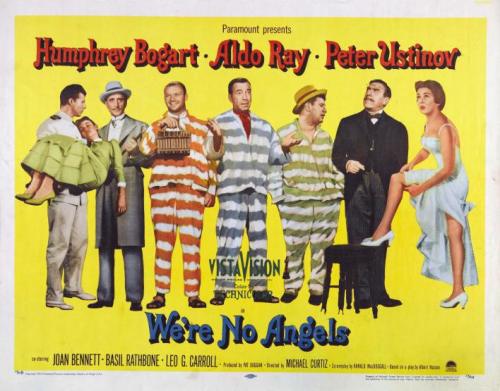
Christmas on Film: “We’re No Angels” (1955)

Guardian angels can come in many forms, and in the film “We’re No Angels” (1955), help arrives from three convicts.

angels3

Early Christmas Eve, Joseph (Humphrey Bogart), Albert (Aldo Ray), Jules (Peter Ustinov) and Adolf the poisonous snake, escape from prison on French colonial Devil’s Island in 1895. Joseph embezzled money, and Albert and Jules are murderers. They are able to blend in easily in the town in their prison clothes, as many paroled convicts work out in the open.

Continue reading

A Gift from Comet Over Hollywood

Almost every Christmas for the past four years, I try to film a special Christmas video for the readers and supporters of Comet Over Hollywood.

This year — as my gift to you — my mother and I re-enacted one of my favorite Christmas scenes from a classic film. I hope you enjoy it as much as I loved making it.

For context, here is a snippet from the trailer.

Merry Christmas and Happy Holidays!

Check out the Comet Over Hollywood Facebook page, follow on Twitter at @HollywoodComet or e-mail at cometoverhollywood@gmail.com

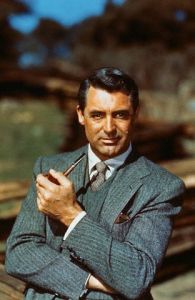
Cary Grant’s “Christmas Lullaby”

late 1940s --- Cary Grant --- Image by © CinemaPhoto/Corbis

Cary Grant in the 1940s

Cary Grant is often noted as one of the best and most attractive actors of all-time. His film resume includes some of Hollywood’s best films such as Alfred Hitchcock’s “Notorious” (1946) to the comedy “His Girl Friday” (1940).

But out of all of that, Cary Grant said his best production was his daughter Jennifer.

Grant became a father for the first time at age 62 with his fourth wife, Dyan Cannon. The two were married from 1965 to 1968. Grant retired from films in 1966 when Jennifer was born; a career that began in 1932 and ended with the film “Walk, Don’t Run.”

Grant doted on his daughter and this is exhibited in the only record he ever made, “A Christmas Lullaby,” which was recorded for her. The 45 was made through Columbia Records and the b-side included the song “Here’s to You.”  Continue reading

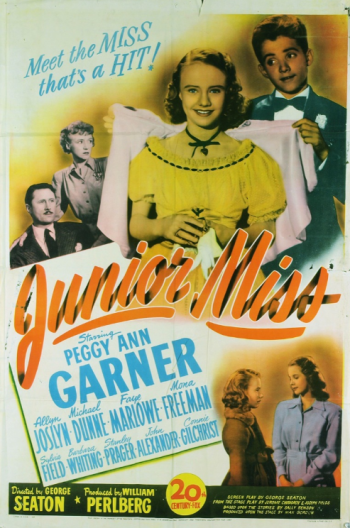
Christmas on Film: Junior Miss (1945)

junior missThe same year Peggy Ann Garner performed her award winning role in “A Tree Grows in Brooklyn,” the 13-year-old actress found herself in a coming of age comedy, “Junior Miss” (1945).

Similar to “And So They Were Married” (1936), Christmas is merely a backdrop to adolescent antics in “Junior Miss” (1945), but the holidays play larger roles in this coming of age film.  Continue reading

A Familiar Face: Character actor John Ridgely

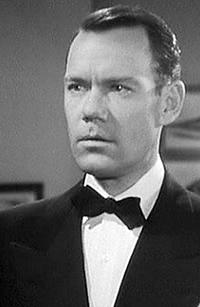
Character actor John Ridgely

Character actor John Ridgely

They are the highlights of most of our favorite films; coming in with the most striking lines and comedic moments.

A character actor is often the best part of the film. Not the star and a little lower than the secondary lead, a character actor has something distinct that they carry from film to film; whether it’s a funny voice, a physical appearance or personality trait. Think S.Z. “Cuddles” Sakall’s chubby cheeks, Joyce Compton’s southern drawl or Una O’Connor’s fussy Irish habits.

But there are character actors who are just below these sidekick-like roles. The audience recognizes their face but may not know their name. These actors usually perform a role in the film that helps move the plot along, even if it is something as simple as being a police officer arresting the bad guy or a hotel clerk checking the lead actors into a hotel.

This role describes the versatile “every man” actor, John Ridgely (sometimes spelled Ridgeley). Born John Huntington Rea in Illinois, Ridgely was a graduate of Stanford University with plans to go into an industrial career. After performing in plays with the Pasadena Playhouse, Ridgely entered films in the 1930s.

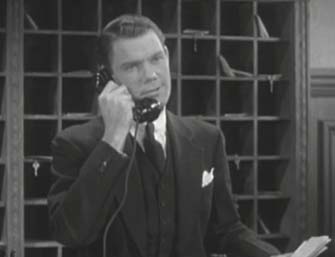
If you have watched a Warner Brother’s film made between 1935 and 1948, chances are you have spotted Ridgley. The tall, dark haired vaguely attractive actor appeared in 145 feature films. His roles ranged from police officers, doctors, heavies, truck drivers, salesmen, orchestra leaders, part of a double date, cab drivers, hotel clerks, coroners and reporters.

John Ridgely as a hotel clerk in

John Ridgely as a hotel clerk in “Nancy Drew-Reporter.”

Some of his films include The Big Sleep (1946), Arsenic and Old Lace (1944), “They Died With Their Boots On (1941), The Letter (1940) and Dark Victory (1939), humorously listed as Man Making Crack About Judith.

Actress Lauren Bacall’s first screen test was with Ridgely for the film “To Have and Have Not” (1944), performing the famous “put your lips together and blow” scene. The scene was written without any real intention of keeping it in the film, but after seeing the screen test, director Howard Hawks changed his mind, according to Bacall’s autobiography “By Myself.”

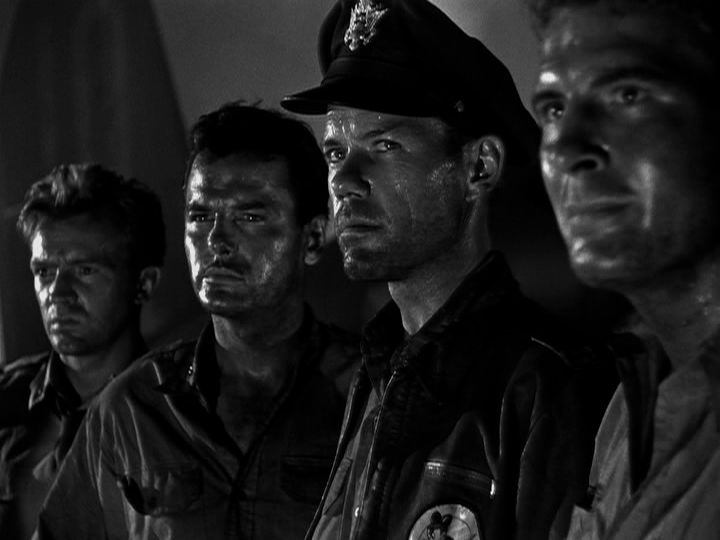
But Ridgely received top billing in the 1943 World War II film “Air Force;” co-starring with John Garfield, Arthur Kennedy, Gig Young and Harry Carey.

John Ridgley had top billing in

John Ridgley had top billing in “Air Force.”

For his first (and last) time in a lead role, Ridgely does an excellent job. In the Feb. 4, 1943, New York Times film review, critic Bosely Crowther called Ridgely’s performance “refreshingly direct.”

“Mr. Hawks very wisely recruited a cast with no outstanding star, thus assuring himself the privilege of giving everyone a chance. And his actors have responded handsomely,” Crowther wrote.

Two years later, Ridgely acted with John Garfield in “Pride of the Marines” (1945). Though the role is not as large as “Air Force,” Ridgely has a sufficient amount of screen time as a next door neighbor and friend of Garfield and his wife, played by Eleanor Parker.

But regardless how much screen time he received in films, Ridgley garnered media attention, as most film stars in the classic era did. This included:

  • April 10, 1943: A humorous newspaper story in an April 10, 1943, article where Ridgely gave a few kids a ride. The kids asked to be let out of the car when they found out he was an actor.
  • July 20, 1943: “Theater Gossip” John Garfield and John Ridgley announced to be acting with Cary Grant in “Destination Tokyo.” The two Johns are both noted for just coming from the film “Air Force.”
  • Nov. 11, 1943:The Evening Independent, “Playhouse Film Provides Thrills, Flynn Stars in Hudson Bay Story of Nazi Spies”: Ridgley is noted for acting in the upcoming Errol Flynn film, “Northern Pursuit.”
  • Feb. 11, 1944: “Sign on Windshield Almost Ruins Actor,” an article tells how Ridgely almost was in a car accident due to his surprise of seeing an old woman driving a 1903 Baker Electric.
  • Oct. 27, 1944: “The Evening Independent” under “Theater Gossip”: John Ridgley is noted for playing a “heavy” in the upcoming film, “The Big Sleep.” “Assignment of Ridgely was announced at the same time it was disclosed Regis Toomey was signed for an important role as a fast talking muscle man…Ridgely portrayed a meteorologist in Destination Tokyo and a confused husband in The Doughgirls.”
  • April 6, 1945: Ridgely is mentioned in the sub-head of a review on “God is My Co-Pilot” starring Dennis Morgan.
  • May 27, 1951: article mentions Ridgely was celebrating his 19th anniversary in film and his next upcoming project, playing a doctor in the “The Blue Veil.”
Arthur Kennedy, Gig Young, John Ridgely and Charles Drake in

Arthur Kennedy, Gig Young, John Ridgely and Charles Drake in “Air Force.”

Ridgely left the industry in 1953 and died in Manhattan in 1968 of heart failure. Conflicting reports say he is buried in New York while other says Forest Lawn in Hollywood. Ridgley was married to Virginia Robinson and had a son, John Ridgely Rea.

While he wasn’t a huge star, Ridgely was still considered important enough to be noted by the press. Regardless of the role, Ridgely always adds something to the film and it’s fun to pick him out in his various roles.

Check out the Comet Over Hollywood Facebook page, follow on Twitter at @HollywoodComet or e-mail at cometoverhollywood@gmail.com

You Stepped Out of a Dream: Fashions of Lana Turner

Nightclubs would play “You Stepped Out of a Dream” as she entered.

Men adored her, including actor William Powell, and showered her with gifts.
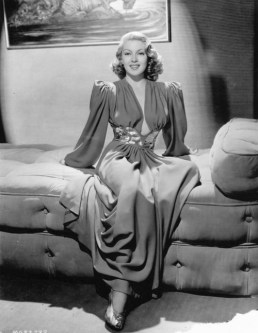
Though Lana rarely wore low cut dresses, this fuchsia gown was a favorite.

Though Lana rarely wore low cut dresses, this fuchsia gown was a favorite.

Lana Turner’s glamor, beauty and style made her one of the top film stars from the 1940s through the early 1960s.

Her fashionable presence and perfection of her appearance has left a lasting impression on classic Hollywood fans.

Before Comet has looked at Turner’s beauty regimens such as moisturizing with Nivea or exfoliating with Boraxo soap once a week.

Today we are looking at how Miss Turner dressed.

“She had a presence, style and beauty,” said her daughter Cheryl Crane in her book LANA: The Memories, the Myths, the Movies. “But she was approachable, rather than  film goddesses like Greta Garbo.” (56)

Her clothes and jewelry were her star persona that she used as a shield and felt vulnerable without them, Crane said.

“Her appearance, whether for screen, at home or in public, was always ‘camera ready,’” Crane wrote. “Make up on, hair done-no matter the time or place.” (82)

“I would rather lose a good earring than be caught without make up,” Turner said.

Turner togs:

Crane describes her mother’s lifestyle and interests in the book in detail-including her clothing.

Turner’s closet in her 1950s home was the length of half of their home complete with a platform for fittings, climate controlled closets for furs, jewelry vaults and revolving closets.

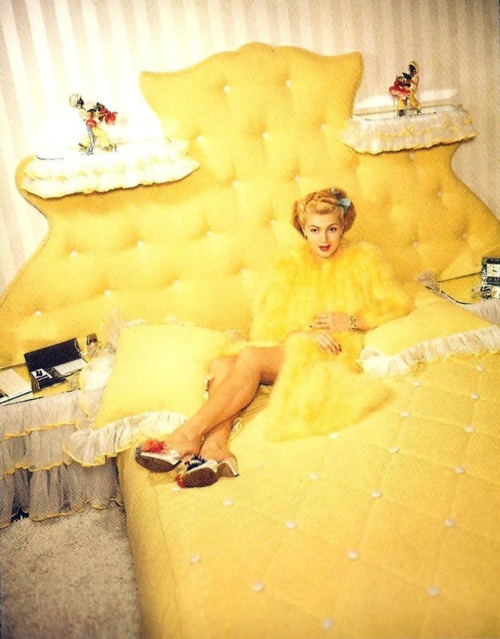
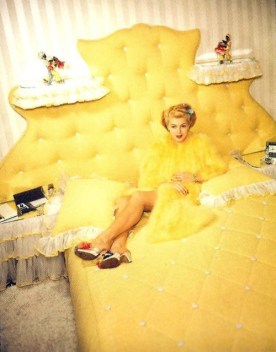
When it came to evening dresses, Turner liked form fitting gowns but rarely wore low cut dresses. She preferred wearing all white or all black for a dramatic look that complimented her skin tone and hair. (95) She also liked clean, bright colors such as yellow.

All white and black ensembles were looked dramatic with her coloring
All white and black ensembles were looked dramatic with her coloring

Lana also liked clean, bright colors such as yellow. Here she is in 1942. (182)

Lana also liked clean, bright colors such as yellow. Here she is in 1942. (182)

For professional performances Lana never wore clothing off the rack so that she wouldn’t be copied by department stores. Her casual clothing was tailored as well.

Her favorite designers were Jean Louis and Nolan Miller, later in life.

“More than often she would look at the latest issue of Harper’s Bizarre or Vogue and then put her dressmaker to work on a vision of the styles she liked,” Crane wrote. “Mother’s perfectionism caused trouble during fittings. It was not unheard of for a dressmaker to walk out because she was so detail oriented.” (96)

Lana locks:

When Lana started in Hollywood, her hair was a reddish brown. It was eventually died blond, which it stayed for most of her career. In other films like “Green Dolphin Street” (1947) and “Betrayed” (1954) her hair was brown.
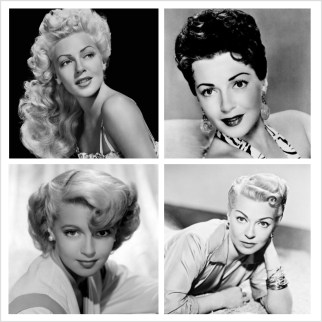
Various Lana Turner hairstyles in the 1940s and 1950s

Various Lana Turner hairstyles in the 1940s and 1950s

Turner’s hairdresser, Helen Young, experimented with up-dos and wove jewels and flowers into her hair, Crane wrote (88).

“It (her hair) was long one moment, short the next,” Crane wrote. “Mother was constantly changing her hair. It was very easy to style.”

Along with jewels, Lana often adorned her head with hats- from flowered pieces to feathers, veils and Spanish influenced mantillas.

“Mom had a face that allowed her to wear any hat,” Crane wrote. (100)

hats

Lana Turner in various hat styles in the 1930s and 1940s.

Finishing touches:

“No dress, however startling, can stand alone,” Lana said.

She coordinated jewelry with outfits and preferred colored jewels to diamonds. (104)

“Even when wearing sweats she had jewelry,” Crane wrote.

Her shoes were by Ferragamo that were designed to match gowns. (96)

When Lana liked a style of shoes, she bought it in ever color. At one point she had 698 shoes. (99)

Fashion copycats and admirers:
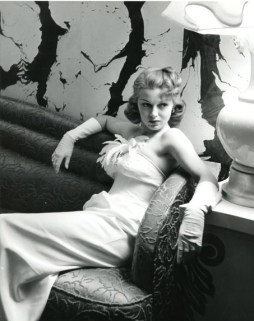
On the nightclub scene in a white evening gown in the 1940s.

On the nightclub scene in a white evening gown in the 1940s.

It wasn’t just men who admired Lana.

Though Ginger Rogers wrote in her autobiography that Eva Peron copied her style in the 1930s, Cheryl Crane wrote that Peron was fascinated with Lana.

“Eva Peron copied fashions and a number of unique hairstyles for which mother was known for,” Crane said. (177)

The fascination made it awkward for Turner when she visited Argentina in 1946.

“Customs seized all of her jewelry and held her up for hours,” she wrote. “She learned that every piece was photographed to be copied later.”

Another notable person fascinated with Lana was artist Salvador Dali-but he was only obsessed with the corners of her eyes, which he wanted to paint. (177)

A legend

Though Lana Turner is one of the most beautiful women in the classic age of Hollywood, she didn’t think so.

“It’s interesting that mother never thought of herself as beautiful,” Crane wrote. “To her, the great beauties were brunettes.”

Regardless of Turner’s personal opinion of herself, her fashion and beauty made her a one of Hollywood’s ethereal and beautiful stars.

Source:

“Lana: The Memories, the Myths, the Movies” by Cheryl Crane

This is part of Fashion in Film blogathon by Hollywood Revue Blog.
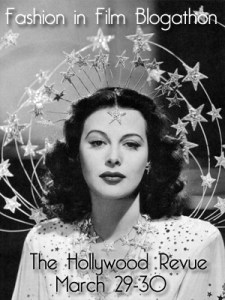
Fashion in Film blogathon hosted by our friends at Hollywood Revue Blog

Fashion in Film blogathon hosted by our friends at Hollywood Revue Blog

Check out the Comet Over Hollywood Facebook page