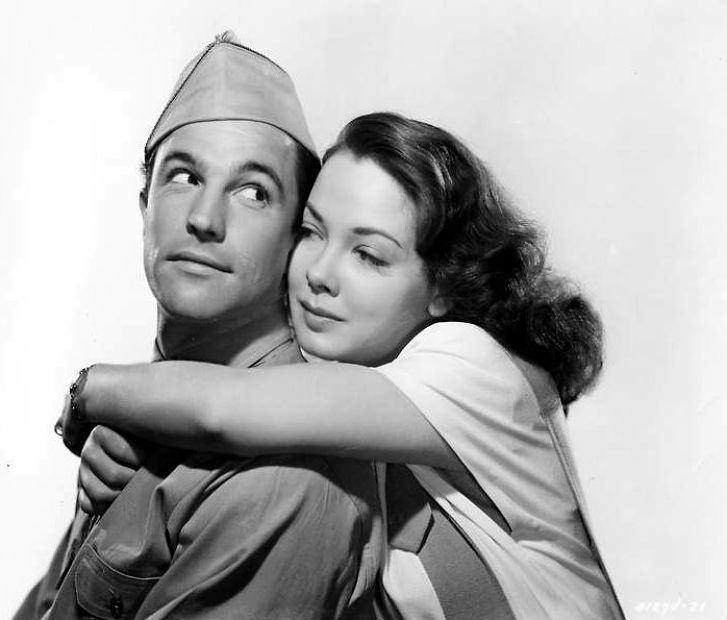
Memorial Day Musical Monday: This is the Army (1943)

It’s no secret that the Hollywood Comet loves musicals.
In 2010, I revealed I had seen 400 movie musicals over the course of eight years. Now that number is over 500. To celebrate and share this musical love, here is my weekly feature about musicals.
TitaposThis week’s musical:
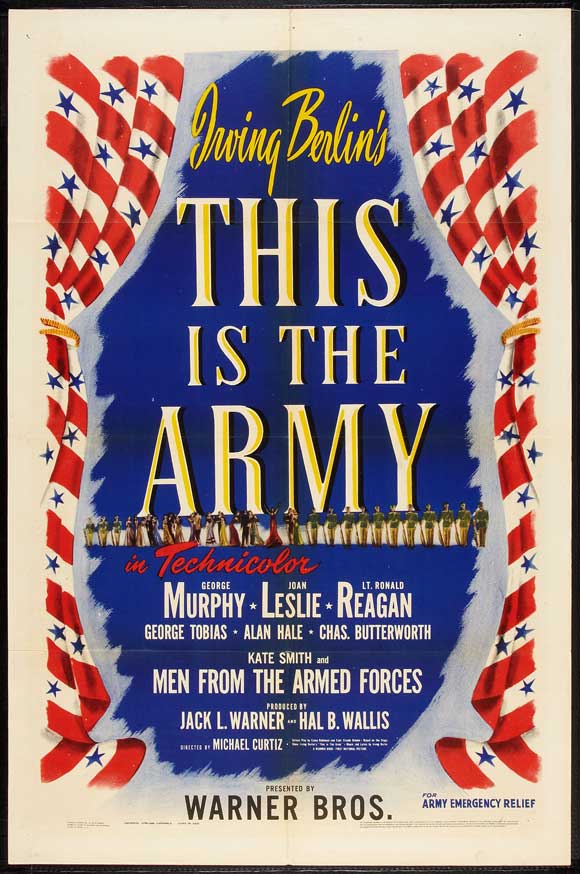
“This is the Army” –Musical #488

Studio:
Warner Brothers

Director:
Michael Curtiz

Starring:
Joan Leslie, Ronald Reagan, George Murphy, Charles Butterworth, George Tobias, Alan Hale, Dolores Costello, Una Merkel, Rosemary DeCamp, Dan Dailey (uncredited), Gary Merrill (uncredited), Gene Nelson (uncredited), Herb Anderson (uncredited), Victor Mature
As themselves: Frances Langford, Kate Smith, Joe Louis, Irving Berlin

Plot:

The movie starts in 1917, when dancer Jerry Jones (Murphy) is drafted to fight in World War I. Before leaving, he marries his sweetheart Ethel (DeCamp).
But before the soldiers are shipped overseas, Jones stages an all-soldier Broadway show called “Yip Yip Yaphank.” While fighting in France, Jones hurts his leg and will no longer be able to dance.
When he returns to the states, he becomes a producer, and his buddy Eddie Dibble (Butterworth) -who was the bugler in the Army-opens a music store.
Over 20 years pass, and we see Jones’s son Johnny (Reagan) preparing to fight in World War II. Dibble’s daughter Eileen (Leslie) wants to get married before Johnny goes overseas, but he doesn’t want to potentially leave her as a young widow.
Now that Johnny is in the military, he is given the order to create a military show just like his dad. This time, it’s called “This is the Army.”
Once the plot is set up, the remainder of the movie is the the actual show “This is the Army” including musical performances, a magic act, a comedian and acrobats.

Character actor Charles Butterworth is the bugler in World War I in "This is the Army"

Character actor Charles Butterworth is the bugler in World War I in “This is the Army”

Trivia:
-The movie came from two Irving Berlin shows “Yip Yip Yaphank” and “This is the Army,” according to a disclaimer from Warner Brothers at the beginning of the film. The cast of both the stage and play version of “This is the Army” included soldiers who were performers in civilian life.
-The original Broadway play of “This is the Army” came by request of the United States War Department. Irving Berlin received a letter in 1942 asking him to do a revival of the World War I show, “Yip Yip Yaphank,” to help raise funds for the Army Emergency Relief. Berlin had already considered doing this, but knew he had to change the title, according to The Complete Lyrics of Irving Berlin  edited by Robert Kimball, Linda Emmet
-Warner Brother’s first three strip Technicolor film.
-Warner Brother’s top film of 1943, earning $9,555,586.44. The money made was donated to the Army Emergency Relief.
-This is actress Dolores Costello’s last film.

Notable Songs:
-God Bless America sung by Kate Smith
-What Does He Look Like sung by Frances Langford
-This is the Army Mr. Jones sung by the chorus
-I’m Getting Tired So I Can Sleep sung by James Burrell
-Ladies of the Chorus sung by Alan Hale (dressed as a woman)
-I Left My Heart at the Stagedoor Canteen sung by Earl Oxford
-That’s What the Well Dressed Men in Harlem Wear sung by James Cross, featuring boxer Joe Louis
-Oh, How I Hate to Get Up in the Morning sung by Irving Berlin

Highlights:
-A disclaimer before the film noted that the Army does not condone black face, which is used in a number during the film, but says it is a part of history.
-Irving Berlin singing “Oh, How I Hate to Get Up in the Morning” in a rare film appearance.
-Real color footage of the attack of Pearl Harbor during the montage of the bombing.
-Alan Hale dressed as a woman in the musical number “Ladies in the Chorus.”
-Warner Brother stars such as Joan Leslie, Ronald Reagan, George Murphy, Alan Hale, Charles Butterworth and Una Merkel in color!
-One of the character actors does fairly convincing speech impersonations of Herbert Marshall, Charles Boyer, Lynn Fontanne and Alfred Lunt.

My Review:

The romance between Joan Leslie and Ronald Reagan took up probably 20 minutes of this film.

The romance between Joan Leslie and Ronald Reagan took up probably 20 minutes of this film.

Like the rest of Hollywood during World War II, Warner Brothers was releasing star spangled patriotic films. Around this same time, “Hollywood Canteen” (1944) and “Thank Your Lucky Stars” (1943) were released. All three films focus mainly on musical performances and celebrity appearances (Kate Smith, Frances Langford, Joe Louis) and a very thin plot.

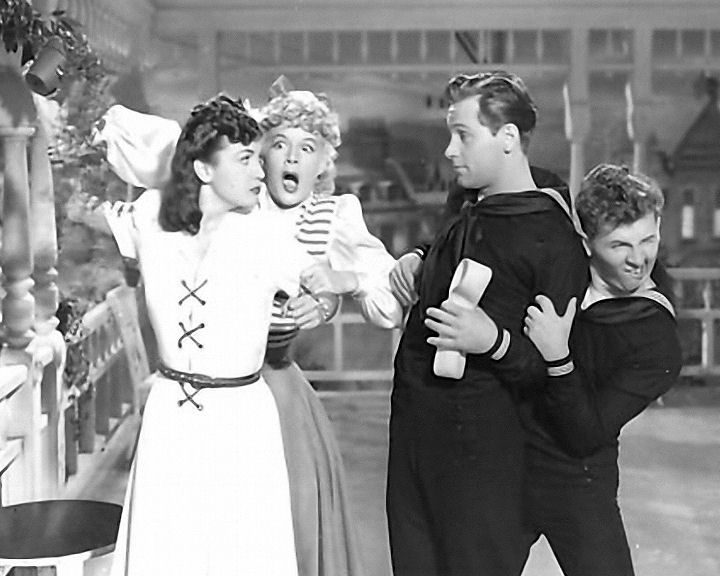
Other studio equivalents would be MGM’s “Two Girls and a Sailor” (1944) and Paramount’s “Star Spangled Rhythm” (1942).

But while the other four listed musicals still hold attention and are fun, somehow “This is the Army” falls flat. The initial plot set up seems promising, but after the first 45 minutes, the movie turns into musical number after number after number with little plot interlude. That is where “This is the Army” differs from similar films. For example, in “Hollywood Canteen,” you have the romance of Joan Leslie and Robert Hutton between the different performances.

The lack of plot interlude is honestly disappointing, because actress Joan Leslie and some of the other leads are maybe on screen for 20 to 30 minutes in the two hour and five minute film.

On a more technical side, the DVD print that came in the 2008 “Homefront Collection” isn’t very good. In close shots, the color is gorgeous. But in a few scenes, it looks over exposed and washed out.

When I first saw this movie in 2009, I really enjoyed it. Now I found I was rather bored. I appreciate any patriotic World War II film, because it gives you a feel of what audiences wanted during the war. After all, this was Warner Brother’s top film of 1943, so apparently audiences enjoyed it at the time. Or maybe they were watching the movie so their money would be donated to the Army Emergency Relief.

I feel that the movie could have been better structured. Actors like Una Merkel, Dolores Costello, George Murphy and Charles Butterworth are wasted in this film because they barely have any screen tirme. Less songs and more plot in this slightly over two hour film would have been more enjoyable.

Check out the Comet Over Hollywood Facebook page, follow on Twitter at @HollywoodComet or e-mail at cometoverhollywood@gmail.com

Musical Monday: Everything I Have is Yours (1952)

It’s no secret that the Hollywood Comet loves musicals.
In 2010, I revealed I had seen 400 movie musicals over the course of eight years. Now that number is over 500. To celebrate and share this musical love, here is my weekly feature about musicals.

everything_i_have_is_yoursThis week’s musical:
“Everything I Have is Yours” –Musical #486

Studio:
Metro-Goldwyn-Mayer

Director:
Robert Z. Leonard

Starring:
Gower Champion, Marge Champion, Dennis O’Keefe, Monica Lewis, Dean Miller, Elaine Stewart

Plot:
Married dancing couple Pamela (Marge) and Chuck Hubbard (Gower) make it big in a show on Broadway. The first night of their success, Pamela finds out she’s pregnant and can’t continue dancing. Once the baby comes, Pamela is encouraged to stay home and raise her child. Problems arise in Pamela and Chuck’s marriage as his fame grow.

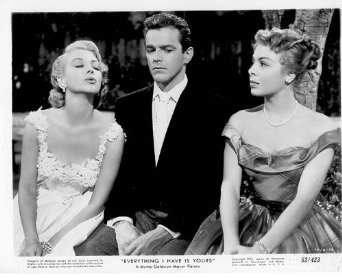
Monica Lewis's character causes problems for Gower and Marge Champion.

Monica Lewis’s character causes problems for Gower and Marge Champion.

Trivia:
-The lead couple in the film, Marge and Gower Champion, were married in real life from 1947 until their divorce in 1973. The dancing couple had two children, Gregg (b. 1956) and Blake (b. 1962). The Champions starred in several other films together such as “Show Boat” (1951), “Lovely to Look At” (1952) and “Jupiter’s Darling” (1955)
-Originally supposed to star Red Skelton and Vera-Ellen, according to TCM.
-Gower Champion did most of the choreography for the film.

Marge and Gower Champion star together in "Everything I Have is Yours"

Marge and Gower Champion star together in “Everything I Have is Yours”

Highlights:
-It’s always a delight to watch the married couple dance together. Both Marge and Gower were excellent dancers and their moves, technique and dancing chemistry make all of their numbers exciting to watch.

Notable Songs:

-Everything I Have is Yours sung by Gower Champion and later by Monica Lewis
-Derry Down Dilly sung by Marge Champion
-“Seventeen Thousand Telephone Poles” sung by Monica Lewis

My Review:

When you glanced at this film in your TCM Now Playing Guide, you may have thought, “Ah, a musical starring Marge and Gower Champion in Technicolor. Sounds like a fluffy b-musical.”

And I can’t say I thought much different. I figured this would be a colorful splash of fun with several fantastic numbers. But I was wrong. This is an honest dramatic musical that look at the issues with marriage and fame.

Real life married dancers Marge and Gower Champion play a dancing married couple in the film. Though Marge didn’t give up her career for children like in the movie, the Champions in the movie and in real life both end in divorce. However, in true Hollywood form- the couple is unhappy in their divorced life and they are in each other’s arms in the last frame.

I enjoy the plot line, because I think it shows a fairly honest look at marriage. They are joyous as newlyweds, happy when the baby comes, but Pamela gets restless. She has little to do at home, because the baby has a nurse, and she wants to go back to work and dance with Chuck. But Chuck is having hit after hit with his new partner Sybil (Lewis). Jealousy also arise as Sybil is making eyes at Chuck. When Pamela finally takes an offer for a how- the marriage is blown to smithereens.

“Petty details all add up until the roof blows up,” the film says after they get a divorce.

The dancing is also a real treat of this film. Marge and Gower Champions’ dances together are exciting, interesting to watch and seamless. Their movements together and fluid and their chemistry is evident through their moves.

In several other MGM musicals the Gowers are supporting stars with a large dance number added in. This is one of the few, if not the only, where the Gowers are the leads in the film, and that makes it a real treat.

Marge Champion dances in a solo number in the film.

Marge Champion dances in a solo number in the film.

Check out the Comet Over Hollywood Facebook page, follow on Twitter at@HollywoodComet or e-mail at cometoverhollywood@gmail.com

Musical Monday: “Happiness Ahead”(1934)

It’s no secret that the Hollywood Comet loves musicals.
In 2010, I revealed I had seen 400 movie musicals over the course of eight years. Now that number is over 500. To celebrate and share this musical love, here is my weekly feature about musicals.

happiness-ahead-movie-poster-1934-1020546164This week’s musical:
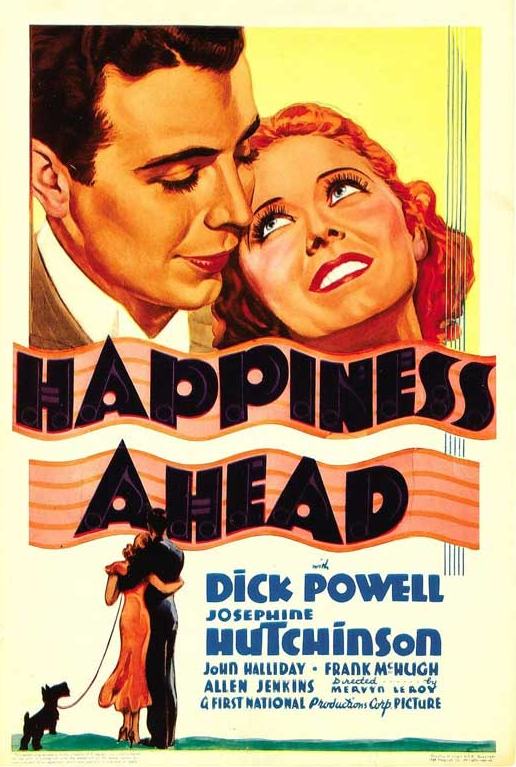
Happiness Ahead” –Musical #485

Studio:
Warner Brothers Studios

Director:
Mervyn LeRoy

Starring:
Dick Powell, Josephine Hutchinson, Frank McHugh, Ruth Donnelly, Allen Jenkins,Jane Darwell, Marjorie Gateson, John Halliday

Plot:

New York socialite Joan Bradford (Hutchinson) is unhappy with life in society. Her mother has picked out a wealthy husband for her to marry, and Joan does not love him.  On New Year’s Eve, Joan ditches her parents’ high class party and goes downtown. Joan meets window washer Bob Lane (Powell) and starts posing as a working class girl so he won’t find out she comes from money. She rents an apartment on the other side of town to keep up the guise.

Trivia:

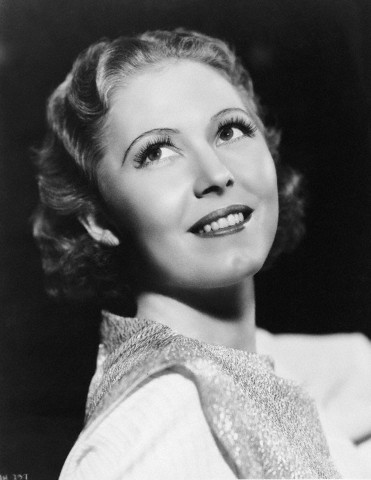
Actress Josephine Hutchinson

Actress Josephine Hutchinson

-Actress Josephine Hutchinson’s debut film role (though she did have a small role in the 1917 version of “The Little Princess” with Mary Pickford). Hutchinson went on to star in films such as “The Story of Louis Pasteur” (1936), “Ruby Gentry” (1952) and “North by Northwest” (1959).
-Reworked as “Here Come Happiness” (1941) and “Love and Learn” (1947).

Notable Songs:
-Happiness Ahead sung by Dick Powell
-Pop! Goes Your Heart sung by Dick Powell
-All Account of an Ice Cream Sundae sung by Dick Powell and Dorothy Dare
-Massaging Window Panes sung by Dick Powell and Frank McHugh

My Review:
All in all, Mr. LeRoy seems to have made a lot out of a little,” Andre Sennwald reviewed in a 1934 New York Times film review
Sennwald hits the nail on the head. “Happiness Ahead” has a very simple and overused plot–an unhappy heiress finds love with a working class man. However, this is a very charming film.
Like most Dick Powell musicals, Powell sings the same song about three times. With some films, this could be tiring. But somehow with Powell’s melted-butter-like-voice it is forgivable.
Though this isn’t a dramatically demanding role for Josephine Hutchinson, she is very likable in her first major film. She may not be as glamorous as Powell’s other leading ladies such as Gloria Stuart or Joan Blondell, or as cute as Ruby Keeler, but she is very pleasant to see on screen. Though Hutchinson went on to act in films through the 1970s, it is curious why her time at Warner Brothers in the 1930s and 1940s wasn’t more stellar.
As with most 1930s Warner Brothers films, the secondary actors were the biggest treat. Frank McHugh plays Powell’s window washing coworker, and Allen Jenkins and Ruth Donnelly play Hutchinson’s servants. John Halliday as Hutchinson’s understanding father is also hilarious.
This film may not be on the same level as other Powell musicals of the 1930s but it is very charming and pleasant. If you are looking to be cheered up, this film offers “Happiness Ahead.”

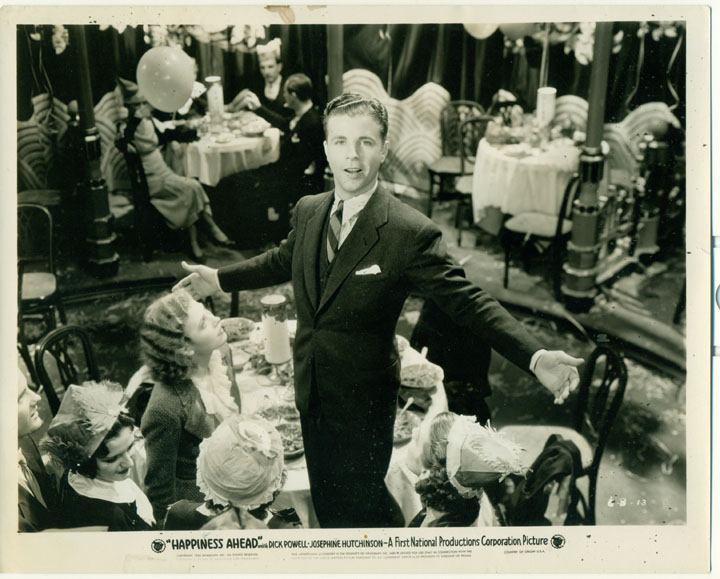
Dick Powell in a publicity still for "Happiness Ahead."

Dick Powell in a publicity still for “Happiness Ahead.”

Check out the Comet Over Hollywood Facebook page, follow on Twitter at @HollywoodComet or e-mail at cometoverhollywood@gmail.com

Musical Monday: “Two Sisters from Boston” (1946)

It’s no secret that the Hollywood Comet loves musicals.
In 2010, I revealed I had seen 400 movie musicals over the course of eight years. Now that number is over 500. To celebrate and share this musical love, here is my weekly feature about musicals.

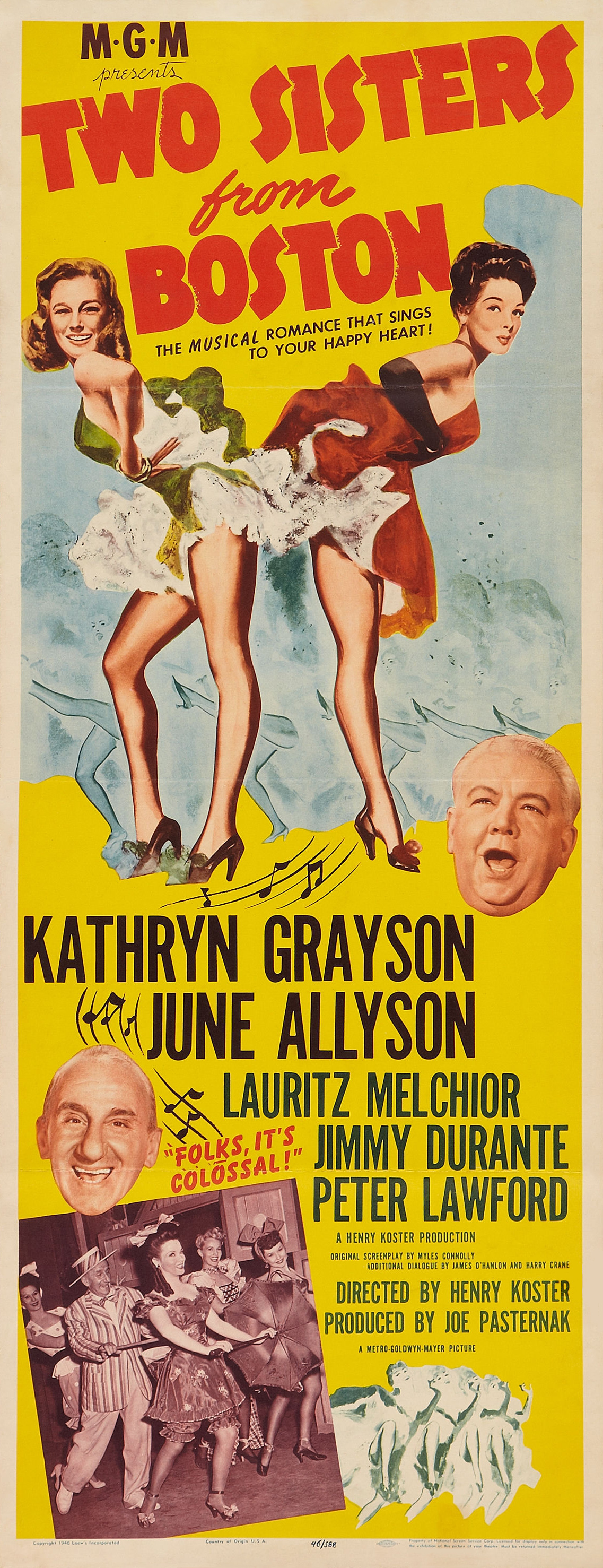
two sistersThis week’s musical:
Two Sisters From Boston” –Musical #85

Studio:
Metro-Goldwyn-Mayer

Director:
Henry Koster

Starring:
June Allyson, Kathryn Grayson, Jimmy Durante, Peter Lawford, Lauritz Melchoir, Ben Blue, Barbara Billingsley (uncredited)

Plot:
Abigail (Grayson) writes to her sister Martha (Allyson) and her other stuffy relatives in Boston that she is a successful opera singer in New York. In reality, she is working in a burlesque show.

Trivia:

-After June Allyson and Peter Lawford starred in this film, MGM publicity was tried to play them up as a couple. This was a common practice and the same attempt was made with her co-star Van Johnson. Allyson wrote in her autobiography that though she and Lawford had a good time together, it was never anything serious. The two later starred in “Little Women” (1949) together.
-Lauritz Melchoir’s second film, his first being “The Thrill of Romance” (1945). Born in Denmark, Melchoir was a Wagnerian tenor and debuted in 1924 in London. He debuted with the Metropolitan Opera in New York in 1926.  Melchoir made five Hollywood films from 1944 to 1953. In the 1940s, MGM studio head Louis B. Mayer signed singers and musicians like Melchoir and pianist Jose Iturbi to give the studio class and culture.
-Sammy Fain and Ralph Freed (brother of Arthur Freed) wrote the songs “Autumn Twilight,” “Indian Holiday,” “Lanterns in the Sky,” “More Than Ever” and “Seattle.”

Notable Songs:
-After the Show sung by June Allyson
-When Romance Passes by sung by Kathryn Grayson
-Performances by Lauritz Melchoir
-Down by the Ocean sung by Kathryn Grayson and Jimmy Durante

Highlights: 
-When proper June Allyson sings takes Kathryn Grayson’s place at the burlesque show, having to undress before an audience.
-Kathryn Grayson unconventionally gets in an opera in the chorus. Lauritz Melchoir is the lead. Much to his chagrin, Grayson keeps singing notes to get attention.

My Review:
This is a cute movie, but I don’t feel it exhibits the full appeal of June Allyson and Kathryn Grayson. June Allyson’s character is a simpering proper girl, ashamed of her sister’s profession in New York.
Kathryn Grayson’s character is a bit more likable but is still a bit uppity (the roles she usually seems to be typecast in).
When I originally saw this film 12 years ago, I was watching it for June Allyson, and I was a bit disappointed in her character then.
Jimmy Durante is the real treat in this film. It’s also interesting to see Metropolitan Opera star Lauritz Melchoir in films, giving a frame of reference of who was famous in the operatic world during this time.
However…despite any character flaws…this is still a fun and enjoyable movie. There are several funny parts and at the end of the day, the movie is down right cute.

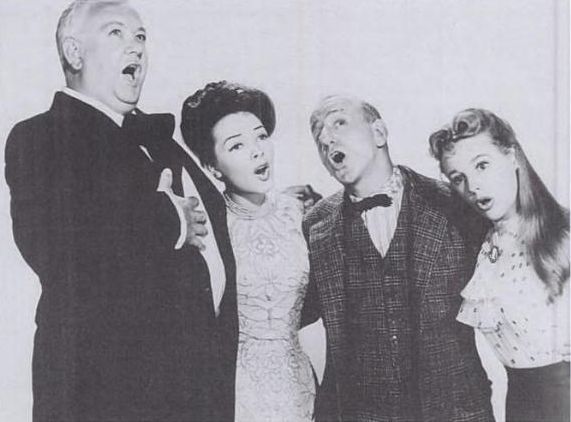
Lauritz Melchoir, Kathryn Grayson, Jimmy Durante and June Allyson in "Two Sisters From Boston."

Lauritz Melchoir, Kathryn Grayson, Jimmy Durante and June Allyson in “Two Sisters From Boston.”

Check out the Comet Over Hollywood Facebook page, follow on Twitter at@HollywoodComet or e-mail at cometoverhollywood@gmail.com


Musical Monday: “Pin-Up Girl” (1944)

It’s no secret that the Hollywood Comet loves musicals.
In 2010, I revealed I had seen 400 movie musicals over the course of eight years. Now that number is over 500. To celebrate and share this musical love, here is my weekly feature about musicals.

pin up girlThis week’s musical:
Pin-Up Girl” –Musical #224

Studio:
20th Century Fox

Director:
H. Bruce Humberstone

Starring:
Betty Grable, Joe E. Brown, Martha Raye, John Harvey, Eugene Pallette, Dorothea Kent, Adele Jergens (uncredited), Hermes Pan (uncredited dancer)

As themselves: bandleader Charlie Spivak, Nat King Cole (uncredited pianist), Skating Vanities, the Condos Brothers (specialty dancers), The Pied Piper singers

Plot:
Lorry (Grable) is a popular pin up girl at the local USO canteen during World War II. She has a bad habit of stretching the truth including saying she’s engaged to every serviceman she gives a photo to. Her latest lie is that she and her friend Kay (Kent) are going to Washington, DC to join a USO show, when they are really going to work as military stenographers. En-route to DC, the girls stop over in New York and go to an exclusive night club. Another lie gets them seated at a table with war hero Tommy Dooley (Harvey), who thinks Lorry is a musical comedy star. When Lorry runs into Tommy in DC, she disguises herself (using the Clark Kent approach by just putting on a pair of glasses) so he doesn’t know it’s her.

Trivia:

Lorry (Grable) and Kay (Kent) are nearly caught in one of their lies in "Pin Up Girl"

Lorry (Grable) and Kay (Kent) are nearly caught in one of their lies in “Pin Up Girl”

-Betty Grable was pregnant during the making of this film. While her waist line is slightly larger than you are used to seeing, she is still quite small. You can tell the most when there is a side shot of her marching at the end of the “The Story of the Very Merry Widow” musical number.

-During the military drill at the end of “The Story of the Very Merry Widow,” the real Women’s Auxiliary Corp (WAC) drill team was used, rather than actresses.

-Linda Darnell and Don Ameche were originally set to star in the movie.

-The film is based on the famous 1941 pin-up photo of Betty Grable taken by Frank Powolny, according to “Twentieth Century Fox: “The Zanuck-Skouras Years, 1935-1965” by Peter Lev.

Lorry's disguise- dull colored clothing and glasses.

Lorry’s disguise- dull colored clothing and glasses.

Highlights:

-The Skating Vanities is a roller skating sequence after the “Red Robins, Bobwhites and Blue Birds” number. It’s like a Sonja Henie ice skating number….but with roller skates. It’s almost less impressive because roller skating is more common place than ice skating.

-Joe E. Brown and Eugene Pallette may be the best part of the film.

-Though rather long, Betty Grable’s drill sequence with WAC’s is pretty interesting.

Notable Songs:
-Don’t Carry Tales Out of School sung by Betty Grable

-The Story of the Very Merry Widow sung by Betty Grable

-Once Too Often sung by Betty Grable

-Red Robins, Bobwhites and Blue Birds sung by Martha Raye

-You’re My Little Pin-Up Girl sung by Betty Grable

-Yankee Doodle Haydown sung by Martha Raye

My Review:

“Pin Up Girl” is colorful, World War II themed and has great music, but it isn’t Betty Grable’s best film. The plot is crazy and her constant lies can be a bit frustrating.
This is also probably stupid, but I hate when Twentieth Century Fox changed Betty Grable’s honey blond hair and made it bleached blond. This bothers me more than it should in this film.
This movie also ends with what I call “the smile resolution.” A couple has a misunderstanding. One of the parties is informed by a secondary character of the truth. The film ends with the misunderstood party performing on stage, the informed lead sitting in the audience and the couple grin at each other–letting the viewers know everything is alright.
I can list several movies off of the top of my head that practice this, and it leaves me feeling unfulfilled.
Though Betty Grable is the star of this film, I think Joe E. Brown and Eugene Pallette steal the show with their minor roles.
The plot is pretty silly, but then it was written to capitalize on her famous 1941 pin-up photo. Wonky plot aside, the real reason I like this movie is I love the music. There isn’t a song I don’t adore in this film. “Don’t Carry Tales Out of School” is my favorite.
If you have never seen a Betty Grable musical, try something like “Moon Over Miami,” “Tin Pan Alley” or “Springtime in the Rockies” first. They better display Grable’s appeal than “Pin Up Girl.”

My boyfriend watched this with me, and while he teaches high school theatre, he is just starting to learn about movies before the 1970s.  Here is what he thought:

“It was entertaining, though some parts stretched the limits of believability quite far.  The songs were enjoyable and the drill scene at the end was impressive, though a bit long. I give it a C+.”

Check out the Comet Over Hollywood Facebook page, follow on Twitter at @HollywoodComet or e-mail at cometoverhollywood@gmail.com

Musical Monday: “Mr. Dodd Takes the Air” (1937)

It’s no secret that the Hollywood Comet loves musicals.
In 2010, I revealed I had seen 400 movie musicals over the course of eight years. Now that number is over 500. To celebrate and share this musical love, here is my weekly feature about musicals.

mrdoddtakesairThis week’s musical:
“Mr. Dodd Takes the Air” — Musical #484

Studio:
Warner Brothers Burbank Studios

Director:
Alfred E. Green

Starring:
Kenny Baker, Jane Wyman, Frank McHugh, Alice Brady, Gertrude Michael, Henry O’Neill, Harry Davenport, William Hopper (uncredited)

Plot:
Electrician Claude Dodd (Baker) becomes a singer on the radio. Dodd is promoted as a baritone singer, but after having an operation on his throat, his voice changes to a tenor. Dodd becomes a sensation on the radio. Dodd also makes waves when he invents a device that makes radio reception more clear.

Trivia:
-Nominated for an Academy Award for Best Music, Original Score for “Remember Me” written by Harry Warren and Al Dubin.

Notable Songs:
-Remember Me? sung by Kenny Baker
-Am I in Love? sung by Kenny Baker

Kenny Baker and Jane Wyman in "Mr. Dodd Takes the Air."

Kenny Baker and Jane Wyman in “Mr. Dodd Takes the Air.”

My Review:
Kenny Baker was under contract with Warner Brothers with the idea that he would replace Dick Powell as the studio’s crooner, who had aged out as the “boy singer.” Baker and Powell look vaguely similar, sing the same crooner like songs and play similar roles. However, though Baker isn’t bad, he is still no Dick Powell.
“Mr. Dodd Takes the Air” is a B-Musical–music by  Harry Warren and Al Dubin– with the typical plot where a small town guy hits it big as a singer. He gets mixed up with glamorous ladies who he thinks are falling for him but are really after his radio invention. Of course, Jane Wyman is his old standby until the end.
Wyman is probably the highlight of this film, however I’m not sure why she is billed fifth.
This is a cute film, but nothing remarkable when it comes to creativity. It is simply entertaining.

Check out the Comet Over Hollywood Facebook page, follow on Twitter at @HollywoodComet or e-mail at cometoverhollywood@gmail.com

Musical Monday: “The Cuban Love Song” (1931)

It’s no secret that the Hollywood Comet loves musicals.
In 2010, I revealed I had seen 400 movie musicals over the course of eight years. Now that number is over 500. To celebrate and share this musical love, here is my weekly feature about musicals.

cubanThis week’s musical:
“The Cuban Love Song” –Musical #482

Studio:
MGM

Director:
W.S. Van Dyke

Starring:
Lupe Velez, Lawrence Tibbett, Karen Morley, Jimmy Durrante, Louise Fazenda

Plot:
Marine Terry (Tibbett) meets Nenita (Velez) when he upsets her peanut cart in Cuba with his car. The two have a romance, but he has to leave her to fight in the Cuban War. Though he loves Nenita, Terry has to return to his fiance Crystal (Morely). Many years later, we see now married Terry reunite with his military buddies and unhappy in his life in the upper social stratosphere. He returns Cuba in search of Nenita.

Trivia:
-The film was not a success, but two of the songs- “The Cuban Love Song” and “El Manisero” (The Peanut Vendor Song)- became hits, according to the book “Lupe Velez: The Life and Career of Hollywood’s “Mexican Spitfire”” by Michelle Vogel.
-At the end of the movie, the prop boys presented Velez with a hand-carved makeup box. She said, “Every man offer Lupe diamonds, which she no take, but no man ever made anything for her with both his hand,” Vogel cited a 1932 issue of “Photoplay” in her book.
-“The authors are doing their best to kill my movie career, I haven’t had a good story yet,” Tibbett is quoted in the book “The First Hollywood Musicals” by Edwin Bradley.
-Tibbett’s final musical for MGM.

Lupe Velez and Lawrence Tibbett in "Cuban Love Song"

Lupe Velez and Lawrence Tibbett in “Cuban Love Song”

Highlights:
-Lawrence Tibbett is the first noted opera singer to star in films, so it is interesting to see Tibbett on screen. The Metropolitan Opera singer was only in six films and was nominated for an Academy Award for Best Actor in “The Rogue Song” (1929).

Notable Songs:
-Cuban Love Song sung by Lawrence Tibbett
-El Manisero sung by Lupe Velez

My Review:
This isn’t the greatest film and did poorly in the box office. However, I enjoy most films that star Lupe Velez. In this movie you get to see her energy and hear her singing voice, which is pretty good.
It is also interesting to see Metropolitan Opera singer Lawrence Tibbett in films.
“Cuban Love Song” isn’t the best musical ever made and doesn’t have a unique plot. But it kept me fairly entertained.

Check out the Comet Over Hollywood Facebook page, follow on Twitter at @HollywoodComet or e-mail at cometoverhollywood@gmail.com
Musical Monday: “Campus Rhythm (1943)

It’s no secret that the Hollywood Comet loves musicals.
In 2010, I revealed I had seen 400 movie musicals over the course of eight years. Now that number is over 500. To celebrate and share this musical love, here is my weekly feature about musicals.

This week’s musical:
Campus Rhythm” — Musical #483

full.campusrhythm-TC-8923__95376.1383175877.1280.1280

Studio:
Monogram Pictures Corporation

Director:
Arthur Dreifuss

Starring:
Gale Storm, Johnny Downs, Marie Blake, Robert Lowery, Claudia Drake, GeGe Pearson, Candy Candido

Plot:
Radio singer Joan Abbott (Storm) has been in show business all her life and wants to go to college. However, her uncle has the power to sign her to a radio contract when she is ready to leave for school. Joan runs away from the radio career and goes to college under the fake name Susie Smith. She meets school newspaper man Scoop (Downs) and frat boy wolf Buzz (Lowery) who vie for her attentions, much to the chagrin of Buzz’s girl Cynthia (Drake). Cynthia suspects Joan’s true identity and contacts the radio station.

Trivia:
-The movie is about a radio singer and features real radio performer GeGe Pearson.
-Candy Candido uses goofy voices in his musical numbers. You may recognize his voice as the voice to characters in some Disney films.

Highlights:
-Jitterbugging co-eds featuring dancer Genevieve Grazis

Notable Songs:
None of the songs are famous or popular, but they are all fun and very World War II era such as:
-It’s Great to be a College Girl sung by Gale Storm
-Walkin’ the Chalk Line sung by Gale Storm and GeGe Pearson
-Swing Your Way Through College sung by Gale Storm
-You Character sung by GeGe Pearson
-But Not You sung by Gale Storm

My Review:
“Campus Rhythm” is a low budget film with a simple plot and several unfamiliar actors. However, it’s a lot of fun.
Collegiate films are some of my favorite and this ranks pretty well. It’s full of 1940s fashion and music.
This is a fresh little film and it’s 63 minutes worth watching.

 Also checkout our friend Raquel’s post on “Campus Rhythm” over at Out of the Past blog

Check out the Comet Over Hollywood Facebook page, follow on Twitter at @HollywoodComet or e-mail at cometoverhollywood@gmail.com
Musical Monday: “The Helen Morgan Story” (1957)

It’s no secret that the Hollywood Comet loves musicals.
In 2010, I revealed I had seen 400 movie musicals over the course of eight years. Now that number is over 500. To celebrate and share this musical love, here is my weekly feature about musicals.

Tthe-helen-morgan-story-movie-poster-1957-1020431163his week’s musical:
The Helen Morgan Story” –Musical #481

Studio:
Warner Brothers

Director:
Michael Curtiz

Starring:
Ann Blyth, Paul Newman, Richard Carlson, Ed Platt, Gene Evans, Alan King, Cara Williams, Virginia Vincent, Juanita Moore, Leonid Kinskey
As themselves: Rudy Vallee, Walter Winchell, Jimmy McHugh

Plot:
Biographical musical film on the life of singer Helen Morgan. The film starts with Morgan (Blyth) starting out her career dancing at a carnival show that is managed by Larry Maddux (Newman).
Morgan becomes famous, going from nightclub singer to Broadway star. Along the way, her alcoholism and on and off relationship with Maddux torment her.
Morgan hits rock bottom, broke and drunk. The movie ends with Morgan healthy and being honored by celebrities and Walter Winchell.

Trivia:

Ann Blyth and Paul Newman in a publicity still for "The Helen Morgan Story"

Ann Blyth and Paul Newman in a publicity still for “The Helen Morgan Story”

-Ann Blyth had a lovely singing voice but was dubbed by singer Gogi Grant.
In an interview, TCM Primetime Host Robert Osborne asked Ann Blyth why she was dubbed.
Blyth told Osborne she figured Warner Brothers wanted a different sound so chose Grant. When Blyth was researching the role, she listened to a record of the real Helen Morgan and her voice was actually more soprano and not very strong. But Grant was popular at the the time, and she figured the producers thought that would help promote the movie.
The critics felt Blyth’s voice would have worked better in the film.


-“The Helen Morgan Story” was Ann Blyth’s last theatrical film.
In an interview with Robert Osborne, she said the parts just weren’t there anymore. She later was offered the lead in “The Three Faces Of Eve” which Joanne Woodward won an Academy Award for.

-Peggy Lee, Susan Hayward, Jennifer Jones, Judy Garland, Patti Page and Doris Day were all considered for the lead.

-Doris Day turned down the role of Helen Morgan, because she thought the hard drinking character would hurt her career. Day had similar concerns before she portrayed Ruth Etting in “Love Me or Leave Me” (1955), according to her autobiography.

-The same year, five months before the film was released, Polly Bergen portrayed “Helen Morgan” on television on “Playhouse 90.” Bergen won an Emmy for Best Lead Performance by an Actress.

Notable Songs:
All of the songs are performed by Gogi Grant and are well known, including:
-“Can’t Help Loving that Man of Mine” from “Show Boat”
-“Bill” from “Show Boat”
-“The One I Love Belongs to Somebody Else”
-“Someone to Watch Over Me”
-“Somebody Loves Me”
-“You Do Something to Me”
-“Why Was I Born?”

For comparison of Helen Morgan and Gogi Grant’s voices, both singing “Why Was I Born?” –

Helen Morgan:

Gogi Grant who dubbed Ann Blyth: 

My Review:

The real Helen Morgan

The real Helen Morgan

Fifty-seven years later, I’m upset that Ann Blyth was dubbed by Gogi Grant.
Blyth said she thought Warner was looking for a different sound, but Blyth would have sang the songs well.

Also, the real Helen Morgan’s voice matched Blyth’s voice more than the belting, Judy Garland-Like Grant’s voice.
Obviously as the story of Helen Morgan’s life is a bit fabricated.

Morgan was married three times, which wasn’t shown in the film. She also died of liver failure due to alcoholism in 1941, yet the film unsurprisingly painted a happy ending.

The Helen Morgan Story” isn’t a great movie, but it isn’t bad either. It is simply a run-of-the-mill sad, torch singer biopic that was characteristic of the 1950s. This time it was just Ann Blyth in the lead role, rather than Susan Hayward.

Check out the Comet Over Hollywood Facebook page, follow on Twitter at @HollywoodComet or e-mail at cometoverhollywood@gmail.com
Musical Monday: “Call Me Madam” (1953)

It’s no secret that the Hollywood Comet loves musicals.
In 2010, I revealed I had seen 400 movie musicals over the course of eight years. Now that number is over 500. To celebrate and share this musical love, here is my weekly feature about musicals.

Call Me MadamThis week’s musical:
Call Me Madam” –Musical #430

Studio:
20th Century Fox

Director:
Walter Lang

Starring:
Ethel Merman, Donald O’Connor, Vera-Ellen, George Sanders, Billy De Wolfe, Helmut Dantine, Walter Slezak

Plot:
Set in 1951 during the Truman-era, socialite Sally Adams (Merman) heads to the fictional European country of Lichtenburg as a United States of America ambassador. Adams’ assistant Kenneth Gibson (O’Connor) falls in love with Princess Maria (Ellen) and Adams falls in love with General Cosmo Constantine (Sanders).
Based on the Broadway play with music by Irving Berlin.

Trivia:
-Film adaptation of the 1950 Broadway play that also starred Ethel Merman. The show opened Oct. 12, 1950, and ran for 644 performances through May 3, 1952. Merman won a Tony for her performance on stage.
-Sally Adams is based on based on Washington, D.C. hostess and Democratic Party fundraiser Perle Mesta. Mesta was selected by Harry Truman to be the American ambassador to Luxembourg. The musical is a satire of the behavior of gauche Americans abroad, according to Hollywood Musicals Year by Year by Stanley Green.
-Carol Richards dubbed Vera-Ellen’s singing voice.
-20th Century Fox studio head Darryl F. Zanuck was making “Call Me Madam” and “Gentlemen Prefer Blondes” at the same time. Zannuck noted in his memoirs “Madam” was a better film but “Blondes” would make more. Blondes did double the gross of Madam, Memo from Darryl F. Zanuck: The Golden Years at Twentieth Century-Fox edited by Rudy Behlmer

Highlights:

Vera-Ellen and Donald O'Connor dancing to "It's a Lovely Day Today"

Vera-Ellen and Donald O’Connor dancing to “It’s a Lovely Day Today”

-George Saunders has a lovely singing voice in “Marrying for Love.”
-Three minutes into the film, Merman almost says “I don’t know what the hell your talking about” but stops herself and repeats the line. “I don’t know what the he- I don’t know what you are talking about.”
-Donald O’Connor and Vera-Ellen’s dance to “It’s a Lovely Day Today” in the garden. And all of their dances together.
-Vera-Ellen’s wardrobe.

Notable Songs:
-Hostess with the Mostest sung by Ethel Merman
-It’s a Lovely Day Today sung by Donald O’Connor and Vera-Ellen. Ellen is dubbed by Carol Richards.
-Marrying for Love sung by George Saunders
-You’re Just In Love sung by Donald O’Connor and Ethel Merman
-Mrs. Sally Adams sung by a trio of ladies answering the phone. Their voices blend beautifully

My Review:
A little bit of Ethel Merman can go a long way, but you can’t deny this is her best film role.
The film was taken from a successful Broadway show that also starred Merman, “Call Me Madam” is colorful and has an excellent cast.
Merman originated several musical roles on stage such as “Annie Get Your Gun,” “Panama Hattie,” “DuBarry was a Lady” and “Gypsy.” However, when the shows went from stage to film, Merman’s role was always recast with a younger, sexier star. However, film audiences get to see Merman in a role she originated on film with “Call Me Madam.” Though to me, her singing voice can be overwhelming, you can tell Merman’s appeal on stage with the energy and humor she shows in the film role.
Also in the film, I would say Donald O’Connor steals the show. He sings and dances beautifully and has the opportunity to sing a duet with Merman. Vera-Ellen also dances beautifully, but her performance is lessened by the terrible accent she has to speak.
George Sanders is a surprise in the musical with his beautiful singing voice.
Though “Call Me Madam” isn’t my favorite musical, its energetic, funny and fun. The Irving Berlin songs are entertaining, the costumes are beautiful and the talent is excellent.

Donald O'Connor, Ethel Merman, George Sander,  Vera-Ellen in "Call Me Madam"

Donald O’Connor, Ethel Merman, George Sander, Vera-Ellen in “Call Me Madam”

 Check out the Comet Over Hollywood Facebook page, follow on Twitter at @HollywoodComet or e-mail at cometoverhollywood@gmail.com